

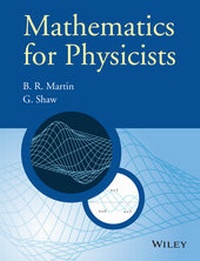
Mathematics for Physicists
Description

Mathematics for Physicists is a relatively short volume covering all the essential mathematics needed for a typical first degree in physics, from a starting point that is compatible with modern school mathematics syllabuses. Early chapters deliberately overlap with senior school mathematics, to a degree that will depend on the background of the individual reader, who may quickly skip over those topics with which he or she is already familiar. The rest of the book covers the mathematics that is usually compulsory for all students in their first two years of a typical university physics degree, plus a little more. There are worked examples throughout the text, and chapter-end problem sets.
Mathematics for Physicists features:
- Interfaces with modern school mathematics syllabuses
- All topics usually taught in the first two years of a physics degree
- Worked examples throughout
- Problems in every chapter, with answers to selected questions at the end of the book and full solutions on a website
This text will be an excellent resource for undergraduate students in physics and a quick reference guide for more advanced students, as well as being appropriate for students in other physical sciences, such as astronomy, chemistry and earth sciences.
Brian Martin was a full-time member of staff of the Department of Physics & Astronomy at UCL from 1968 to 1995, including a decade from 1994 to 2004 as Head of the Department. I retired in 2005 and now hold the title of Emeritus Professor of Physics. I have extensive experience of teaching undergraduate mathematics classes at all levels and experience of other universities via external examining for first degrees at Imperial College and Royal Holloway College London. I was also the external member of the General Board of the Department of Physics at Cambridge University that reviewed the whole academic programme of that department, including teaching.
Graham Shaw is a full-time member of staff of the School of Physics & Astronomy at Manchester University and will retire in September 2009. I have extensive experience of teaching undergraduate physics and the associated mathematics, and have been a member of the department's Teaching Committee and the Course Director of the Honours School of Mathematics and Physics for many years.
More details
Other editions
Additional editions
Content
- Intro
- Mathematics for Physicists
- Contents
- Editors' preface to the Manchester Physics Series
- Authors' preface
- Notes and website information
- 'Starred' material
- Website
- Examples, problems and solutions
- 1 Real numbers, variables and functions
- 1.1 Real numbers
- 1.1.1 Rules of arithmetic: rational and irrational numbers
- 1.1.2 Factors, powers and rationalisation
- 1.1.3 Number systems
- 1.2 Real variables
- 1.2.1 Rules of elementary algebra
- 1.2.2 Proof of the irrationality of V2
- 1.2.3 Formulas, identities and equations
- 1.2.4 The binomial theorem
- 1.2.5 Absolute values and inequalities
- 1.3 Functions, graphs and co-ordinates
- 1.3.1 Functions
- 1.3.2 Cartesian co-ordinates
- Problems 1
- 2 Some basic functions and equations
- 2.1 Algebraic functions
- 2.1.1 Polynomials
- 2.1.2 Rational functions and partial fractions
- 2.1.3 Algebraic and transcendental functions
- 2.2 Trigonometric functions
- 2.2.1 Angles and polar co-ordinates
- 2.2.2 Sine and cosine
- 2.2.3 More trigonometric functions
- 2.2.4 Trigonometric identities and equations
- 2.2.5 Sine and cosine rules
- 2.3 Logarithms and exponentials
- 2.3.1 The laws of logarithms
- 2.3.2 Exponential function
- 2.3.3 Hyperbolic functions
- 2.4 Conic sections
- Problems 2
- 3 Differential calculus
- 3.1 Limits and continuity
- 3.1.1 Limits
- 3.1.2 Continuity
- 3.2 Differentiation
- 3.2.1 Differentiability
- 3.2.2 Some standard derivatives
- 3.3 General methods
- 3.3.1 Product rule
- 3.3.2 Quotient rule
- 3.3.3 Reciprocal relation
- 3.3.4 Chain rule
- 3.3.5 More standard derivatives
- 3.3.6 Implicit functions
- 3.4 Higher derivatives and stationary points
- 3.4.1 Stationary points
- 3.5 Curve sketching
- Problems 3
- 4 Integral calculus
- 4.1 Indefinite integrals
- 4.2 Definite integrals
- 4.2.1 Integrals and areas
- 4.2.2 Riemann integration
- 4.3 Change of variables and substitutions
- 4.3.1 Change of variables
- 4.3.2 Products of sines and cosines
- 4.3.3 Logarithmic integration
- 4.3.4 Partial fractions
- 4.3.5 More standard integrals
- 4.3.6 Tangent substitutions
- 4.3.7 Symmetric and antisymmetric integrals
- 4.4 Integration by parts
- 4.5 Numerical integration
- 4.6 Improper integrals
- 4.6.1 Infinite integrals
- 4.6.2 Singular integrals
- 4.7 Applications of integration
- 4.7.1 Work done by a varying force
- 4.7.2 The length of a curve
- 4.7.3 Surfaces and volumes of revolution
- 4.7.4 Moments of inertia
- Problems 4
- 5 Series and expansions
- 5.1 Series
- 5.2 Convergence of infinite series
- 5.3 Taylors theorem and its applications
- 5.3.1 Taylors theorem
- 5.3.2 Small changes and l'Hôpitals rule
- 5.3.3 Newtons method
- 5.3.4 Approximation errors: Euler's number
- 5.4 Series expansions
- 5.4.1 Taylor and Maclaurin series
- 5.4.2 Operations with series
- 5.5 Proof of d'Alembert's ratio test
- 5.5.1 Positive series
- 5.5.2 General series
- 5.6 Alternating and other series
- Problems 5
- 6 Complex numbers and variables
- 6.1 Complex numbers
- 6.2 Complex plane: Argand diagrams
- 6.3 Complex variables and series
- 6.3.1 Proof of the ratio test for complex series
- 6.4 Eulers formula
- 6.4.1 Powers and roots
- 6.4.2 Exponentials and logarithms
- 6.4.3 De Moivre's theorem
- 6.4.4 Summation of series and evaluation of integrals
- Problems 6
- 7 Partial differentiation
- 7.1 Partial derivatives
- 7.2 Differentials
- 7.2.1 Two standard results
- 7.2.2 Exact differentials
- 7.2.3 The chain rule
- 7.2.4 Homogeneous functions and Euler's theorem
- 7.3 Change of variables
- 7.4 Taylor series
- 7.5 Stationary points
- 7.6 Lagrange multipliers
- 7.7 Differentiation of integrals
- Problems 7
- 8 Vectors
- 8.1 Scalars and vectors
- 8.1.1 Vector algebra
- 8.1.2 Components of vectors: Cartesian co-ordinates
- 8.2 Products of vectors
- 8.2.1 Scalar product
- 8.2.2 Vector product
- 8.2.3 Triple products
- 8.2.4 Reciprocal vectors
- 8.3 Applications to geometry
- 8.3.1 Straight lines
- 8.3.2 Planes
- 8.4 Differentiation and integration
- Problems 8
- 9 Determinants, Vectors and Matrices
- 9.1 Determinants
- 9.1.1 General properties of determinants
- 9.1.2 Homogeneous linear equations
- 9.2 Vectors in n Dimensions
- 9.2.1 Basis vectors
- 9.2.2 Scalar products
- 9.3 Matrices and linear transformations
- 9.3.1 Matrices
- 9.3.2 Linear transformations
- 9.3.3 Transpose, complex, and Hermitian conjugates
- 9.4 Square Matrices
- 9.4.1 Some special square matrices
- 9.4.2 The determinant of a matrix
- 9.4.3 Matrix inversion
- 9.4.4 Inhomogeneous simultaneous linear equations
- Problems 9
- 10 Eigenvalues and eigenvectors
- 10.1 The eigenvalue equation
- 10.1.1 Properties of eigenvalues
- 10.1.2 Properties of eigenvectors
- 10.1.3 Hermitian matrices
- 10.2 Diagonalisation of matrices
- 10.2.1 Normal modes of oscillation
- 10.2.2 Quadratic forms
- Problems 10
- 11 Line and multiple integrals
- 11.1 Line integrals
- 11.1.1 Line integrals in a plane
- 11.1.2 Integrals around closed contours and along arcs
- 11.1.3 Line integrals in three dimensions
- 11.2 Double integrals
- 11.2.1 Greens theorem in the plane and perfect differentials
- 11.2.2 Other co-ordinate systems and change of variables
- 11.3 Curvilinear co-ordinates in three dimensions
- 11.3.1 Cylindrical and spherical polar co-ordinates
- 11.4 Triple or volume integrals
- 11.4.1 Change of variables
- Problems 11
- 12 Vector calculus
- 12.1 Scalar and vector fields
- 12.1.1 Gradient of a scalar field
- 12.1.2 Div, grad and curl
- 12.1.3 Orthogonal curvilinear co-ordinates
- 12.2 Line, surface, and volume integrals
- 12.2.1 Line integrals
- 12.2.2 Conservative fields and potentials
- 12.2.3 Surface integrals
- 12.2.4 Volume integrals: moments of inertia
- 12.3 The divergence theorem
- 12.3.1 Proof of the divergence theorem and Green's identities
- 12.3.2 Divergence in orthogonal curvilinear co-ordinates
- 12.3.3 Poissons equation and Gaus's theorem
- 12.3.4 The continuity equation
- 12.4 Stokes theorem
- 12.4.1 Proof of Stokes' theorem
- 12.4.2 Curl in curvilinear co-ordinates
- 12.4.3 Applications to electromagnetic fields
- Problems 12
- 13 Fourier analysis
- 13.1 Fourier series
- 13.1.1 Fourier coefficients
- 13.1.2 Convergence
- 13.1.3 Change of period
- 13.1.4 Non-periodic functions
- 13.1.5 Integration and differentiation of Fourier series
- 13.1.6 Mean values and Parseval's theorem
- 13.2 Complex Fourier series
- 13.2.1 Fourier expansions and vector spaces
- 13.3 Fourier transforms
- 13.3.1 Properties of Fourier transforms
- 13.3.2 The Dirac delta function
- 13.3.3 The convolution theorem
- Problems 13
- 14 Ordinary differential equations
- 14.1 First-order equations
- 14.1.1 Direct integration
- 14.1.2 Separation of variables
- 14.1.3 Homogeneous equations
- 14.1.4 Exact equations
- 14.1.5 First-order linear equations
- 14.2 Linear ODEs with constant coefficients
- 14.2.1 Complementary functions
- 14.2.2 Particular integrals: method of undetermined coefficients
- 14.2.3 Particular integrals: the D-operator method
- 14.2.4 Laplace Transforms
- 14.3 Eulers equation
- Problems 14
- 15 Series solutions of ordinary differential equations
- 15.1 Series solutions
- 15.1.1 Series solutions about a regular point
- 15.1.2 Series solutions about a regular singularity: Frobenius method
- 15.1.3 Polynomial solutions
- 15.2 Eigenvalue equations
- 15.3 Legendres equation
- 15.3.1 Legendre functions and Legendre polynomials
- 15.3.2 The generating function
- 15.3.3 Associated Legendre equation
- 15.3.4 Rodrigues formula
- 15.4 Bessels equation
- 15.4.1 Bessel functions
- 15.4.2 Properties of non-singular Bessel functions J? (x)
- Problems 15
- 16 Partial differential equations
- 16.1 Some important PDEs in physics
- 16.2 Separation of variables: Cartesian co-ordinates
- 16.2.1 The wave equation in one spatial dimension
- 16.2.2 The wave equation in three spatial dimensions
- 16.2.3 The diffusion equation in one spatial dimension
- 16.3 Separation of variables: polar co-ordinates
- 16.3.1 Plane-polar co-ordinates
- 16.3.2 Spherical polar co-ordinates
- 16.3.3 Cylindrical polar co-ordinates
- 16.4 The wave equation: d'Alembert's solution
- 16.5 Euler Equations
- 16.6 Boundary conditions and uniqueness
- 16.6.1 Laplace transforms
- Problems 16
- Answers to selected problems
- Index
- EULA
