Many-Body Problems and Quantum Field Theory
Description

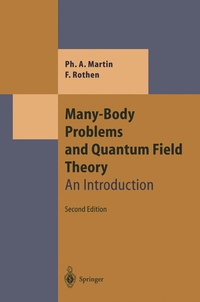
Many-Body Problems and Quantum Field Theory introduces the concepts and methods of the topics on a level suitable for graduate students and researchers. The formalism is developed in close conjunction with the description of a number of physical systems: cohesion and dielectric properties of the electron gas, superconductivity, superfluidity, nuclear matter and nucleon pairing, matter and radiation, interaction of fields by particle exchange and mass generation. Emphasis is placed on analogies between the various systems rather than on advanced or specialized aspects, with the purpose of illustrating common ideas within different domains of physics. Starting from a basic knowledge of quantum mechanics and classical electromagnetism, the exposition is self-contained and explicitly details all steps of the derivations. The new edition features a subtantially new treatment of nucleon pairing.
Reviews / Votes
"The book is aimed to provide a reasonably broad and nevertheless high level of knowledge to Ph.D. students. I think that this challenge is truly reached. The authors achieve a good balance between formal developments and physical applications. The former are limited to the essential, and the connection between the mathematical representations and the physical concepts and paradigms is pedagogically presented. The latter are well chosen and belong, I believe, to the basic culture of every Ph.D. student, too often driven to specialization. [...] In conclusion, this book provides an excellent introduction to quantum field theory and its applications. It should be considered as one of the favourite books for any Ph.D. student and as a good reference book for more advanced physicists." (Joseph Cugnon, Physicalia, 25/3, 2003)
"[...] came out of a graduate course that presented a unified treatment of condensed-matter, nuclear, and particle theory. The course emphasized the similarities, sometimes even the identity, of the methods used in those fields - a wonderful idea, because students are often led to believe that the fields are disparate and never meet." (Physics Today, April 2003)
"Very well written and has a strong pedagogical style: mathematical steps in the explanations are complete and timely examples worked out in detail. I applaud the authors attempt to bring together the threads of many-body theory, which forms the cornerstone of traditionally distinct problems, into a readable textbook for students. and reference for the practitioner." (The Physicist)
From the reviews of the second edition:
"The book provides a nice unified approach to the quantum field theory of the solid state and the nucleon. . The book applies the same, consistent language for the different and broad fields of physics. This approach makes the book attractive to beginners who want to learn some more advanced methods and . need to see arange of applications . . The book can be used as an introduction for beginners in the field, advanced researchers can use it as a look up reference." (Andreas Knorr, Zentralblatt MATH, Vol. 1065, 2005)
More details
Other editions
Additional editions