

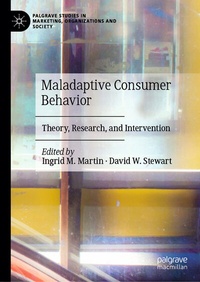
Maladaptive Consumer Behavior
Description

This edited volume provides a marketing perspective on maladaptive consumer behavior, especially behavior with dysfunctional consequences that does not have its origins in physical addiction. It brings together contributions of leading scholars who have expertise in various forms of maladaptive consumption. The chapters address specific manifestations of maladaptive consumption, such as those related to food, alcoholic beverages, online gaming, and media consumption, among others, with an emphasis on behaviors that are not traditionally regarded as arising from physical addiction.
Further, the book includes chapters that focus more broadly of definitional and conceptual issues, methodological approaches, implications for intervention and regulation, and the value judgments inherent in the identification and classification of behaviors as "maladaptive." It examines numerous alternative theories of maladaptive consumption and places such behavior in a larger market context.
Taken together, the contributions in this volume (1) describe the general phenomenon of maladaptive consumption, (2) describe specific manifestations of maladaptive consumption, (3) identify issues of research methodology and definition related to the study of maladaptive consumption, and (4) address relevant interventions, regulations, and public policy issues. It will appeal to scholars interested in maladaptive consumption behaviors and their treatments as well as consumer behavior more generally across multiple fields, including marketing, clinical psychology, social work, and public health.
Reviews / Votes
"In "Maladaptive Consumer Behavior: Theory, Research, and Intervention," Ingrid M. Martin and David W. Stewart orchestrate a critical exploration into the domain where consumer behavior and public policy converge: the increasingly pertinent issue of maladaptive consumption. With contributions from established marketing scholars, this volume dissects the multifaceted nature of problematic consumption patterns and extends the dialogue beyond traditional vices to encompass digital-age challenges such as smartphones, social media, and online gaming. This edited volume not only illuminates the dire consequences of maladaptive consumption-including depression, social isolation, and physical dependency-but also positions marketing as a pivotal player in understanding and mitigating these issues. A beacon for marketing scholars, consumers, and policymakers alike, this handbook is a call to further examine the dark side of consumer behavior. It is a must-read for those committed to advancing the discourse on consumer well-being and public policy." (Martin Reimann, The University of Arizona)
"It is hard to think of better coeditors for such a volume than Professors Stewart and Martin. They recognize the dimensions of maladaptive consumption, and they have organized a team of contributors who span generations of researchers who present the vast spectrum of important ideas. My plan is to incorporate this work into my course on social issues in marketing as its centerpiece for discussion with students with diverse backgrounds." (Ronald Paul Hill, Dean's Professor of Marketing and Public Policy and Distinguished Professor Kogod School of Business, Marketing Department Chair, Editor-in-Chief, Responsible Research in Business and Management Honor Roll)
More details
Other editions
Additional editions
Persons
Ingrid Martin is Professor of Marketing in the College of Business (COB) at Cal State University Long Beach, USA. Her published work has covered a range of social marketing topics including risk communication, maladaptive behaviors in the areas of disaster mitigation and consumption practices.
David W. Stewart is President's Professor of Marketing and Business Law (Emeritus) in the College of Business Administration at Loyola Marymount University, USA. He has authored/co-authored over 350 publications and 20 books, including A Primer on Consumer Behavior: A Guide for Managers , The Impact of Risk Communication on Consumption and Consumer Well-Being , and Financial Dimensions of Marketing Decisions , among others. He is a past Editor of Journal of Marketing , the Journal of the Academy of Marketing Science , and the Journal of Public Policy and Marketing .
Content
Chapter 1 Introduction and Conceptual Foundations.- Chapter 2 Online Gaming, Maladaptive Consumption, and Regulatory Standards and Options.- Chapter 3 Internet gaming disorder as a maladaptive behavioral consumption of online Gaming.- Chapter 4 Technology-Mediated Problematic Behaviours.- Chapter 5 Maladaptive Smartphone Usage.- Chapter 6 When is Food Consumption Maladaptive?.- Chapter 7 Maladaptive Food and Well-Being: Toward a Sustainable Future.- Chapter 8 Maladaptive Healthcare Seeking: A Comprehensive and Generative Model of Care-Seeking Using a Consumer Behavior Lens.- Chapter 9 Qualitative Inquiry into the Compulsive Buying Dimension of Maladaptive Consumption.- Chapter 10 Maladaptive Consumption: A Failure of Intentional Fluency.- Chapter 11 Maladaptive Consumption Conceptual Identification Model.- Chapter 12 Discussion and Conclusions.
