

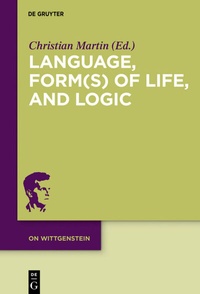
Language, Form(s) of Life, and Logic
Description

This volume deals with the connection between thinking-and-speaking and our form(s) of life. All contributions engage with Wittgenstein's approach to this topic. As a whole, the volume takes a stance against both biological and ethnological interpretations of the notion "form of life" and seeks to promote a broadly logico-linguistic understanding instead.
The structure of this book is threefold. Part one focuses on lines of thinking that lead from Wittgenstein's earlier thought to the concept of form of life in his later work. Contributions to part two examine the concrete philosophical function of this notion as well as the ways in which it differs from cognate concepts. Contributions to part three put Wittgenstein's notion of form of life in perspective by relating it to phenomenology, ordinary language philosophy and problems in contemporary analytic philosophy.
Reviews / Votes
This book's title (unlike some titles) accurately represents the excellent content of this collection of eleven papers and the editor's introduction. My overall impression is that most of the chapters are written with a similar level of expertise and precision on one hand, and with openness and creativity on the other. . To conclude, anyone interested in interpretations of Wittgenstein's major philosophical concepts -- some of which (e.g., language-games and Form(s) of Life) thinkers were so taken with internationally they became standard philosophical and non-philosophical terms -- should recognize this collection as a valuable contribution to the ongoing debate on the interpretation of one of Wittgenstein's major philosophical concepts. . Last but not least, this collection, as opposed to writings that promote other accounts of FOLs, rests on the new critical apparatus that researches not only Wittgenstein's published works, but also online available manuscripts and typescripts that are now being published more and more.
(Kristijan Krkac in Notre Dame Philosophical Reviews (6/3/2019, https://ndpr.nd.edu/news/language-form-s-of-life-and-logic-investigations-after-wittgenstein/, accessed 6/6/2019)
More details
Other editions
Additional editions
Person
Christian Georg Martin , LMU Munich.
Content
- Intro
- Table of Contents
- List of Abbreviations
- Introduction: The Form of Our Life with Language
- Paths to Form(s) of Life
- The Rule of the Game (The Moment of Truth)
- Lebensformen: Living Logic
- Human Life and Self-consciousness. The Idea of 'Our' Form of Life in Hegel and Wittgenstein
- Duality, Force, Language-games and Our Form of Life
- Form(s) of Life: the Very Idea
- Our Life with Truth
- Language-games, Lebensform, and the Ancient City
- Language-games and Forms of Life in Mathematics
- The Representation of Language
- Form(s) of Life after Wittgenstein
- Wittgenstein and the Difficulty of What Normally Goes Without Saying
- Wittgenstein. Ordinary Language as Lifeform
- Hostage to a Stranger
- Biographical Notes
- Index
