

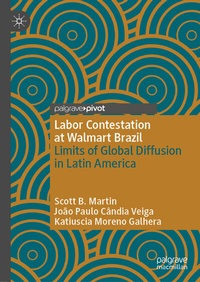
Labor Contestation at Walmart Brazil
Description

Reviews / Votes
"Martin, Veiga and Galhera provide an eloquent and insightful analysis of how one of the world's most powerful corporations attempted to impose its model of 'repressive, anti-union familialism' on the largest economy in Latin America, and how it was met with resistance from workers, unions and the state. Their 'nested agency within institutions' perspective provides powerful insights on regional variations. It is a must-read for practitioners and scholars of employment relations and human resource management."- Mark Anner , Professor, Labor and Employment Relations, and Director, Center for Global Workers' Rights, Penn State University, USA, and author of Solidarity Transformed: Labor Responses to Globalization and Crisis in Latin America (2011)
"Why did Walmart fail in Brazil? Thoroughly researched and convincingly argued, this is the compelling story of how one of the world's most powerful companies struggled to impose its model in Brazil, and of why national institutions and labor unions matter. It's a cautionary tale of global expansion and corporate parochialism.
- Maria Lorena Cook , Professor Emeritus, ILR School, Cornell University, and author of The Politics of Labor Reform in Latin America: Between Flexibility and Rights (2007)
More details
Other editions
Additional editions
Persons
Scott B. Martin is a Regular Lecturer in International Affairs at Columbia University, USA, and The New School, New York, and has also taught at Yale, Princeton, and Sarah Lawrence College. Among his publications on employment relations and social and industrial development in the Americas, he co-authored El Estado de Bienestar ante la Globalización: El Caso de Norteamérica ( 2012) and was co-editor and contributor to Competitividade e Desenvolvimento: Atores e Instituições Locais (2001) and The New Politics of Inequality: Rethinking Participation and Representation (1997).
João Paulo Cândia Veiga is Assistant Professor at the Department of Political Science of the Universidade de São Paulo, Brazil, which he chairs, and a Researcher at the University's Center for International Negotiations (CAENI). He has (co)authored or (co)edited four books on labor rights, corporate social responsibility, and regional economic integration in Brazil and the Mercosur region, among them The Question of Child Labor (1998), and published articles in such international journals as Labor Studies Journal .
Katiuscia Moreno Galhera is Visiting Faculty at Universidade Federal da Grande Dourados, Brazil. She holds a Ph.D. in Political Science from the Universidade de Campinas, Brazil, was a Visiting Scholar at Penn State University, USA, and a postdoctoral researcher in Sociology at Universidade Estadual de Londrina, Brazil. Among her works on gender, labor, and global value chains is "Transnational Corporations," Routledge Handbook to the Political Economy and Governance of the Americas (2020, with S.B. Martin and J.P. Veiga).
