

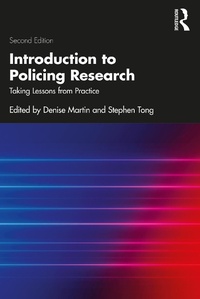
Introduction to Policing Research
Taking Lessons from Practice
2nd Edition
Published on 5. December 2023
366 pages
978-1-003-81179-4 (ISBN)
Description

This book offers a first-hand insight into the work of policing scholars and the research that they undertake. Bringing together a range of leading scholars and drawing on a range of pressing topics, it introduces the diverse nature of policing research, and the ethical and practical challenges faced by policing researchers. Each chapter brings clarity to the concept of empirical research within policing, introduces readers to the theoretical explanations and assumptions that underpin the rational of research design in policing, as well as considering the limitations of research. Topics include:
* research methods in police research;
* police professionalisation;
* police and diversity;
* police leadership;
* undercover policing;
* police and vulnerability;
* activist research;
* social media and policing.
This revised and expanded new edition includes more focus on the role of research in policing, police and academic partnerships and practitioners as researchers, as well as a brand new section offering international perspectives on policing research. Brimming with practical examples, case studies, key learning points and practical advice, this book is essential reading for Professional Policing students, as well as early-career researchers and those engaged with criminological research methods.
* research methods in police research;
* police professionalisation;
* police and diversity;
* police leadership;
* undercover policing;
* police and vulnerability;
* activist research;
* social media and policing.
This revised and expanded new edition includes more focus on the role of research in policing, police and academic partnerships and practitioners as researchers, as well as a brand new section offering international perspectives on policing research. Brimming with practical examples, case studies, key learning points and practical advice, this book is essential reading for Professional Policing students, as well as early-career researchers and those engaged with criminological research methods.
Reviews / Votes
"Policing in the modern era is a mixture of socio-legal, socio-cultural, ethical and normative, and administrative and policy interaction. Such inquiry must apply quantitative and qualitative analysis to explain formal social control in democratic societies. This second edition continues the pursuit of broadening the knowledge base of policing introducing chapters rooted in theory, method and the practicalities of policing, an often-delicate balance. In this volume, notable police scholars examine policing from inside the occupation, and externally as to the impacts of policing, as well as efforts to transition and transform the police. The breadth of the volume is a refreshing contribution to understanding this complex institution, simultaneously charged with formal social control, yet under the constraint of rule of law. The volume will be well received by academics and police practitioners".Jack R. Green, Professor Emeritus, School of Criminology and Criminal Justice, Northeastern University, Boston
"Policing research is rich in its diversity and broad in its approach. Through a series of fascinating case studies, this second edition of Introduction to Policing Research celebrates that kaleidoscope of work by bringing alive the challenges, pitfalls and joys of research. Leading national and international policing scholars introduce readers to a variety of traditional and innovative research methodologies set within the important context of research design, ethics, limitations and impact. The editors should be commended because not only will this book be an invaluable resource for students, practitioners and researchers alike but is also testament to the very healthy state of policing research going into the future".
Dr Sarah Charman, Professor of Criminology at the University of Portsmouth
"Both the conduct of policing and the ways it is researched have been evolving and adapting rapidly in recent years. This book provides a unique perspective on these issues by utilising a variety of analytic lenses that illuminate the art, craft and science of contemporary police work".
Professor Martin Innes, Security, Crime and Intelligence Innovation Institute, Cardiff University
"Policing and researchers have a long and vexed history which has greatly improved over recent years. This improvement has been brought about by some of the authors in this edition, who have identified the value of working 'with' police to truly add value and validate their work. Hopefully, some of the examples in this edition will inspire a future generation of policing scholars".
Dr Tracey Green, CEO ANZPAA Australia New Zealand Policing Advisory Agency
"Read this book! The study of policing has changed as has policing. For students and professors, this important book points the way to the challenges of the future. It is courageous in setting out needed research on the complexity of the police organization, diversity, leadership and global transitions in police work. It is both practical and readable".
Peter Manning, Senior Fellow at Garfinkel Archive, Former Fellow of Balliol College Oxford, the Socio-legal Centre, Wolfson, and Fellow of Wolfson College Oxford
More details
Edition
2nd edition
Language
English
Place of publication
London
United Kingdom
Publishing group
Taylor & Francis Ebooks
Target group
College/higher education
Illustrations
1 Tables, black and white; 2 Line drawings, black and white; 2 Illustrations, black and white
ISBN-13
978-1-003-81179-4 (9781003811794)
Copyright in bibliographic data and cover images is held by Nielsen Book Services Limited or by the publishers or by their respective licensors: all rights reserved.
Schweitzer Classification
Other editions
Additional editions
Book
12/2023
2nd Edition
Routledge
€64.20
Shipment within 10-20 days
Book
12/2023
2nd Edition
Routledge
€207.30
Shipment within 10-20 days
Persons
Denise Martin is Professor of Criminology at Abertay University, UK. Stephen Tong is Professor in Policing and Criminal Justice and Head of the School for Law, Social and Behavioral Sciences at Kingston University.
Content
Introduction Denise Martin and Stephen Tong 1. The Practicalities of Police Research Denise Martin 2. Policing and Academic Partnerships John Coxhead 3. Outside Insiders: Police Officers Who Research Gareth Stubbs 4. Police and the Use of Evidence-Based Practice Cody W. Telep Part 2: Inside Policing 5. Researching Detective Pathways: Opportunities and Challenges Martin O'Neill and Stephen Tong 6. Researching Police Professionalisation in Scotland, Sweden and Finland Larissa Engleman and Andrew Tatnell 7. Researching Challenging Issues: The Case of Policing Diversity Karen Bullock, Jon Garland and Michael Rowe 8. Researching Power and the Powerful: Reflections from Police Leadership Research Claire Davis 9. Researching Police Custody: Past, Present and Future Layla Skinns, Rebecca Banwell-Moore, Lindsey Rice and Andrew Wooff Part 3: Researching Police in Transition 10. Research and the Police in South Africa: The Case of a Violent, Unequal, Post-Authoritarian Democracy Andrew Faull 11. Positionality and its Implications for Researching the Police in Vietnam Melissa Jardine and Hai Thanh Luong 12. Policing in Northern Ireland: Research, Meaning and Lessons from a Contested Landscape John Topping and Richard Martin 13. Researching Police Reform: Experiences from Scotland and the Netherlands Nicholas R. Fyfe and Jan Terpstra Part 4: The Challenges of Police Research 14. Extending the Scope of Multidisciplinary Research on Undercover Policing Paul McFarlane 15. Cautionary Tales and Useful Instruments: Researching Vulnerability in Policing Nicole L. Asquith and Isabelle Bartkowiak-Theron 16. From Ethnography to Virtual Reality: Researching Police-Public Interactions Ben Bradford 17. 'You'll Find No Smoking Gun': Challenging the Police Narrative in the Aftermath of the Hillsborough Disaster Phil Scraton 18. Researching Visible Policing Liam Ralph, Michael Rowe, Andrew Millie and Matthew Jones 19. Researching Project Vigilant, a Police Response to Violence Against Women in the Night Time Economy: Reclaiming the Night? Chris Magill and Peter Squires 20. Whose Side Were We On? Positionality and Identities in Researching the Plural Policing of Scottish Football Colin Atkinson and William Graham 21. Conclusions and the Future Direction of Police Research Denise Martin and Stephen Tong
