

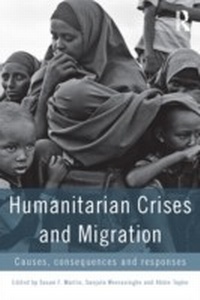
Humanitarian Crises and Migration
Causes, Consequences and Responses
1st Edition
Published on 24. April 2014
400 pages
978-1-135-08554-4 (ISBN)
Description

Whether it is the stranding of tens of thousands of migrant workers at the Libyan-Tunisian border, or the large-scale displacement triggered by floods in Pakistan and Colombia, hardly a week goes by in which humanitarian crises have not precipitated human movement. While some people move internally, others internationally, some temporarily and others permanently, there are also those who become "trapped" in place, unable to move to greater safety. Responses to these "crisis migrations" are varied and inadequate. Only a fraction of "crisis migrants" are protected by existing international, regional or national law. Even where law exists, practice does not necessarily guarantee safety and security for those who are forced to move or remain trapped. Improvements are desperately needed to ensure more consistent and effective responses.
This timely book brings together leading experts from multi-disciplinary backgrounds to reflect on diverse humanitarian crises and to shed light on a series of exploratory questions: In what ways do people move in the face of crisis situations? Why do some people move, while others do not? Where do people move? When do people move, and for how long? What are the challenges and opportunities in providing protection to crisis migrants? How might we formulate appropriate responses and sustainable solutions, and upon what factors should these depend? This volume is divided into four parts, with an introductory section outlining the parameters of "crisis migration," conceptualizing the term and evaluating its utility. This section also explores the legal, policy and institutional architecture upon which current responses are based. Part II presents a diverse set of case studies, from the earthquake in Haiti and the widespread violence in Mexico, to the ongoing exodus from Somalia, and environmental degradation in Alaska and the Carteret Islands, among others. Part III focuses on populations that may be at particular risk, including non-citizens, migrants at sea, those displaced to urban areas, and trapped populations. The concluding section maps the global governance of crisis migration and highlights gaps in current provisions for crisis-related movement across multiple levels.
This valuable book brings together previously diffuse research and policy issues under the analytical umbrella of "crisis migration." It lays the foundations for assessing and addressing real challenges to the status quo, and will be of interest to scholars, policy makers, and practitioners committed to seeking out improved responses and ensuring the dignity and safety of millions who move in the context of humanitarian crises.
This timely book brings together leading experts from multi-disciplinary backgrounds to reflect on diverse humanitarian crises and to shed light on a series of exploratory questions: In what ways do people move in the face of crisis situations? Why do some people move, while others do not? Where do people move? When do people move, and for how long? What are the challenges and opportunities in providing protection to crisis migrants? How might we formulate appropriate responses and sustainable solutions, and upon what factors should these depend? This volume is divided into four parts, with an introductory section outlining the parameters of "crisis migration," conceptualizing the term and evaluating its utility. This section also explores the legal, policy and institutional architecture upon which current responses are based. Part II presents a diverse set of case studies, from the earthquake in Haiti and the widespread violence in Mexico, to the ongoing exodus from Somalia, and environmental degradation in Alaska and the Carteret Islands, among others. Part III focuses on populations that may be at particular risk, including non-citizens, migrants at sea, those displaced to urban areas, and trapped populations. The concluding section maps the global governance of crisis migration and highlights gaps in current provisions for crisis-related movement across multiple levels.
This valuable book brings together previously diffuse research and policy issues under the analytical umbrella of "crisis migration." It lays the foundations for assessing and addressing real challenges to the status quo, and will be of interest to scholars, policy makers, and practitioners committed to seeking out improved responses and ensuring the dignity and safety of millions who move in the context of humanitarian crises.
Reviews / Votes
"This innovative volume develops an intriguing new conceptual framework on forced migration at the outset of a multi-year project undertaken by the Institute for the Study of International Migration at Georgetown University." - Journal of International Humanitarian Legal Studies, Benoit Mayer, Wuhan University"The volume brings together an impressive array of 24 authors, many of them wellknown names, who hold various combinations of expertise in academic research, policy, and practice. Readers will presumably have equally diverse backgrounds and appreciate different parts of the book." - Journal of Refugee Studies, Jorgen, Peace Research Institute Oslo (PRIO)
"This breadth of focus-on those who move both across borders and within countries, along with those who are not able to move-is analytically ambitious but effectively addressed by the first two chapters of the book." - Refuge, James Milner, Carleton University
More details
Language
English
Place of publication
London
United Kingdom
Publishing group
Taylor & Francis Ltd
Target group
College/higher education
Professional and scholarly
Product notice
Reflowable
Illustrations
7 s/w Abbildungen, 6 s/w Tabellen, 7 s/w Zeichnungen
6 Tables, black and white; 7 Line drawings, black and white; 7 Illustrations, black and white
File size
2,34 MB
ISBN-13
978-1-135-08554-4 (9781135085544)
Copyright in bibliographic data and cover images is held by Nielsen Book Services Limited or by the publishers or by their respective licensors: all rights reserved.
Schweitzer Classification
Other editions
Additional editions
Susan Martin | Sanjula Weerasinghe | Abbie Taylor
Humanitarian Crises and Migration
Causes, Consequences and Responses
Book
04/2014
1st Edition
Routledge
€242.90
Shipment within 15-20 days
Susan Martin | Sanjula Weerasinghe | Abbie Taylor
Humanitarian Crises and Migration
Causes, Consequences and Responses
Book
04/2014
1st Edition
Routledge
€72.50
Shipment within 15-20 days
Persons
Susan F. Martin, Institute for the Study of International Migration, School of Foreign Service, Georgetown University.
Sanjula Weerasinghe, Institute for the Study of International Migration, School of Foreign Service, Georgetown University.
Abbie Taylor, Institute for the Study of International Migration, School of Foreign Service, Georgetown University.
Sanjula Weerasinghe, Institute for the Study of International Migration, School of Foreign Service, Georgetown University.
Abbie Taylor, Institute for the Study of International Migration, School of Foreign Service, Georgetown University.
Content
Part One: Introduction and a Theoretical Perspective Chapter 1: Setting the Scene Chapter 2: Conceptualizing "Crisis Migration": A Theoretical Perspective Part Two: Case Studies of Humanitarian Crises: Movements, Protection Implications and Responses Chapter 3: Rising Waters, Broken Lives: Experience from Pakistan and Colombia Floods Suggests New Approaches are NeededChapter 4: Recurrent Acute Disasters, Crisis Migration: Haiti Has Had It All Chapter 5: Health Crises and Migration Chapter 6: Criminal Violence, Displacement, and Migration in Mexico and Central America Chapter 7: Intractability and Change in Crisis Migration: North Koreans in China and Burmese in Thailand Chapter 8: Environmental Processes, Political Conflict and Migration: A Somali Case Study Chapter 9: Environmental Stress, Displacement and the Challenge of Rights Protection Chapter 10: Enhancing Adaptation Options and Managing Human Mobility in the Context of Climate Change Chapter 11: Community Relocations: The Arctic and South Pacific Chapter 12: Something Old and Something New: Resettlement in the Twenty First Century Part Three: At Risk Populations Chapter 13: Protecting Non-Citizens in Situations of Conflict, Violence, and Disaster Chapter 14: 'Trapped' Populations: Controls on Mobility at Times of Crises Chapter 15: Policy Adrift: The Challenge of Mixed Migration By Sea Chapter 16: Flight to the Cities: Urban Options and Adaptations Part Four: Governance Chapter 17: The Global Governance of Crisis Migration
