

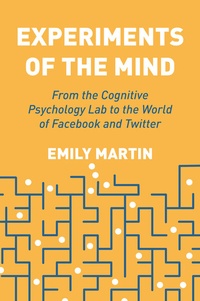
Experiments of the Mind
From the Cognitive Psychology Lab to the World of Facebook and Twitter
1st Edition
Published on 12. November 2021
312 pages
978-0-691-23207-2 (ISBN)
Description

An inside view of the experimental practices of cognitive psychology-and their influence on the addictive nature of social media
Experimental cognitive psychology research is a hidden force in our online lives. We engage with it, often unknowingly, whenever we download a health app, complete a Facebook quiz, or rate our latest purchase. How did experimental psychology come to play an outsized role in these developments? Experiments of the Mind considers this question through a look at cognitive psychology laboratories. Emily Martin traces how psychological research methods evolved, escaped the boundaries of the discipline, and infiltrated social media and our digital universe.
Martin recounts her participation in psychology labs, and she conveys their activities through the voices of principal investigators, graduate students, and subjects. Despite claims of experimental psychology's focus on isolated individuals, Martin finds that the history of the field-from early German labs to Gestalt psychology-has led to research methods that are, in fact, highly social. She shows how these methods are deployed online: amplified by troves of data and powerful machine learning, an unprecedented model of human psychology is now widespread-one in which statistical measures are paired with algorithms to predict and influence users' behavior.
Experiments of the Mind examines how psychology research has shaped us to be perfectly suited for our networked age.
Experimental cognitive psychology research is a hidden force in our online lives. We engage with it, often unknowingly, whenever we download a health app, complete a Facebook quiz, or rate our latest purchase. How did experimental psychology come to play an outsized role in these developments? Experiments of the Mind considers this question through a look at cognitive psychology laboratories. Emily Martin traces how psychological research methods evolved, escaped the boundaries of the discipline, and infiltrated social media and our digital universe.
Martin recounts her participation in psychology labs, and she conveys their activities through the voices of principal investigators, graduate students, and subjects. Despite claims of experimental psychology's focus on isolated individuals, Martin finds that the history of the field-from early German labs to Gestalt psychology-has led to research methods that are, in fact, highly social. She shows how these methods are deployed online: amplified by troves of data and powerful machine learning, an unprecedented model of human psychology is now widespread-one in which statistical measures are paired with algorithms to predict and influence users' behavior.
Experiments of the Mind examines how psychology research has shaped us to be perfectly suited for our networked age.
More details
Other editions
Additional editions
Emily Martin
Experiments of the Mind
From the Cognitive Psychology Lab to the World of Facebook and Twitter
Book
01/2022
Princeton University Press
€101.51
Article not available at the moment
Emily Martin
Experiments of the Mind
From the Cognitive Psychology Lab to the World of Facebook and Twitter
Book
01/2022
Princeton University Press
€34.50
Available immediately
Person
Emily Martin is professor emerita of anthropology at New York University. Her many books include Bipolar Expeditions (Princeton). Twitter @hanmuli
Content
- Cover
- Contents
- List of Illustrations
- Preface
- Acknowledgments
- Dramatis Personae
- Introduction
- My Research Questions
- The Deep Penetration of Experimental Psychology into Daily Life
- Invidious Practices
- Road Map
- 1. Doing This Ethnography
- Stymied
- Sociality
- Terms
- The Kitchen Table of Science
- 2. Sensing the World
- Early Fieldwork
- Wundt's Introspective Methods
- James Cattell and the Lip Key
- James Cattell and William James
- Torres Straits Islands-The "Generalized Mind"
- Bringing Back Context
- Music
- Away from the Social
- Titchener and Introspection
- J.B. Watson and His Ultimatum
- World War I and Watson
- 3. Experimenting Scientifically
- What Are the Ingredients of an Experiment?
- What It Is Like to Experience an Experiment?
- Interpretations
- 4. Normalizing Data
- Selection
- Amazon Mechanical Turk
- Normalizing Data
- Reaction Time
- 5. Delimiting Technologies
- Understanding the Limits of Tools
- EEG
- fMRI
- Behavioral Technologies
- Conversation as a Technology
- Publication as a Technology
- 6. Stabilizing Subjects
- Stabilizing the Subject in Space
- Stabilizing the Subject in Time
- Stabilizing the Subject with Tables
- 7. Gazing Technologically
- "The Eyes Don't Lie"
- In the Lab with the Eye Tracker
- Manipulation or Induction in an Eye Tracking Session
- Leftovers Redux
- Wrap-Up
- 8. Practicing Experimental Tasks
- Discovering Practice
- Objectivity versus Subjectivity
- Demand Characteristics
- 9. Envisaging "Productive Thinking"
- Historical Fork in the Road
- Gestalt Theory 101
- Structure and Process
- The Ether of the Field
- Why Gestalt Psychology Was Rejected
- The Vigor of the Experimental Method
- 10. Moving beyond the Lab
- Ergonomics
- User Friendly Design
- The Playbook
- 11. Entering Social and Digital Media
- Uncovering Subjectivity
- The Gaps
- Data and Individuals
- Commodification
- Looking Ahead
- Notes
- References Cited
- Index
