

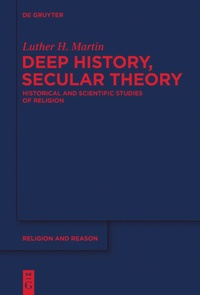
Deep History, Secular Theory
Description

Over the course of his career, Luther H. Martin has primarily produced articles rather than monographs. This approach to publication has given him the opportunity to experiment with different methodological approaches to an academic study of religion, with updates to and different interpretations of his field of historical specialization, namely Hellenistic religions, the subject of his only monograph (1987). The contents of this collected volume represent Martin's shift from comparative studies, to socio-political studies, to scientific studies of religion, and especially to the cognitive science of religion. He currently considers the latter to be the most viable approach for a scientific study of religion within the academic context of a modern research university. The twenty-five contributions collected in this volume are selected from over one hundred essays, articles, and book chapters published over a long and industrious career and are representative of Martin's work over the past two decades.
Reviews / Votes
"[...] Deep History, Secular Theory excels as a crucial asset in the emergent field of cognitive historiography and will undoubtedly help to firmly set the coordinates of a renovated scientific study of human culture/s and religion/s."Leonardo Ambasciano: Journal of Cognitive Historiography, Vol 3, No 1-2 (2016): 201-203
More details
Other editions
Additional editions
Person
Content
2 - Acknowledgements [Seite 7]
3 - Introduction [Seite 13]
4 - 1. The Academic Study of Religion: A Theological or Theoretical Undertaking? [Seite 24]
5 - 2. The Academic Study of Religions during the Cold War: A Western Perspective [Seite 34]
6 - 3. Secular Theory and the Academic Study of Religion [Seite 47]
7 - 4. Of Religious Syncretism, Comparative Religion and Spiritual Quests [Seite 57]
8 - 5. To Use "Syncretism," or Not to Use "Syncretism": That is the Question [Seite 66]
9 - 6. Comparison [Seite 78]
10 - 7. Comparativism and Sociobiological Theory [Seite 92]
11 - 8. Akin to the Gods or Simply One to Another? Comparison with Respect to Religions in Antiquity [Seite 106]
12 - 9. Secrecy in Hellenistic Religious Communities [Seite 119]
13 - 10. The Anti-Individualistic Ideology of Hellenistic Culture [Seite 139]
14 - 11. Rationalism and Relativity in History of Religions Research [Seite 161]
15 - 12. Evolution, Cognition, and History [Seite 175]
16 - 13. Does Religion Really Evolve? (And What Is It Anyway?) [Seite 187]
17 - 14. Religion and Cognition [Seite 194]
18 - 15. The Promise of Cognitive Science for the Study of Early Christianity [Seite 214]
19 - 16. Globalization, Syncretism, and Religion in Western Antiquity: Some Neurocognitive Considerations [Seite 233]
20 - 17. What Do Rituals Do (and How Do They Do It)? Cognition and the Study of Ritual [Seite 252]
21 - 18. The Deep History of Religious Ritual [Seite 266]
22 - 19. Performativity, Narrative, and Cognition: "Demythologizing" the Roman Cult of Mithras [Seite 284]
23 - 20. Cognitive Science, Ritual, and the Hellenistic Mystery Religions [Seite 310]
24 - 21. Why Christianity Was Accepted by Romans but Not by Rome [Seite 320]
25 - 22. Aspects of Religious Experience among the Hellenistic Mystery Religions [Seite 335]
26 - 23. The Uses (and Abuse) of the Cognitive Sciences for the Study of Religion [Seite 348]
27 - 24. The Future of the Past: The History of Religions and Cognitive Historiography [Seite 355]
28 - Author Index [Seite 370]
29 - Subject Index [Seite 374]
