

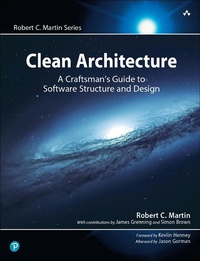
Clean Architecture
A Craftsman's Guide to Software Structure and Design
1st Edition
Published on 12. September 2017
432 pages
978-0-13-449432-6 (ISBN)
Description

Practical Software Architecture Solutions from the Legendary Robert C. Martin ("Uncle Bob")
By applying universal rules of software architecture, you can dramatically improve developer productivity throughout the life of any software system. Now, building upon the success of his best-selling books Clean Code and The Clean Coder, legendary software craftsman Robert C. Martin ("Uncle Bob") reveals those rules and helps you apply them.
Martin's Clean Architecture doesn't merely present options. Drawing on over a half-century of experience in software environments of every imaginable type, Martin tells you what choices to make and why they are critical to your success. As you've come to expect from Uncle Bob, this book is packed with direct, no-nonsense solutions for the real challenges you'll face-the ones that will make or break your projects.
Learn what software architects need to achieve-and core disciplines and practices for achieving it
Master essential software design principles for addressing function, component separation, and data management
See how programming paradigms impose discipline by restricting what developers can do
Understand what's critically important and what's merely a "detail"
Implement optimal, high-level structures for web, database, thick-client, console, and embedded applications
Define appropriate boundaries and layers, and organize components and services
See why designs and architectures go wrong, and how to prevent (or fix) these failures
Clean Architecture is essential reading for every current or aspiring software architect, systems analyst, system designer, and software manager-and for every programmer who must execute someone else's designs.
Register your product for convenient access to downloads, updates, and/or corrections as they become available.
By applying universal rules of software architecture, you can dramatically improve developer productivity throughout the life of any software system. Now, building upon the success of his best-selling books Clean Code and The Clean Coder, legendary software craftsman Robert C. Martin ("Uncle Bob") reveals those rules and helps you apply them.
Martin's Clean Architecture doesn't merely present options. Drawing on over a half-century of experience in software environments of every imaginable type, Martin tells you what choices to make and why they are critical to your success. As you've come to expect from Uncle Bob, this book is packed with direct, no-nonsense solutions for the real challenges you'll face-the ones that will make or break your projects.
Learn what software architects need to achieve-and core disciplines and practices for achieving it
Master essential software design principles for addressing function, component separation, and data management
See how programming paradigms impose discipline by restricting what developers can do
Understand what's critically important and what's merely a "detail"
Implement optimal, high-level structures for web, database, thick-client, console, and embedded applications
Define appropriate boundaries and layers, and organize components and services
See why designs and architectures go wrong, and how to prevent (or fix) these failures
Clean Architecture is essential reading for every current or aspiring software architect, systems analyst, system designer, and software manager-and for every programmer who must execute someone else's designs.
Register your product for convenient access to downloads, updates, and/or corrections as they become available.
More details
Series
Edition
1. Auflage
Language
English
Place of publication
Hoboken
United States
Publishing group
Pearson Education (US)
Target group
Professional and scholarly
File size
8,14 MB
ISBN-13
978-0-13-449432-6 (9780134494326)
Copyright in bibliographic data and cover images is held by Nielsen Book Services Limited or by the publishers or by their respective licensors: all rights reserved.
Schweitzer Classification
Other editions
Additional editions
Robert Martin | Robert C. Martin
Clean Architecture: A Craftsman's Guide to Software Structure and Design
A Craftsman's Guide to Software Structure and Design
Book
09/2017
1st Edition
Pearson
€43.99
Available immediately
Person
Robert C. Martin ("Uncle Bob") has been a programmer since 1970. He is founder of Uncle Bob Consulting, LLC, and cofounder with his son Micah Martin of The Clean Coders LLC. Martin has published dozens of articles in various trade journals and is a regular speaker at international conferences and trade shows. He has authored and edited many books, including: Designing Object Oriented C++ Applications Using the Booch Method, Patterns Languages of Program Design 3, More C++ Gems, Extreme Programming in Practice, Agile Software Development: Principles, Patterns, and Practices, UML for Java Programmers, Clean Code, and The Clean Coder. A leader in the industry of software development, Martin served for three years as editor-in-chief of the C++ Report, and he served as the first chairman of the Agile Alliance.
Content
Chapter 1: What Is Design and Architecture?
Chapter 2: A Tale of Two Values
Chapter 3: Paradigm Overview
Chapter 4: Structured Programming
Chapter 5: Object-Oriented Programming
Chapter 6: Functional Programming
Chapter 7: SRP: The Single Responsibility Principle
Chapter 8: OCP: The Open-Closed Principle
Chapter 9: LSP: The Liskov Substitution Principle
Chapter 10: ISP: The Interface Segregation Principle
Chapter 11: DIP: The Dependency Inversion Principle 8
Chapter 12: Components
Chapter 13: Component Cohesion
Chapter 14: Component Coupling
Chapter 15: What Is Architecture?
Chapter 16: Independence
Chapter 17: Boundaries: Drawing Lines
Chapter 18: Boundary Anatomy
Chapter 19: Policy and Level
Chapter 20: Business Rules
Chapter 21: Screaming Architecture
Chapter 22: The Clean Architecture
Chapter 23: Presenters and Humble Objects
Chapter 24: Partial Boundaries
Chapter 25: Layers and Boundaries
Chapter 26: The Main Component
Chapter 27: Services: Great and Small
Chapter 28: The Test Boundary
Chapter 29: Clean Embedded Architecture
Chapter 30: The Database Is a Detail
Chapter 31: The Web Is a Detail
Chapter 32: Frameworks Are Details
Chapter 33: Case Study: Video Sales
Chapter 34: The Missing Chapter
Chapter 2: A Tale of Two Values
Chapter 3: Paradigm Overview
Chapter 4: Structured Programming
Chapter 5: Object-Oriented Programming
Chapter 6: Functional Programming
Chapter 7: SRP: The Single Responsibility Principle
Chapter 8: OCP: The Open-Closed Principle
Chapter 9: LSP: The Liskov Substitution Principle
Chapter 10: ISP: The Interface Segregation Principle
Chapter 11: DIP: The Dependency Inversion Principle 8
Chapter 12: Components
Chapter 13: Component Cohesion
Chapter 14: Component Coupling
Chapter 15: What Is Architecture?
Chapter 16: Independence
Chapter 17: Boundaries: Drawing Lines
Chapter 18: Boundary Anatomy
Chapter 19: Policy and Level
Chapter 20: Business Rules
Chapter 21: Screaming Architecture
Chapter 22: The Clean Architecture
Chapter 23: Presenters and Humble Objects
Chapter 24: Partial Boundaries
Chapter 25: Layers and Boundaries
Chapter 26: The Main Component
Chapter 27: Services: Great and Small
Chapter 28: The Test Boundary
Chapter 29: Clean Embedded Architecture
Chapter 30: The Database Is a Detail
Chapter 31: The Web Is a Detail
Chapter 32: Frameworks Are Details
Chapter 33: Case Study: Video Sales
Chapter 34: The Missing Chapter
