

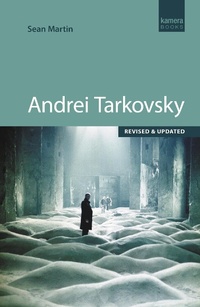
Andrei Tarkovsky
Published on 25. May 2011
224 pages
978-1-84243-440-6 (ISBN)
Description

Andrei Tarkovsky is the most celebrated Russian filmmaker since Eisenstein, and one of the most important directors to have emerged during the 1960s and 70s.
Although he made only seven features, each one was a major landmark in cinema, the most well-known of them being the mediaeval epic Andrei Rublev - widely regarded as one of the greatest films of all time - and the autobiographical Mirror, set during the Russia of Stalin's purges in the 1930s and the years of stagnation under Brezhnev. Both films landed Tarkovsky in considerable trouble with the authorities, and he gained a reputation for being a tortured - and ultimately martyred - filmmaker. Despite the harshness of the conditions under which he worked, Tarkovsky built up a remarkable body of work.
He burst upon the international scene in 1962 with his debut feature Ivan's Childhood, which won the Golden Lion at Venice and immediately established him as a major filmmaker. During the 1970s, he made two classic ventures into science-fiction, Solaris, regarded at the time as being the Soviet reply to Kubrick's 2001: A Space Odyssey and later remade by Steven Soderbergh, and Stalker, which was thought to have predicted the Chernobyl disaster. Harassed at home, Tarkovsky went into exile and made his last two films in the West, where he also published his classic work of film and artistic theory, Sculpting in Time. Since his death in Paris in 1986, his reputation continued - and continues - to grow.
Sean Martin considers the whole of Tarkovsky's oeuvre, from the classic student film The Steamroller and the Violin, across the full-length films, to the later stage works and Tarkovsky's writings, paintings and photographs. Martin also seeks to demystify Tarkovsky as a 'difficult' director, whilst also celebrating his radical aesthetic of long takes and tracking shots, which Tarkovsky was to dub 'imprinted' or 'sculpted' time, and to make a case for Tarkovsky's position not just as an important filmmaker, but also as an artist who speaks directly about the most important spiritual issues of our time.
Although he made only seven features, each one was a major landmark in cinema, the most well-known of them being the mediaeval epic Andrei Rublev - widely regarded as one of the greatest films of all time - and the autobiographical Mirror, set during the Russia of Stalin's purges in the 1930s and the years of stagnation under Brezhnev. Both films landed Tarkovsky in considerable trouble with the authorities, and he gained a reputation for being a tortured - and ultimately martyred - filmmaker. Despite the harshness of the conditions under which he worked, Tarkovsky built up a remarkable body of work.
He burst upon the international scene in 1962 with his debut feature Ivan's Childhood, which won the Golden Lion at Venice and immediately established him as a major filmmaker. During the 1970s, he made two classic ventures into science-fiction, Solaris, regarded at the time as being the Soviet reply to Kubrick's 2001: A Space Odyssey and later remade by Steven Soderbergh, and Stalker, which was thought to have predicted the Chernobyl disaster. Harassed at home, Tarkovsky went into exile and made his last two films in the West, where he also published his classic work of film and artistic theory, Sculpting in Time. Since his death in Paris in 1986, his reputation continued - and continues - to grow.
Sean Martin considers the whole of Tarkovsky's oeuvre, from the classic student film The Steamroller and the Violin, across the full-length films, to the later stage works and Tarkovsky's writings, paintings and photographs. Martin also seeks to demystify Tarkovsky as a 'difficult' director, whilst also celebrating his radical aesthetic of long takes and tracking shots, which Tarkovsky was to dub 'imprinted' or 'sculpted' time, and to make a case for Tarkovsky's position not just as an important filmmaker, but also as an artist who speaks directly about the most important spiritual issues of our time.
Reviews / Votes
An ideal intro to the austere auteur * Total Film * A thorough and compelling overview that provides newcomers with an idea of what exactly Tarkovsky means to film history -- Edwin Davies * Flux Magazine * Sean Martin is not only conscientious and scrupulous in his use of sources - he is nuanced and insightful when it comes to the work -- Paul Kane * Jildy Sauce *More details
Language
English
Place of publication
United Kingdom
Publishing group
Oldcastle Books Ltd
File size
1,26 MB
ISBN-13
978-1-84243-440-6 (9781842434406)
Copyright in bibliographic data and cover images is held by Nielsen Book Services Limited or by the publishers or by their respective licensors: all rights reserved.
Schweitzer Classification
Other editions
Additional editions
Person
Sean Martin is a writer, poet and filmmaker. He is the author of The Knights Templar, The Cathars, The Gnostics, The Black Death, Alchemy and Alchemists, A Short History of Disease and, for Kamera Books, Andrei Tarkovsky and New Waves in Cinema. His films include Lanterna Magicka: Bill Douglas & the Secret History of Cinema ('a fine documentary' - Guardian), Folie a Deux, and a series of documentaries on Tarkovsky: Tarkovsky's Andrei Rublev: A Journey and The Dream in the Mirror.
