

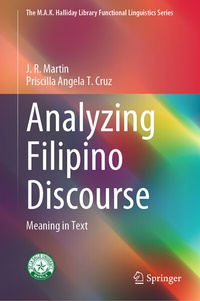
Analyzing Filipino Discourse
Description

This book explores Filipino, the national language of the Philippines, from the perspectives of Critical Discourse Analysis (CDA) and Positive Discourse Analysis (PDA)-informed by Systemic Functional Linguistics (SFL). It is designed to encourage researchers to study Filipino texts-both spoken and written-and to unpack them in a way that clarifies their function in Philippine society. With this goal in mind, the book introduces a number of discourse analysis tools and shows how to apply them to a range of Filipino texts-including a children's picture book story, some mental health advice about coping with COVID-19, President Duterte's speech about the Philippine government's initial response to the COVID-19 pandemic, a comment piece from a student newspaper about problems with online learning modules produced by the Department of Education, and a reflective text about growing up in Davao. This is the first book to draw on a range of functional linguistic tools to analyse Filipino discourse in order to provide deeper insights into the role of language in bilingual education, the linguistic enactment of power, and the importance of thinking across languages when analysing texts. Key issues addressed include the complementarity of CDA and PDA, SFL's model of social context (as register and genre), analysing bilingual texts and bilingual education. The book fosters appliable linguistics as a dialectic of theory, description, and practice-supporting Filipino discourse analysts as they engage with the challenge of giving people access to a range of tools they can use productively to mean and thereby more successfully pursue their social goals. As such, it provides a model for researchers of other languages of how to encourage the analysis of meaning in texts within and beyond the clause. It is relevant to scholars across the spectrum of linguistics, particularly those working in Systemic Functional Linguistics.
More details
Other editions
Additional editions
Persons
J R Martin is a professor of Linguistics at the University of Sydney. He was elected a fellow of the Australian Academy of the Humanities in 1998 (acting as the head of its Linguistics Section from 2010-2012) and was awarded a Centenary Medal for his services to Linguistics and Philology in 2003. In April 2014, Shanghai Jiao Tong University opened its Martin Centre for Appliable Linguistics, appointing Professor Martin as a director.
Priscilla Angela T Cruz is an associate professor at the Department of English, Ateneo de Manila University, Philippines. Her research focuses on discourse analysis, appliable linguistics, educational linguistics, language variation, and systemic functional linguistics. She has also worked on mother-tongue-based multilingual education.
Content
Analysing Filipino texts.- Ideational meaning: mapping the world.- Interpersonal meaning: managing social relations.- Textual meaning: organising information flow.- Making a point: organising information flow.- Tackling a text.- Further steps.- Appendices.
