

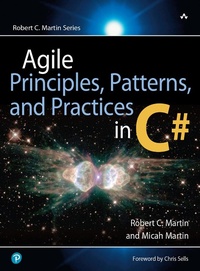
Agile Principles, Patterns, and Practices in C#
1st Edition
Published on 20. July 2006
768 pages
978-0-13-279714-6 (ISBN)
Description

With the award-winning book Agile Software Development: Principles, Patterns, and Practices, Robert C. Martin helped bring Agile principles to tens of thousands of Java and C++ programmers. Now .NET programmers have a definitive guide to agile methods with this completely updated volume from Robert C. Martin and Micah Martin, Agile Principles, Patterns, and Practices in C#.
This book presents a series of case studies illustrating the fundamentals of Agile development and Agile design, and moves quickly from UML models to real C# code. The introductory chapters lay out the basics of the agile movement, while the later chapters show proven techniques in action. The book includes many source code examples that are also available for download from the authors' Web site.
Readers will come away from this book understanding
Agile principles, and the fourteen practices of Extreme Programming
Spiking, splitting, velocity, and planning iterations and releases
Test-driven development, test-first design, and acceptance testing
Refactoring with unit testing
Pair programming
Agile design and design smells
The five types of UML diagrams and how to use them effectively
Object-oriented package design and design patterns
How to put all of it together for a real-world project
Whether you are a C# programmer or a Visual Basic or Java programmer learning C#, a software development manager, or a business analyst, Agile Principles, Patterns, and Practices in C# is the first book you should read to understand agile software and how it applies to programming in the .NET Framework.
This book presents a series of case studies illustrating the fundamentals of Agile development and Agile design, and moves quickly from UML models to real C# code. The introductory chapters lay out the basics of the agile movement, while the later chapters show proven techniques in action. The book includes many source code examples that are also available for download from the authors' Web site.
Readers will come away from this book understanding
Agile principles, and the fourteen practices of Extreme Programming
Spiking, splitting, velocity, and planning iterations and releases
Test-driven development, test-first design, and acceptance testing
Refactoring with unit testing
Pair programming
Agile design and design smells
The five types of UML diagrams and how to use them effectively
Object-oriented package design and design patterns
How to put all of it together for a real-world project
Whether you are a C# programmer or a Visual Basic or Java programmer learning C#, a software development manager, or a business analyst, Agile Principles, Patterns, and Practices in C# is the first book you should read to understand agile software and how it applies to programming in the .NET Framework.
More details
Edition
1. Auflage
Language
English
Place of publication
Hoboken
United States
Publishing group
Pearson Education (US)
Target group
College/higher education
ISBN-13
978-0-13-279714-6 (9780132797146)
Copyright in bibliographic data and cover images is held by Nielsen Book Services Limited or by the publishers or by their respective licensors: all rights reserved.
Schweitzer Classification
Other editions
Additional editions
Robert Martin | Micah Martin
Agile Principles, Patterns, and Practices in C#
Book
08/2006
Pearson
€74.50
Shipment within 15-20 days
Persons
Robert C. Martin has been a software professional since 1970 and an international software consultant since 1990. He is founder and president of Object Mentor, Inc., a team of experienced consultants who mentor their clients in the fields of C++, Java, OO, Patterns, UML, Agile Methodologies, and Extreme Programming.
Micah Martin works with Object Mentor as a developer, consultant, and mentor on topics ranging from object-oriented principles and patterns to agile software development practices. Micah is the cocreator and lead developer of the open source FitNesse project. He is also a published author and speaks regularly at conferences.
Micah Martin works with Object Mentor as a developer, consultant, and mentor on topics ranging from object-oriented principles and patterns to agile software development practices. Micah is the cocreator and lead developer of the open source FitNesse project. He is also a published author and speaks regularly at conferences.
Content
Chapter 1: Agile Practices
Chapter 2: Overview of Extreme Programming
Chapter 3: Planning
Chapter 4: Testing
Chapter 5: Refactoring
Chapter 6: A Programming Episode
Chapter 7: What Is Agile Design?
Chapter 8: The Single-Responsibility Principle (SRP)
Chapter 9: The Open/Closed Principle (OCP)
Chapter 10: The Liskov Substitution Principle (LSP)
Chapter 11: The Dependency-Inversion Principle (DIP)
Chapter 12: The Interface Segregation Principle (ISP)
Chapter 13: Overview of UML for C# Programmers
Chapter 14: Working with Diagrams
Chapter 15: State Diagrams
Chapter 16: Object Diagrams
Chapter 17: Use Cases
Chapter 18: Sequence Diagrams
Chapter 19: Class Diagrams
Chapter 20: Heuristics and Coffee
Chapter 21: Command and Active Object: Versatility and Multitasking
Chapter 22: Template Method and Strategy: Inheritance versus Delegation
Chapter 23: Facade and Mediator
Chapter 24: Singleton and Monostate
Chapter 25: Null Object
Chapter 26: The Payroll Case Study: Iteration 1
Chapter 27: The Payroll Case Study: Implementation
Chapter 28: Principles of Package and Component Design
Chapter 29: Factory
Chapter 30: The Payroll Case Study: Package Analysis
Chapter 31: Composite
Chapter 32: Observer: Evolving into a Pattern
Chapter 33: Abstract Server, Adapter, and Bridge
Chapter 34: Proxy and Gateway: Managing Third-Party APIs
Chapter 35: Visitor
Chapter 36: State
Chapter 37: The Payroll Case Study: The Database
Chapter 38: The Payroll User Interface: Model View Presenter
Appendix A: A Satire of Two Companies
Appendix B: What Is Software?
Chapter 2: Overview of Extreme Programming
Chapter 3: Planning
Chapter 4: Testing
Chapter 5: Refactoring
Chapter 6: A Programming Episode
Chapter 7: What Is Agile Design?
Chapter 8: The Single-Responsibility Principle (SRP)
Chapter 9: The Open/Closed Principle (OCP)
Chapter 10: The Liskov Substitution Principle (LSP)
Chapter 11: The Dependency-Inversion Principle (DIP)
Chapter 12: The Interface Segregation Principle (ISP)
Chapter 13: Overview of UML for C# Programmers
Chapter 14: Working with Diagrams
Chapter 15: State Diagrams
Chapter 16: Object Diagrams
Chapter 17: Use Cases
Chapter 18: Sequence Diagrams
Chapter 19: Class Diagrams
Chapter 20: Heuristics and Coffee
Chapter 21: Command and Active Object: Versatility and Multitasking
Chapter 22: Template Method and Strategy: Inheritance versus Delegation
Chapter 23: Facade and Mediator
Chapter 24: Singleton and Monostate
Chapter 25: Null Object
Chapter 26: The Payroll Case Study: Iteration 1
Chapter 27: The Payroll Case Study: Implementation
Chapter 28: Principles of Package and Component Design
Chapter 29: Factory
Chapter 30: The Payroll Case Study: Package Analysis
Chapter 31: Composite
Chapter 32: Observer: Evolving into a Pattern
Chapter 33: Abstract Server, Adapter, and Bridge
Chapter 34: Proxy and Gateway: Managing Third-Party APIs
Chapter 35: Visitor
Chapter 36: State
Chapter 37: The Payroll Case Study: The Database
Chapter 38: The Payroll User Interface: Model View Presenter
Appendix A: A Satire of Two Companies
Appendix B: What Is Software?
