

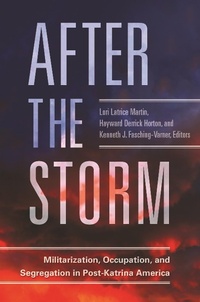
After the Storm
Militarization, Occupation, and Segregation in Post-Katrina America
1st Edition
Published on 20. June 2016
184 pages
979-8-216-04373-7 (ISBN)
Description

This book examines the state of race relations in America 10 years after one of the worst natural disasters in American history, Hurricane Katrina, and looks at the socioeconomic consequences of decades of public and private practices brought to light by the storm in cities throughout the Gulf Coast as well as in America more broadly.
More than a decade ago, Hurricane Katrina served to expose a well-engineered system of oppression, one which continues to privilege some groups and disadvantage others. In the wake of the natural disaster that hit New Orleans, it became clear that institutions such as residential segregation, mass incarceration and unemployment, police brutality, political disenfranchisement, racial profiling, gentrification, community occupation, discrimination, and a prison-to-school pipeline are expressly intended to work against people of color and individuals from economically disadvantaged backgrounds. Unfortunately, very little has improved in the lives of people living in majority-minority communities since Katrina.
After the Storm uses Hurricane Katrina and the aftermath of the natural disaster as a point of departure for understanding enduring racial divides in asset ownership, academic achievement, educational attainment, and mass incarceration in New Orleans and beyond. The book explores the many specific aspects of the widespread problem and considers how to move toward achieving a state where all can thrive. Readers will better appreciate the key roles of race, inequality, education, occupation, and militarization in understanding the failures in the responses to this disaster and grasp how institutionalized inequity continues to plague our nation.
More than a decade ago, Hurricane Katrina served to expose a well-engineered system of oppression, one which continues to privilege some groups and disadvantage others. In the wake of the natural disaster that hit New Orleans, it became clear that institutions such as residential segregation, mass incarceration and unemployment, police brutality, political disenfranchisement, racial profiling, gentrification, community occupation, discrimination, and a prison-to-school pipeline are expressly intended to work against people of color and individuals from economically disadvantaged backgrounds. Unfortunately, very little has improved in the lives of people living in majority-minority communities since Katrina.
After the Storm uses Hurricane Katrina and the aftermath of the natural disaster as a point of departure for understanding enduring racial divides in asset ownership, academic achievement, educational attainment, and mass incarceration in New Orleans and beyond. The book explores the many specific aspects of the widespread problem and considers how to move toward achieving a state where all can thrive. Readers will better appreciate the key roles of race, inequality, education, occupation, and militarization in understanding the failures in the responses to this disaster and grasp how institutionalized inequity continues to plague our nation.
More details
Edition
1. Auflage
Language
English
Place of publication
New York
United States
Publishing group
Bloomsbury Publishing Plc
ISBN-13
979-8-216-04373-7 (9798216043737)
Copyright in bibliographic data and cover images is held by Nielsen Book Services Limited or by the publishers or by their respective licensors: all rights reserved.
Schweitzer Classification
Other editions
Additional editions
Lori Latrice Martin | Hayward Derrick Horton | Kenneth J. Fasching-Varner Ph.D.
After the Storm
Militarization, Occupation, and Segregation in Post-Katrina America
Book
06/2016
Praeger Publishers Inc
€58.30
Shipment within 10-20 days
Persons
Lori Latrice Martin, PhD, is associate professor of sociology and African and African American studies at Louisiana State University.
Hayward Derrick Horton, PhD, is professor of sociology at University at Albany, State University of New York.
Kenneth J. Fasching-Varner, PhD, is Shirley B. Barton Endowed Associate Professor in the College of Human Sciences and Education at Louisiana State University.
Hayward Derrick Horton, PhD, is professor of sociology at University at Albany, State University of New York.
Kenneth J. Fasching-Varner, PhD, is Shirley B. Barton Endowed Associate Professor in the College of Human Sciences and Education at Louisiana State University.
Content
Acknowledgments
Introduction
Lori Latrice Martin
Chapter One: A Tale of Two Cities: Race and Wealth Inequality in the New South
Lori Latrice Martin, Kenneth J. Fasching-Varner, and Melinda Jackson
Chapter Two: Accelerated Categorical Inequality: New Orleans in the Eye of the Storm
Geoffrey L. Wood
Chapter Three: Loaded-God Complex: Engaging Educational and Penal Realism in Post-Katrina Times
Kenneth J. Fasching-Varner
Chapter Four: What Do You Know about My Black Son? A Counternarrative That Challenges the Deficit Perspective
Traci P. Baxley
Chapter Five: Three Louisiana Floods: Cases of Genocide?
Teresa A. Booker
Chapter Six: Can You Hear Me Now? Race, Call-ins, and the Myth of Public Accountability
Lori Latrice Martin and Kenneth J. Fasching-Varner
Chapter Seven: The Effects of Hurricane Katrina on Black Women: Understanding Women's Fear through an Intersectional Lens
Melinda Jackson, Castel Sweet, and Dari Green
Chapter Eight: Hand Over Minority Economies (H.O.M.E.): Examining the Persistent Waves of Divesting, Dismantling, and Devaluing of Black Bodies in America
Tifanie Pulley and Lori Latrice Martin
Chapter Nine: Giving Students Voice: Book Dealing and Discussions That Build a Broken Community
Susan Densmore-James
Chapter Ten: Triple Threat: Militarization, Occupation, and Segregation in Post-Katrina America
Lori Latrice Martin
Bibliography
Index
About the Editors and Contributors
Introduction
Lori Latrice Martin
Chapter One: A Tale of Two Cities: Race and Wealth Inequality in the New South
Lori Latrice Martin, Kenneth J. Fasching-Varner, and Melinda Jackson
Chapter Two: Accelerated Categorical Inequality: New Orleans in the Eye of the Storm
Geoffrey L. Wood
Chapter Three: Loaded-God Complex: Engaging Educational and Penal Realism in Post-Katrina Times
Kenneth J. Fasching-Varner
Chapter Four: What Do You Know about My Black Son? A Counternarrative That Challenges the Deficit Perspective
Traci P. Baxley
Chapter Five: Three Louisiana Floods: Cases of Genocide?
Teresa A. Booker
Chapter Six: Can You Hear Me Now? Race, Call-ins, and the Myth of Public Accountability
Lori Latrice Martin and Kenneth J. Fasching-Varner
Chapter Seven: The Effects of Hurricane Katrina on Black Women: Understanding Women's Fear through an Intersectional Lens
Melinda Jackson, Castel Sweet, and Dari Green
Chapter Eight: Hand Over Minority Economies (H.O.M.E.): Examining the Persistent Waves of Divesting, Dismantling, and Devaluing of Black Bodies in America
Tifanie Pulley and Lori Latrice Martin
Chapter Nine: Giving Students Voice: Book Dealing and Discussions That Build a Broken Community
Susan Densmore-James
Chapter Ten: Triple Threat: Militarization, Occupation, and Segregation in Post-Katrina America
Lori Latrice Martin
Bibliography
Index
About the Editors and Contributors
