

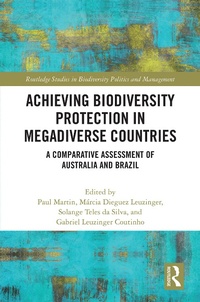
Achieving Biodiversity Protection in Megadiverse Countries
A Comparative Assessment of Australia and Brazil
1st Edition
Published on 19. March 2020
310 pages
978-1-000-05245-9 (ISBN)
Description

This volume systematically analyses why legal doctrines for the protection of biodiversity are not sufficiently effective. It examples implementation in Australia and Brazil, two megadiverse countries with very differing legal and cultural traditions and natural environments.
Substantial effort goes into the development and interpretation of legal doctrines for the protection of biodiversity in national and international law. Despite this, biodiversity continues in steep decline. Nowhere is this more evident than in megadiverse countries, such as Australia and Brazil, which possess the greatest number and diversity of animals and plants on Earth. The book covers a wide range of topics, including farming, mining, marine environments, indigenous interests and governance. Achieving Biodiversity Protection in Megadiverse Countries highlights specific causes of underperformance in protecting diverse terrestrial and marine environments. It provides proposals for more effective implementation in these two jurisdictions, relevant to other megadiverse territories, and for biodiversity protection generally. Each chapter was written by teams of Australian and Brazilian authors, so that similar issues are considered across both jurisdictions, to provide both country-specific and generalisable insights.
Achieving Biodiversity Protection in Megadiverse Countries will be of great interest to students and scholars of environmental law and governance and biodiversity conservation, as well as policymakers, practitioners and NGOs working in these fields.
Substantial effort goes into the development and interpretation of legal doctrines for the protection of biodiversity in national and international law. Despite this, biodiversity continues in steep decline. Nowhere is this more evident than in megadiverse countries, such as Australia and Brazil, which possess the greatest number and diversity of animals and plants on Earth. The book covers a wide range of topics, including farming, mining, marine environments, indigenous interests and governance. Achieving Biodiversity Protection in Megadiverse Countries highlights specific causes of underperformance in protecting diverse terrestrial and marine environments. It provides proposals for more effective implementation in these two jurisdictions, relevant to other megadiverse territories, and for biodiversity protection generally. Each chapter was written by teams of Australian and Brazilian authors, so that similar issues are considered across both jurisdictions, to provide both country-specific and generalisable insights.
Achieving Biodiversity Protection in Megadiverse Countries will be of great interest to students and scholars of environmental law and governance and biodiversity conservation, as well as policymakers, practitioners and NGOs working in these fields.
More details
Series
Edition
1. Auflage
Language
English
Place of publication
London
United Kingdom
Publishing group
Taylor & Francis Ltd
Target group
College/higher education
Product notice
Reflowable
Illustrations
18 Tables, black and white; 12 Line drawings, black and white; 12 Illustrations, black and white
ISBN-13
978-1-000-05245-9 (9781000052459)
Copyright in bibliographic data and cover images is held by Nielsen Book Services Limited or by the publishers or by their respective licensors: all rights reserved.
Schweitzer Classification
Other editions
Additional editions
Paul Martin | Marcia Dieguez Leuzinger | Solange Teles da Silva
Achieving Biodiversity Protection in Megadiverse Countries
A Comparative Assessment of Australia and Brazil
Book
12/2021
1st Edition
Routledge
€65.80
Shipment within 10-20 days
Paul Martin | Marcia Dieguez Leuzinger | Solange Teles da Silva
Achieving Biodiversity Protection in Megadiverse Countries
A Comparative Assessment of Australia and Brazil
Book
03/2020
1st Edition
Routledge
€206.90
Shipment within 15-20 days
Persons
Paul Martin is the Director of the Australian Centre for Agriculture and Law at the University of New England in Australia, and a member of the Research Committee of the IUCN Academy of Environmental Law. He has conducted extensive research on the implementation of biodiversity protection a number of countries.
Marcia Dieguez Leuzinger is an Environmental Law Professor at Brasilia University Centre - UniCEUB, and a State Attorney for Parana. She has undergraduate, masters and doctoral degrees in Sustainable Development from Brasilia University - UnB and leads the Environmental Law and Sustainable Development Research Group at UniCEUB.
Solange Teles Da Silva is a Law Professor at Mackenzie Presbyterian University. She graduated in Law at Sao Paulo University and has a PhD in Environmental Law at Paris I - Pantheon Sorbonne University. She has a CNPq Research Productivity Fellowship in Brazil, and is the Leader of the Research Group on Law and Sustainable Development. She is actively involved in the IUCN Academy of Environmental Law.
Gabriel Leuzinger Coutinho is an electrical engineer with an MBA in Project Management from the Fundacao Getulio Vargas, and an MSc in Sustainability Policy and Management from the University of Brasilia (UnB). He is currently a PhD student at UnB's Center for Sustainable Development, and is a coordinator of the environmental law and sustainable development research group at UniCEUB.
Marcia Dieguez Leuzinger is an Environmental Law Professor at Brasilia University Centre - UniCEUB, and a State Attorney for Parana. She has undergraduate, masters and doctoral degrees in Sustainable Development from Brasilia University - UnB and leads the Environmental Law and Sustainable Development Research Group at UniCEUB.
Solange Teles Da Silva is a Law Professor at Mackenzie Presbyterian University. She graduated in Law at Sao Paulo University and has a PhD in Environmental Law at Paris I - Pantheon Sorbonne University. She has a CNPq Research Productivity Fellowship in Brazil, and is the Leader of the Research Group on Law and Sustainable Development. She is actively involved in the IUCN Academy of Environmental Law.
Gabriel Leuzinger Coutinho is an electrical engineer with an MBA in Project Management from the Fundacao Getulio Vargas, and an MSc in Sustainability Policy and Management from the University of Brasilia (UnB). He is currently a PhD student at UnB's Center for Sustainable Development, and is a coordinator of the environmental law and sustainable development research group at UniCEUB.
Content
List of figures
List of tables
List of contributors
Foreword
Preface
List of acronyms and abbreviations
1: The issues, methods and evidence
2: Controlling the biodiversity impacts of agriculture
3: Biodiversity risk management in mining
4: Creating and managing marine protected areas
5: Social justice and the management of protected areas
6: Low impact recreational use and biodiversity protection
7: Partnered governance of biodiversity
8: Biodiversity intelligence from satellites
9: The challenge of using drones
10: Funding biodiversity conservation
11: Governing the governance system
12: Strategies to improve outcomes
Appendix A: Legislation list
Appendix B: International material
Appendix C: Cases
Index
List of tables
List of contributors
Foreword
Preface
List of acronyms and abbreviations
1: The issues, methods and evidence
2: Controlling the biodiversity impacts of agriculture
3: Biodiversity risk management in mining
4: Creating and managing marine protected areas
5: Social justice and the management of protected areas
6: Low impact recreational use and biodiversity protection
7: Partnered governance of biodiversity
8: Biodiversity intelligence from satellites
9: The challenge of using drones
10: Funding biodiversity conservation
11: Governing the governance system
12: Strategies to improve outcomes
Appendix A: Legislation list
Appendix B: International material
Appendix C: Cases
Index
