

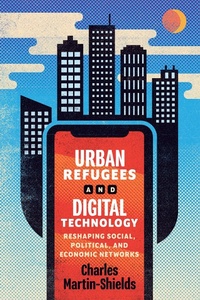
Urban Refugees and Digital Technology
Reshaping Social, Political, and Economic Networks
1st Edition
Published on 12. March 2024
234 pages
978-0-2280-2054-7 (ISBN)
Description

Refugees and displaced people are increasingly moving to cities around the world, seeking out the social, economic, and political opportunity that urban areas provide. Against this backdrop digital technologies are fundamentally changing how refugees and displaced people engage with urban landscapes and economies where they settle.
Urban Refugees and Digital Technology draws on contemporary data gathered from refugee communities in Bogota, Nairobi, and Kuala Lumpur to build a new theoretical understanding of how technological change influences the ways urban refugees contribute to the social, economic, and political networks in their cities of arrival. This data is presented against the broader history of technological change in urban areas since the start of industrialization, showing how displaced people across time have used technologized urban spaces to shape the societies where they settle. The case studies and history demonstrate how refugees' interactions with environments that are often hostile to their presence spur novel adaptations to idiosyncratic features of a city's technological landscape.
A wide-ranging study across histories and geographies of urban displacement, Urban Refugees and Digital Technology introduces readers to the myriad ways technological change creates spaces for urban refugees to build rich political, social, and economic lives in cities.
Urban Refugees and Digital Technology draws on contemporary data gathered from refugee communities in Bogota, Nairobi, and Kuala Lumpur to build a new theoretical understanding of how technological change influences the ways urban refugees contribute to the social, economic, and political networks in their cities of arrival. This data is presented against the broader history of technological change in urban areas since the start of industrialization, showing how displaced people across time have used technologized urban spaces to shape the societies where they settle. The case studies and history demonstrate how refugees' interactions with environments that are often hostile to their presence spur novel adaptations to idiosyncratic features of a city's technological landscape.
A wide-ranging study across histories and geographies of urban displacement, Urban Refugees and Digital Technology introduces readers to the myriad ways technological change creates spaces for urban refugees to build rich political, social, and economic lives in cities.
Reviews / Votes
"This strongly theorized and historically aware study, presenting rich empirical material, will shape the emergent interdisciplinary research area of digital migration studies, with potential to positively influence policy and planning. The book offers key new insights on an understudied population while avoiding a tokenistic account. Charles Martin-Shields innovatively combines contemporary and historical approaches to offer new conceptual understandings of refugee integration." Koen Leurs, Utrecht University and author of Digital Migration "Two of the most notable features of modern urban life are the global development of refugee and other migrant communities in cities and the prevalence of digital communication in nearly all activities. Martin-Shields makes an interesting and useful contribution by linking issues of digital technology and urban refugees in South America, Africa, and Southeast Asia. Recommended. General readers, through faculty; professionals" Choice "Martin-Shields makes an interesting and useful contribution by linking issues of digital technology and urban refugees in South America, Africa, and Southeast Asia. The book's most helpful policy suggestion may be the need for more attention to refugees' use of the digital infrastructure from local governments and international agencies." ChoiceMore details
Series
Language
English
Place of publication
Canada
Canada
Target group
Professional and scholarly
Illustrations
7 diagrams, 2 tables
File size
5,02 MB
ISBN-13
978-0-2280-2054-7 (9780228020547)
Copyright in bibliographic data and cover images is held by Nielsen Book Services Limited or by the publishers or by their respective licensors: all rights reserved.
Schweitzer Classification
Other editions
Additional editions
Charles Martin-Shields
Urban Refugees and Digital Technology
Reshaping Social, Political, and Economic Networks
Book
03/2024
McGill-Queen's University Press
€36.00
Shipment within 15-20 days
Charles Martin-Shields
Urban Refugees and Digital Technology
Reshaping Social, Political, and Economic Networks
Book
03/2024
McGill-Queen's University Press
€130.94
Article not available at the moment
Person
Charles Martin-Shields is senior researcher at the German Institute of Development and Sustainability.
Content
- Urban Refugees and Digital Technology: Reshaping Social, Political, and Economic Networks
- Cover
- Half Title Page
- Series Page
- Title Page
- Copyright
- Contents
- Tables and Figures
- Preface
- Acknowledgments
- PART ONE: Conceptualizing Technology and Urban Displacement in Theory and History
- 1 Urban Refugees in a Digital World
- DIGITAL URBAN SOCIETY: WHAT DOES TWENTY-FIRST-CENTURY TECHNOLOGICAL CHANGE MEAN FOR GROWING CITIES?
- INDUSTRIAL TECHNOLOGICAL CHANGE AND URBANIZATION: ENGAGING WITH HISTORIES OF DISPLACEMENT
- TECHNOLOGY AND MIGRATION ADMINISTRATION: KEEPING TRACK OF PEOPLE IN CITIES
- CONTEMPORARY DEBATES: FORCED DISPLACEMENT, URBAN REFUGEES, AND TECHNOLOGY
- BOGOTÁ, KUALA LUMPUR, AND NAIROBI AS CASE STUDIES
- METHODS AND CASES ACROSS TIME: HOW HISTORICAL AND CONTEMPORARY ANALYSIS COME TOGETHER
- MIGRANTS, REFUGEES, AND DISPLACED PEOPLE: A NOTE ON TERMINOLOGY
- THE FINDINGS IN PRACTICE
- 2 The Urban Context: Where Displacement and Digitalization Meet
- ECONOMIC DEVELOPMENT, CITIES, AND MIGRANTS
- DIGITALIZATION IN URBAN SOCIETY AND THE ADMINISTRATION OF CITIES
- WHAT DOES THE FUTURE OF CITIES LOOK LIKE IN AN ERA OF DIGITALIZATION AND URBAN DISPLACEMENT?
- HOW THE HISTORY OF URBAN MIGRATION AND TECHNOLOGY HELP BRING THE SCENARIOS TO LIFE
- 3 Technological Change, New Displacement Patterns, and Urbanization
- THE HISTORICAL METHODS EMPLOYED
- FROM THE COMMONS TO THE CITIES: ENGLAND AND THE FIRST INDUSTRIAL REVOLUTION
- FROM EUROPE TO NEW YORK CITY: THE GARMENT INDUSTRY AND URBAN DISPLACEMENT
- THE SOUTH TO THE NORTH: LATE TWENTIETH-CENTURY INTERNAL DISPLACEMENT IN THE UNITED STATES
- FROM INDUSTRIAL TO ADMINISTRATIVE TECHNOLOGY IN URBAN REFUGEES' LIVES
- 4 Digitalization and Urban Administration: Evolutions of Surveillance
- STATISTICS AS TECHNOLOGY: MAKING INDUSTRIALIZING CITIES ADMINISTRATIVELY LEGIBLE
- URBAN EPIDEMIOLOGY AS TECHNOLOGY: PUBLIC HEALTH DURING THE INDUSTRIAL REVOLUTION
- PASSPORTS AND THE TECHNOLOGY OF BORDER CONTROL
- DIGITAL TECHNOLOGY IN THE LIVES OF TODAY'S URBAN REFUGEES IN THE GLOBAL SOUTH
- APPLYING THE HISTORY OF TECHNOLOGY AND DISPLACEMENT TO THE PRESENT
- PART TWO: Contemporary Case Studies and the Digital Future of Urban Displacement
- 5 Methods in the Contemporary Context: Case Studies and Data Collection
- CASE STUDIES IN MIGRATION AND DIGITALIZATION RESEARCH
- WHY THESE CITIES?
- EMPIRICAL METHODS WITHIN THE CASES
- INSIGHTS FROM THE DATA COLLECTION
- 6 Bogotá: ICT Access in the Neighbourhood
- BRIEF HISTORY: BOGOTÁ AND URBAN DISPLACEMENT
- TECHNOLOGY IN BOGOTÁ
- DIGITALIZATION IN THE LIVES OF URBAN DISPLACED PEOPLE
- THE INTERACTION BETWEEN DIGITALIZATION AND URBAN INTEGRATION
- 7 Kuala Lumpur: Time, Distance, and Legal Exclusion
- BRIEF HISTORY: KUALA LUMPUR AND URBAN DISPLACEMENT
- TECHNOLOGY IN KUALA LUMPUR
- DIGITALIZATION IN THE LIVES OF REFUGEES
- THE INTERACTION BETWEEN DIGITALIZATION AND URBAN INTEGRATION
- 8 Nairobi: Shifting Politics in a Digital Metropolis
- BRIEF HISTORY: NAIROBI AND URBAN DISPLACEMENT
- TECHNOLOGY IN NAIROBI
- DIGITALIZATION IN THE LIVES OF REFUGEES
- THE INTERACTION BETWEEN DIGITALIZATION AND URBAN INTEGRATION
- 9 Digitalization and Urban Displacement: Future Scenarios
- NORTH END
- JOBLESS PANOPTICON
- LONELY HUSTLE
- RUST BELT
- THE DIGITAL FUTURE FOR URBAN REFUGEES AND THE CITIES THEY CALL HOME
- 10 The Future: Digitalization, Displacement, and New Urban Societies
- NEW RESEARCH DIRECTIONS: TECHNOLOGY, URBANIZATION, ECONOMICS, AND HUMAN MOBILITY
- ECONOMIC DEVELOPMENT AID AND THE DEVELOPMENTAL ARC OF CITIES
- HUMANITARIAN AGENCIES AND DIGITAL TECHNOLOGY
- WHAT THIS MEANS FOR THE EVERYDAY PERSON
- Notes
- References
- Index
