

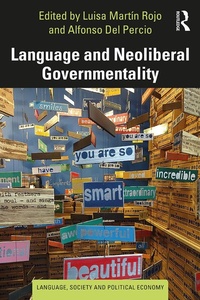
Language and Neoliberal Governmentality
1st Edition
Published on 26. June 2019
242 pages
978-1-000-01233-0 (ISBN)
Description

Against a background of the ongoing crisis of global capitalism and the fracturing of the neoliberal project, this book provides a detailed account of the ways in which language is profoundly imbricated in the neoliberalising of the fabric of social life.
With chapters from a cast list of international scholars covering topics such as the commodification of education and language, unemployment, and the governmentality of the self, and discussion chapters from Monica Heller and Jackie Urla bringing the various strands together, the book ultimately helps us to understand how language is part of political economy and the everyday making and remaking of society and individuals. It provides both a theoretical framework and a significant methodological "tool-box" to critically detect, understand, and resist the impact of neoliberalism on everyday social spheres, particularly in relation to language.
Presenting richly empirical studies that expand our understanding of how neoliberalism as a regime of truth and as a practice of governance performs within the terrain of language, this book is an essential resource for researchers and graduate students in English language, sociolinguistics, applied linguistics, linguistic anthropology, and related areas.
With chapters from a cast list of international scholars covering topics such as the commodification of education and language, unemployment, and the governmentality of the self, and discussion chapters from Monica Heller and Jackie Urla bringing the various strands together, the book ultimately helps us to understand how language is part of political economy and the everyday making and remaking of society and individuals. It provides both a theoretical framework and a significant methodological "tool-box" to critically detect, understand, and resist the impact of neoliberalism on everyday social spheres, particularly in relation to language.
Presenting richly empirical studies that expand our understanding of how neoliberalism as a regime of truth and as a practice of governance performs within the terrain of language, this book is an essential resource for researchers and graduate students in English language, sociolinguistics, applied linguistics, linguistic anthropology, and related areas.
Reviews / Votes
"Led by a lucid introduction that outlines the idea of governmentality, contributions to this book open up a new space for debating the role of language and subjectivity in the persistence of neoliberalism. Their critique of neoliberal rationality offers a timely reflection on how to resist and counter the logic of the market."Joseph Sung-Yul Park, National University of Singapore, Singapore
"This book reveals the faultlines in neoliberalism which scholars can uncover when they examine the ways people use neoliberal technologies of the self to manage language use and representations of language. With an expansive approach to educational sites, this imaginative volume lays important groundwork for understanding when neoliberal logics go awry."
Ilana Gershon, Indiana University, USA
More details
Series
Edition
1. Auflage
Language
English
Place of publication
London
United Kingdom
Publishing group
Taylor & Francis Ltd
Target group
College/higher education
Product notice
Reflowable
Illustrations
5 Illustrations, black and white
ISBN-13
978-1-000-01233-0 (9781000012330)
Copyright in bibliographic data and cover images is held by Nielsen Book Services Limited or by the publishers or by their respective licensors: all rights reserved.
Schweitzer Classification
Other editions
Additional editions
Luisa Martin Rojo | Alfonso Del Percio
Language and Neoliberal Governmentality
Book
06/2019
1st Edition
Routledge
€67.30
Shipment within 10-20 days
Luisa Martin Rojo | Alfonso Del Percio
Language and Neoliberal Governmentality
Book
06/2019
1st Edition
Routledge
€215.41
Shipment within 10-20 days
Persons
Luisa Martin Rojo is Professor in Linguistics at the Universidad Autonoma in Madrid.
Alfonso Del Percio is Lecturer in Applied Linguistics at UCL Institute of Education in London.
Alfonso Del Percio is Lecturer in Applied Linguistics at UCL Institute of Education in London.
Content
List of contributors
Acknowledgements
CHAPTER 1 Neoliberalism, language, and governmentality
PART I
Language and the neoliberalisation of institutions
CHAPTER 2 Linguistic securitisation as a governmentality in the neoliberalising welfare state
CHAPTER 3 Producing national and neoliberal subjects: Bilingual education and governmentality in the United States
CHAPTER 4 Framing 'choice' in language education: The case of freedom in constructing inequality
CHAPTER 5 Leadership communication 'skills' and undergraduate neoliberal subjectivity
PART II
Language and the neoliberal subject
CHAPTER 6 Linguistic entrepreneurship: Neoliberalism, language learning, and class
CHAPTER 7 Fabricating neoliberal subjects through the International Baccalaureate Diploma Programme
CHAPTER 8 The 'self-made speaker': The neoliberal governance of speakers
CHAPTER 9 Resetting minds and souls: Language, employability and the making of neoliberal subjects
Afterwords
Towards an ethnography of linguistic governmentalities
Neoliberalism as a regime of truth: Studies in hegemony
Index
Acknowledgements
CHAPTER 1 Neoliberalism, language, and governmentality
PART I
Language and the neoliberalisation of institutions
CHAPTER 2 Linguistic securitisation as a governmentality in the neoliberalising welfare state
CHAPTER 3 Producing national and neoliberal subjects: Bilingual education and governmentality in the United States
CHAPTER 4 Framing 'choice' in language education: The case of freedom in constructing inequality
CHAPTER 5 Leadership communication 'skills' and undergraduate neoliberal subjectivity
PART II
Language and the neoliberal subject
CHAPTER 6 Linguistic entrepreneurship: Neoliberalism, language learning, and class
CHAPTER 7 Fabricating neoliberal subjects through the International Baccalaureate Diploma Programme
CHAPTER 8 The 'self-made speaker': The neoliberal governance of speakers
CHAPTER 9 Resetting minds and souls: Language, employability and the making of neoliberal subjects
Afterwords
Towards an ethnography of linguistic governmentalities
Neoliberalism as a regime of truth: Studies in hegemony
Index
