

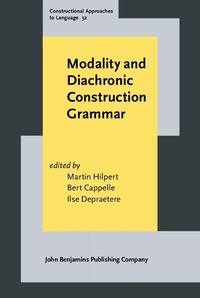
Modality and Diachronic Construction Grammar
1st Edition
Published on 12. October 2021
257 pages
978-90-272-5900-4 (ISBN)
Description

This volume explores how Diachronic Construction Grammar can shed new light on changes in a central and well-researched domain of grammar, namely modality. Its main goal is to show how constructional analyses can help us address some of the long-standing questions that have informed discussions of modal expressions and their development, and to illustrate the processes that are involved in these developments on the basis of data from languages such as English, Finnish, French, Galician, German, and Japanese. The studies in this volume are organized around three interrelated topics. The first of these concerns the organization of modal constructions in a network. A second focus area of the studies in this volume concerns the developmental pathways that modal constructions follow diachronically. The third topic that ties the contributions of this volume together is the contrast between constructionalization and constructional change.
More details
Other editions
Additional editions
Martin Hilpert | Bert Cappelle | Ilse Depraetere
Modality and Diachronic Construction Grammar
Book
10/2021
John Benjamins Publishing Co
€119.20
Shipment within 10-15 days
Content
- Intro
- Modality and Diachronic Construction Grammar
- Editorial page
- Title page
- Copyright page
- Table of contents
- Modality in Diachronic Construction Grammar: Long-standing questions, new perspectives
- 1. Introduction
- 2. The contributions in this volume
- 3. Concluding remarks
- References
- Contractions, constructions and constructional change: Investigating the constructionhood of English modal contractions from a diachronic perspective
- 1. Introduction
- 2. English modal verb contractions across textbooks, grammars and corpus-based studies
- 3. The constructionhood of modal contractions: Three case studies
- 3.1 Formal properties of contracted modal cxns
- 3.2 Corpus selection and outline for data exploration
- 3.3 Relative frequency distribution across time
- 3.4 Changes in the collostructional behavior of the alternations
- 3.5 Modelling speakers' choice between a contracted modal cxn and its full form
- 4. From contractions to constructions
- 5. Concluding remarks
- Acknowledgements
- Corpora, software, packages and scripts
- References
- Exploring relative degrees of auxiliarization empirically in German modal constructions with wissen and verstehen: Does host class expansion provide enough evidence?
- 1. Introduction
- 2. Problem statement: Host class expansion in grammaticalization studies
- 3. Case study
- 3.1 Constructions of dynamic modality with wissen and verstehen
- 3.2 Data
- 3.3 Response and fixed-effect variables
- 3.4 Mixed-effects model and random-effect variables
- 4. Results and discussion
- 5. Conclusion
- Abbreviations
- References
- Grammaticalization of verdienen into an auxiliary marker of deontic modality: An item-driven usage-based approach
- 1. Introduction
- 2. Theoretical background
- 2.1 Grammaticalization and constructional concepts
- 2.2 Deontic modality
- 3. Methods
- 3.1 Data and identification of constructions with verdienen
- 3.2 Simple collexeme analysis
- 3.3 Semantic classification of strongly attracted lexemes
- 4. Results
- 5. Discussion
- Lex1 and Lex2
- Movement along the grammaticalization path from LEX to GRAM
- Gram1 and Gram2
- 6. Conclusion
- Acknowledgements
- References
- Appendix
- The diachrony of Galician certamente and seguramente: A case of grammatical constructionalization
- 1. Introduction
- 2. Data and analytical categories
- 2.1 Manner uses
- 2.2 Epistemic uses
- 2.3 The strengthening use
- 2.4 The pragmatic use
- 2.5 A note on syntax
- 2.6 Ambiguities
- 3. Corpus findings
- 4. A constructionalization approach
- 4.1 The emergence of (inter)subjective adverbs
- 4.2 Seguramente: A new probability marker
- 5. Final remarks
- Acknowledgements
- Funding
- References
- Unfolding constructions: Postmodal auxiliaries in mirative complement patterns
- 1. Introduction
- 1.1 Objectives of the study
- 1.2 Data
- 2. Postmodality and mental accessing of complements
- 2.1 The modal and postmodal semantics of pouvoir and pitää
- 2.2 Interclausal chains
- 3. Interplay with the lexical semantics of the matrix
- 3.1 Pouvoirpm and pitääpm as markers of going-beyond-epistemic-limits
- 3.2 Pouvoirpm and pitääpm as markers of going-beyond-axiological-limits
- 4. Procedural meaning and interclausal cohesion
- 4.1 From modal possibility and necessity to postmodal asymmetrical relationships
- 4.2 The evolution of pouvoirpm and pitääpm as relational strategies
- 5. Discussion
- 6. Conclusion
- Acknowledgements
- Abbreviations
- The data collections used
- References
- Horizontal links within and between paradigms: The constructional network of reported directives in German
- 1. Introduction
- 2. Reported directives in German
- 3. Reported directives as a constructional network: Vertical and horizontal links
- 4. Data
- 5. Diachronic changes in horizontal links
- 5.1 Within the network of reported directives: Strengthening of horizontal connections
- 5.2 Paradigmatic opposition between reported statements and reported directives
- 6. Conclusions
- References
- Constructionalization of Japanese koto imperatives
- 1. Introduction
- 2. Japanese koto imperatives
- 2.1 Semantic properties of koto imperatives
- 2.2 Syntactic properties
- 3. Koto imperatives as an instance of constructionalization
- 4. Suspended clauses
- 5. Concluding remarks
- Acknowledgements
- Abbreviations
- References
- Index
