

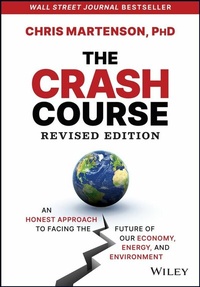
The Crash Course
Description

The world is experiencing a series of crises. In The Crash Course: An Honest Approach to Facing the Future of Our Economy, Energy, and Environment, Revised Edition, veteran executive and strategist Chris Martenson delivers an incisive and eye-opening exploration that explains why the reader needs to understand that it is the interconnectedness of the various crises that matters most. From energy shortages to climate instability, financial crises, supply chain disruptions, pandemics, war, and crop failures, you'll discover the common factor that is driving them all and how to adapt to volatile new realities and safeguard your own personal wealth, health, and community.
In the book, you'll find effective solutions for living with unpredictability and change, as well as:
* A workable framework for understanding the "how" and "why" of dramatic societal, environmental, and economic transformation
* A rich set of solutions, complete with examples, you can use to draw inspiration and motivation to act in your own life
* An expansive amount of new material, fully updated since the last edition
A transformative and thought-provoking strategic playbook for managing increasingly unexpected events, crises, and revolutions, The Crash Course, Revised Edition is an essential resource for anyone concerned about their retirement savings, the world's environment, as well as anyone hoping to become more independent and self-reliant.
More details
Other editions
Additional editions
Person
Content
Introduction
Part I: How to Approach the Next Twenty Years
Chapter 1 The Coming Storm
Chapter 2 The Lens: How to See the Future
Chapter 3 A World Worth Inheriting
Chapter 4 Trust Yourself
Part II: Foundation
Chapter 5 Dangerous Exponentials
Chapter 6 Problems versus Predicaments
Chapter 7 An Inconvenient Lie: The Truth about Growth
Chapter 8 Complex Systems
Chapter 9 Our Money System
Chapter 10 What Is Wealth? (Hint: It's Not Money)
Part III: Economy
Chapter 11 Debt
Chapter 12 The Great Credit Bubble
Chapter 13 Like a Moth to Flame: Our Destructive Tendency to Print
Chapter 14 Fuzzy Numbers
Chapter 15 Crumbling Before Our Eyes: The Story of Concrete
Part IV: Energy
Chapter 16 Energy and the Economy
Chapter 17 Peak Oil
Chapter 18 Shale Oil
Chapter 19 Necessary but Insufficient: Coal, Nuclear, and Alternatives
Chapter 20 Why Technology Can't Fix This
Part V: Environment
Chapter 21 Minerals: Gone with the Wind
Chapter 22 Soil: Thin, Thinner, Gone
Chapter 23 Parched: The Coming Water Wars
Chapter 24 All Fished Out
Chapter 25 What Do You Mean We're Running Out of Sand? Strange but True
Part VI: Convergence
Chapter 26 Where Have All the Insects Gone? Silence of the Lamps
Chapter 27 The Bumpy Path to 2030
Part VII: What Should I Do?
Chapter 28 The Good News
Chapter 29 Closing the Book on Growth
Chapter 30 What Should I Do?
Chapter 31: Build Up Your Capital!
Appendix
Notes
Index
CHAPTER 2
The Lens: How to See the Future
I would like to share with you the method of thinking that led me to buy an irresponsible quantity of gold and silver in 2001, allowed me to skirt the worst of the 2008 financial crisis, and why I now live on a farm in rural Massachusetts. When I am not working at my desk to serve the community assembled at PeakProsperity.com, my partner Evie and I work daily to increase our resilience so that we cannot just survive the coming years and decades, but thrive while we help others do the same.
This method is a "lens" through which the world can be viewed. It combines the economy, energy, and the environment-which I introduced in Chapter 1 (The Coming Storm) as the three Es-into a single, comprehensive whole. It is a systems-level approach, but one founded on common sense instead of complicated math. If you want to make any sense of the world at all, then the deep expertise of the narrow specialists dominating the mainstream media must be set aside in favor of a generalist's panoramic view. If you find it compelling, then it might change your life and how you see the world, as it has for thousands of other people. If it's not your cup of tea, then that's perfectly fine, too; we need lots of different viewpoints to get through these next few trying years.
The first E, the economy, is founded on a workable understanding of how our money system actually operates, as well as basic economic information about debt, savings, and inflation. Not too much information; just enough to allow you to assess the sustainability of our current trajectory so you can undertake new actions and make new decisions.
Much of this analysis springs from the observation that our particular style of economy is hooked on growth. It needs growth the way some sharks must keep swimming because without constant movement, they'll die. Our financial system isn't addicted to just any kind of growth, but perpetual exponential growth, which is a peculiar thing because that's an impossibility; nothing grows exponentially forever. Or even for all that long.
As you may have noticed, world events seem to be speeding up and becoming ever more chaotic, if not urgent. I believe a thorough understanding of exponential growth helps to explain what's happening. If you are interested in peering into the future with the intent of predicting how it will unfold, you must learn this concept, and how and why it relates to our system of money and, by extension, economy.
Even if we were to limit ourselves to examining just the economy while completely ignoring energy and the environment (as most professional economists do), I could make a compelling case that after the past 50 years our accumulated debts and fiscal mismanagement now comprise the most daunting structural challenges ever in history. As well, there are demographic issues to factor (such as aging populations cashing in and checking out) that make the whole thing look like a rather poorly designed pyramid scheme. The developed world made a collective and colossal bet that the future economy will be a lot larger to pay it all back. But will it?
That's a good question. When we bring in the second E, energy, the story quickly falls apart. Our economy is dependent on growth, and petroleum-oil-is the undisputed king of fuels that drives economic expansion. It has no substitutes, no replacements waiting in the wings, and it is indisputably depleting. As of this writing, there are simply zero credible plans for how alternative or "clean" energy will move from interesting side shows to being the main act. The European natural gas crisis of 2022 revealed that for all of Germany's hundreds of billions of dollars of investments in wind and solar, those technologies were not even remotely close to being able to power the country.
Further, there is growing alignment between various government and private institutions on when Peak Oil will arrive, after which the irreversible decline in oil production will start and last . forever. This does not mean we'll "run out of oil" all at once; it means that despite our best and even heroic efforts, gradually less and less oil will be extracted each year, at higher and higher costs. If oil is depleting but our debt loads and economic system require more oil to fund more growth in order to avoid collapsing, then how does this "pencil out," as they say? It doesn't. And that's why I wrote this book: to alert you to a quite obvious, but little appreciated, systems-level impossibility.
Oil is not the only critical resource that will be in shorter-than-hoped-for supply in the future.
Literally dozens of essential minerals and other natural resources found in the third E, the environment (such as silver, copper, cobalt, lithium, and phosphorus) will peak right alongside oil. Many hold out hope that perhaps Elon Musk's electric cars will help save the day, but even the most rudimentary of calculations reveal that getting enough cobalt-an irreplaceable battery component-will be a huge problem. The known reserves simply don't exist.
Again, this is not a story of "running out;" this is a story of resources not being available in sufficient reserves or remaining concentrations to simply step in and take over all the heavy lifting oil provides so perfectly. We'll have to make other arrangements. That's not necessarily a bad thing, but if all your retirement dreams and hopes for your offspring are rooted in the idea that things will carry on as they have, you will be unpleasantly surprised by what the future holds. Forewarned is forearmed.
As fewer and fewer resources are wrested out of the earth to sustain the economy, it will begin to shudder and then shrink.
Will all economic activity cease with the depletion of a few key elements? No, of course not. But neither can our economy continue to operate in precisely the same way that it did when demand alone dictated supply-a system that was based on exponential growth. When that stops, our debt-based financial system will cease to function as it has for the past few hundred years. Perhaps it won't operate at all and, to be honest, nobody really knows for sure what's going to happen.
It's a really big change and I'm not at all confident anybody in power has any sort of a workable plan. The fact that so many of them have built bunker properties on island nations of late should tell you they don't have full confidence in their plans either.
More worryingly, we are in the midst of several ecosystem collapses and species losses happening with staggering speed. The insect apocalypse is terrifying, with bees and butterflies getting a lot of the attention, but countless smaller and less flashy insect species are also in steep declines. We're busily overseeing the dismantling of a 450-million-year-old food chain, and nobody has the slightest clue what the impacts might be. Worst of all, practically nobody seems to know the cause and even fewer are trying to figure out what it might be.
Droughts and floods now plague our living and agricultural areas with increasing frequency and intensity, raising fears that we might be entering a new era of climate chaos.
A wealth of data suggests a period of profound change is already upon us that warrants the attention of every serious long-term investor and prudent adult with an eye on the future. We can no longer constrain our thinking to just one E, the economy; we must include the other two Es, energy and the environment. Each of the three Es depends on the other two. They are utterly intertwined and interdependent, and that's why we need to consider them together, all at once.
For far too long, economists behaved as if the economy was an independent system. It is not. It is a subset of the larger world. I attribute all of my success at predicting the unfolding events to the fact that I hold this larger, more complete, and therefore more useful and even predictive view of the world. To understand the economy, we have to understand energy and the environment. Once we see the role of energy in promoting economic growth and complexity (which we'll get into in some detail later) we will be in a position to assess future prospects that might inhibit or reverse the growth.
When we do, we are using what I call "the lens." The critical insight achieved from using this tool brings the understanding that continued economic growth is absolutely essential for our financial system to avoid collapsing, but is also an impossibility. This is the primary tension of our times. The implications are both profound and numerous.
Once I adopted this lens, I found myself unable to put it completely aside. It shapes my thinking and my decisions and is the primary means by which I make sense of new information when it becomes available.
As a scientist, I have constantly sought evidence that this view, this lens, might be wrong, but the data continues to pile up in its favor.
Of course, if new information comes along and proves this lens to be mistaken or misleading I would change my thinking. But as the information has rolled in over the past several years, the validity of this view has only been confirmed and reinforced.
My big picture conclusion: The next few years and decades will be shaped by Resource...
