

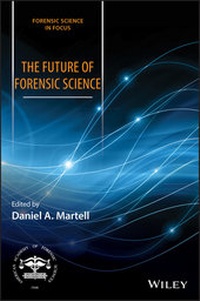
The Future of Forensic Science
Description

This one-of-a-kind book is a collection of content from the Past and Current Presidents of the American Academy of Forensic Sciences--providing readers with all of their forensic science experience, knowledge, insight, and wisdom. It envisions where forensic science will be a decade from now and the impact of these emerging advances on the law (along with our place in it), emphasizing theoretical advances, innovative leads from the laboratory, and emerging technologies.
Filled with information from some of the greatest forensic minds of their generation, The Future of Forensic Science covers all of the eleven sections that comprise the AAFS. It discusses new directions in forensic anthropology, and looks at the future of such disciplines as criminalistics, forensic engineering science, forensic psychiatry and behavioral science, forensic toxicology, and forensic document examination. It also touches on the current and future state of digital and multimedia sciences.
* Contains contributions from an eminent group of forensic science experts
* Presents a valuable repository of forensic science experience, knowledge, insight, and wisdom
* Offers an insightful interdisciplinary look at the future of forensic science and how it is changing forensic science for the better
* Timed to coincide with the NIST forensic science initiative and the OSAC process
The Future of Forensic Science is a must-have book for practicing forensic science professionals, academics, and advanced undergraduate and graduate students in forensic science.
This book is published as part of the AAFS series 'Forensic Science in Focus'.
More details
Other editions
Additional editions
Person
Edited by
Daniel A. Martell, PhD, is a Past President of the American Academy of Forensic Sciences, and Professor at the Semel Institute for Neuroscience and Human Behavior, David Geffen School of Medicine at UCLA. He is Board-Certified in Forensic Psychology by the American Board of Professional Psychology; a Fellow of the American Academy of Forensic Psychology; a Fellow of the National Academy of Neuropsychology; and a Fellow of the American Academy of Forensic Sciences. He is also a consultant for the United Nations International Criminal Court in The Hague.
Content
Notes on contributors xi
Series preface xix
Preface xxi
1 New directions in forensic anthropology 1
Douglas H. Ubelaker
1.1 Introduction 1
1.2 Detection and recovery 3
1.3 Determination of human status 4
1.4 Age at death 6
1.5 Time since death 7
1.6 Sex estimation 8
1.7 Ancestry 9
1.8 Living stature 9
1.9 Postmortem history 10
1.10 Positive identification 10
1.11 Foul play 11
1.12 Certification 12
1.13 Conclusion 13
Acknowledgments 14
References 14
2 Some thoughts on the future challenges to criminalistics 19
Ronald L. Singer
2.1 Introduction 19
2.2 Technological advances 20
2.2.1 Computers software and databases 20
2.2.2 DNA 21
2.2.3 Impression evidence 21
2.2.4 Instrumentation 22
2.3 Quality issues 23
2.3.1 NAS Report 23
2.4 Financial burdens 24
2.4.1 Seeking additional sources of grant funding 25
2.4.2 Staffing 25
2.4.3 Regionalization 26
2.4.4 Consolidation 26
2.4.5 Cost recovery 27
2.4.6 Privatization 28
Acknowledgments 29
References 29
3 Digital and multimedia sciences 31
Zeno Geradts
3.1 Introduction 31
3.2 History 33
3.3 Digital evidence 35
3.4 Damaged (mobile) devices 37
3.5 Multimedia 38
3.5.1 Deep learning (Hinton et al. 2006) 39
3.5.2 Camera identification 40
3.5.3 Other biometrics 41
3.6 Wearables and quantified self 41
3.7 Drones 41
3.8 Sensors 42
3.9 Geo satellites 42
3.10 Disasters/large scale incidents 42
3.11 Quality assurance 43
3.12 Challenges 43
References 44
4 A look at the future of forensic engineering science 49
Thomas L. Bohan
"The future": a preface 49
4.1 Junk law in the courtroom 50
4.2 Forensic engineering sciences and needs of the modern world at large 55
Acknowledgments 58
References 58
5 General section history: look at two disciplines and a review of standards certifications and education 61
John E. Gerns
5.1 Introduction 61
5.2 Forensic veterinary science 62
5.3 Certification: introduction 66
5.4 Certification-ABMDI 66
5.5 Standards evolution-OSAC 68
5.6 Standard evolution-ASB 69
5.7 Education accreditation 70
5.8 Summary 71
Acknowledgements 72
References 72
6 The future of forensic science: hot leads in contemporary forensic research: Jurisprudence 73
Carol Henderson
6.1 Daubert's history 75
6.2 The Daubert test 77
6.3 Questions raised by Daubert 77
6.4 The NAS report 78
6.5 The national commission on forensic science and the organization of scientific area committees 80
6.6 NCFS 80
6.7 OSAC 82
6.8 The path forward for judicial and legal education in forensic science 84
Acknowledgments 87
References 87
7 Forensic odontology 91
Robert E. Barsley
7.1 Introduction 91
7.2 Roles of the forensic odontologist 92
7.3 Current considerations 94
7.4 Identification by teeth 96
7.5 Dental age assessment 104
7.6 Bitemarks 105
7.7 Abuse and negligence 107
7.8 Closing 107
8 Opportunities and problems faced in forensic pathology 109
Edmund R. Donoghue
8.1 Opportunity: radiology technology and computer imaging 109
8.2 Threat: dropping forensic pathology training requirement for anatomic pathology 110
8.3 Threat: maintenance of certification could see some forensic pathologists unemployed 111
8.4 Threat: standards are becoming increasingly detailed and rigorous 112
8.5 Threat: forensic: overregulation by federal government and other entities 112
8.6 Conclusion 112
9 The future of forensic psychiatry and behavioral science 113
Richard Rosner
9.1 The BRAIN initiative 114
9.2 The law and the human mind 114
9.3 Correlation is NOT causation 115
9.4 Theories of consciousness 115
9.5 The hard problem of consciousness 116
9.6 Consciousness and the failure of the physical sciences 117
9.7 The problem of free will 118
9.8 The bottom line 119
References 119
10 The future of forensic document examination 121
John L. Sang Linton A. Mohammed and Carl R. McClary
10.1 What is a forensic document examiner (FDE)? 121
10.2 Origins of questioned document examination 123
10.3 Albert S. Osborn and the formation of the American Society of Questioned Document Examiners (ASQDE) 125
10.4 Ordway Hilton and the formation of American Academy of Forensic Sciences (AAFS) 126
10.5 Questioned documents and the formation of the International Association of Forensic Sciences (IAFS) 128
10.6 Key issues 128
10.6.1 Certification 128
10.6.2 Standardization 129
10.7 Standards of practice 132
10.8 The Daubert standard and FDE 135
10.9 How FDE meets Daubert 137
10.9.1 Standards 137
10.9.2 Error rate/reliability 138
10.9.3 Testing of basic principles 139
10.9.4 Peer review and publication 142
10.9.5 General acceptance in the forensic community 143
10.10 Research in FDE 144
10.10.1 Neuroscience 144
10.10.2 Eye tracking 146
10.11 Signature and handwriting verification systems 148
10.12 Automation in the forensic examination of handwriting 148
10.13 Current research 149
10.14 Conclusion 150
10.14.1 The public and how law and forensics will be shaped 150
10.14.2 Research 151
10.14.3 Research in other document examinations 151
References 152
Further readings 155
Measurement science and standards in forensic handwriting analysis - U.S. Commerce Department's National Institute of Standards and Technology (NIST) Symposium June 2013 presentations 157
11 Past perspectives and future directions in forensic toxicology 159
Barry K. Logan F-ABFT
11.1 Our history 159
11.2 Reflections on factors affecting our future direction 163
11.3 Facing forward 167
11.3.1 Laboratory resources and the role of the Federal Government 168
11.3.2 Standards development and harmonization of best practices 168
11.3.3 Technology 169
11.3.4 Training research and interdisciplinary collaboration 171
11.4 Conclusion 173
Acknowledgments 174
Index 175
Notes on contributors
Bob Barsley, has been continually licensed in Louisiana to practice dentistry since 1977 and to practice law since 1987. He is a tenured Professor at LSU where he has been full-time faculty since 1882. He is a fellow of the American College of Dentists, the International College of Dentists, the Pierre Fauchard Academy, and the Odontology Section of the American Academy of Forensic Sciences. He has also served as a Robert Wood Johnson Foundation Congressional Health Policy Fellow in the office of Senator John Breaux. He is a past president, past Speaker of the House, and a past secretary/treasurer of the Louisiana Dental Association. He is the immediate past Chair of the Council of Scientific Society Presidents in Washington, DC.
Dr. Barsley has also served as Acting State Dental Director of the Louisiana Office of Public Health and as the Chief Compliance Office for the LSU Health Sciences Center. He has held numerous officers in various forensic organizations and is a past president of the American Academy of Forensic Sciences, past Treasurer of the Forensic Science Foundation, and is a past president of the American Board of Forensic Odontology and of the American Society of Forensic Odontology. He has been a member of the Journal of Forensic Sciences Editorial Board for many years and is a frequent guest reviewer for the Journal of the American Dental Association and the Journal of Dental Education. He was named by NIST to chair the Odontology Subcommittee of the Organization of Scientific Area Committees under the auspices of the Forensic Sciences Standards Board. He served as the magistrate judge for the Ponchatoula City Court for nine years.
Thomas L. Bohan, Ph.D., J.D., holds his physics PhD from the University of Illinois-Urbana/Champagne and his law degree from the University of New Hampshire School of Law. He has authored books and peer-reviewed papers in the scientific and legal professional literature. Reflecting his interest in forensic science and its admission into evidence, these publications include early commentary on the Daubert decision and an extensive review of the 2009 National Academy of Science report Forensic Science in the United States.
While president of the American Academy of Forensic Sciences (2009-2010), he sought to make the Academy a partner in the forensic-science reform called from by the report. Later, while president of the Forensic Specialties Accreditation Board (2015-2017), he oversaw the revision of that organization's standards so as to limit the board's offer of accreditation to those Conformity Assessment Bodies that certified forensic practices that are reliable and reproducible. He resides in Casco Bay's Peaks Island in the State of Maine.
Edmund R. Donoghue, M.D. is a forensic pathologist and regional medical examiner for the Georgia Bureau of Investigation in Savannah, GA. Dr. Donoghue is a graduate of the University of Notre Dame and the Medical College of Wisconsin. He received postgraduate medical specialty training at the Mayo Clinic, the Wayne County Medical Examiner's Office, and the Armed Forces Institute of Pathology. For 30 years he was employed by the Office of the Medical Examiner of Cook County in Chicago, IL, and for the last 14 of those years he was chief medical examiner.
Dr. Donoghue is certified by the American Board of Pathology in anatomic and forensic pathology. He served as a clinical professor of forensic pathology at the University of Illinois at Chicago. He has served as president and chair of the board of directors of the National Association of Medical Examiners. Dr. Donoghue is a past president of the Chicago Medical Society, the Georgia Medical Society, and the American Academy of Forensic Sciences.
Zeno Geradts is a senior forensic scientist at the department of Digital and Biometric Traces of the Netherlands Forensic Institute. He is for one day a week full professor by special chair of forensic data science at the University of Amsterdam. His research interests are the use of deep learning and artificial intelligence in forensic science in interpreting images and data.
He is president elect of the American Academy of Forensic Sciences 2018-2019 and will be the 2019-2020 president of the AAFS. Furthermore, he is associate editor of the Journal of Forensic Sciences, and chairman of the European Network of Forensic Science (ENFSI) Forensic IT working group.
John Gerns is past president of the AAFS and sat on the AAFS Executive Committee and the board of directors. He has been with the AAFS since 1983 and became a Fellow in 1992. He is an Adjunct Professor for Central Texas College and the University of Maryland University College where he teaches Forensic Science and Criminal Justice. In addition, he provides forensic science consultation on violent crimes.
Prior to his retirement on 30 September 2013, he was the Investigations and Operations Consultant assigned to the Fourth Field Investigations Squadron, Vogelweh, Germany. He has extensive training and experience in major investigations involving death, child physical and sexual abuse, sexual assault, mass grave exhumations, along with crime scene processing and reconstruction. Special Agent Gerns' assignments have included Command Forensic Advisor, Director of Criminal Investigations, Director of Investigative Specialties, Forensic Consultant to International Criminal Tribunal for the former Yugoslavia (ICTY), and Chief of Death Investigations. His primary role during that period was ensuring the latest innovations in the forensic sciences were applied to AFOSI's investigative mission.
Carol Henderson is the founding director of the National Clearinghouse for Science, Technology, and the Law, and a professor of law at Stetson University College of Law. Professor Henderson has presented more than 300 lectures and workshops worldwide on scientific evidence, courtroom testimony, and professional responsibility. She has more than 90 publications including "Sleuthing Scientific Evidence Information on the Internet," 106 Journal of Criminal Law and Criminology59 (2016) and "Future Focus for Forensic Science," a special issue of The Sci Tech Lawyer (2017).
Professor Henderson has appeared in national media as a legal analyst and testified before the US Congress. She served as the president of the American Academy of Forensic Sciences (2008-2009) and presently serves on the ABA's Science and Technology Law Section Council. She is the deputy editor-in-chief of The SciTech Lawyer. She also serves on the ABA Judicial Division Forensic Science Committee and as faculty for the National Judicial College. In February 2019, she received the American Academy of Forensic Sciences Distinguished Fellow award.
Barry K. Logan PhD, is chief scientist at NMS Labs and executive director of the Center for Forensic Science Research and Education in Willow Grove PA. He has authored or coauthored over 120 publications, and his current research interests are in the area of Novel Psychoactive Substances, and Drug and Alcohol Impaired Driving.
He holds academic appointments at Indiana University, where he directs the Robert F. Borkenstein Course on Alcohol, and at Thomas Jefferson University where he is director of the Forensic Toxicology Professional Science Masters Program. He served as president of the American Academy of Forensic Sciences between 2013 and 2014.
Daniel A. Martell, Ph.D., A.B.P.P. is a forensic neuropsychologist who has specialized experience applying diverse knowledge to cases involving forensic neuroscience and human behavior. He is Board-Certified in Forensic Psychology by the American Board of Professional Psychology; a Fellow of the American Academy of Forensic Psychology; and a Fellow of the National Academy of Neuropsychology; a Fellow of the Royal Society of Medicine in London; and a Fellow and Past President of the American Academy of Forensic Sciences.
He is a member of the Clinical Faculty in the Department of Psychiatry and Biobehavioral Sciences at the Semel Institute for Neuroscience and Human Behavior at the David Geffen School of Medicine at UCLA.
Examples of his expertise in criminal cases include brain damage and crimes of violence, mass murderers and serial killers, violent sexual predators, and capital habeas corpus appeals litigation. He is particularly experienced with dozens of cases involving determinations of Intellectual Disability and the death penalty pursuant to Atkins v. Virginia, having been the prosecution's expert in that landmark case. His experience in civil litigation includes damages determinations in mass torts, lawsuits arising from clergy abuse, corporate civil and products liability, employment law, and elder law cases involving testamentary capacity and undue influence.
Carl R. McClary is a senior forensic document examiner and technical lead with the Bureau of Alcohol, Tobacco, Firearms, and Explosives forensic science laboratory in Atlanta, Georgia. He is a member of the Questioned Documents consensus body of the Academy Standards Board (ASB) and former chair of the E30.02 Questioned Documents subcommittee of the American Society for Testing and Materials International (ASTM). Some of his recent research focus has been on document examiner aptitude in determining stroke velocity rates in handwriting, opinion terminology standardization, and forensic science training development and standardization. He is the current treasurer of the American Academy of...
