

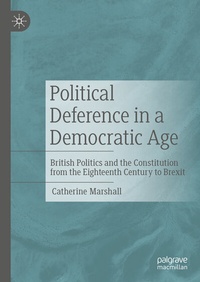
Political Deference in a Democratic Age
Description

This book explores the concept of deference as used by historians and political scientists. Often confused and judged to be outdated, it shows how deference remains central to understanding British politics to the present day. This study aims to make sense of how political deference has functioned in different periods and how it has played a crucial role in legitimising British politics. It shows how deference sustained what are essentially English institutions, those which dominated the Union well into the second half of the twentieth century until the post-1997 constitutional transformations under New Labour. While many dismiss political and institutional deference as having died out, this book argues that a number of recent political decisions - including the vote in favour of Brexit in June 2016 - are the result of a deferential way of thinking that has persisted through the democratic changes of the twentieth century. Combining close readings of theoretical texts with analysesof specific legal changes and historical events, the book charts the development of deference from the eighteenth century through to the present day. Rather than offering a comprehensive history of deference, it picks out key moments that show the changing nature of deference, both as a concept and as a political force.
Reviews / Votes
"[Marshall] takes her readers on an institutional and political journey from aristocratic deference in the Victorian Age to egalitarian deference in a democratic age, using her expertise in the history of ideas in mid-Victorian England and British history generally. . Well written, this book, while dealing with technical legal and political concepts, remains throughout highly accessible to all readers." (Elizabeth Gibson-Morgan, Revue Française de Civilisation Britannique, Vol. 27 (3), 2022)
"Her timely book offers a rare combination of comprehensive historical scholarship and critical political insight which makes it indispensable reading for those interested in both the past and the present of Anglo-British constitutionalism. It deserves, indeed, to become a standard reference work on that subject." (Noel O'Sullivan, Cercles, cercles.com, March 15, 2021)
More details
Other editions
Additional editions
Person
Catherine Marshall is Professor of British Studies at CY Cergy Paris Université, France. Her research focuses mainly on the history of ideas in mid-Victorian England and the legacy of some of those ideas on twentieth and twenty-first century Britain. She teaches British history and the history of political ideas.
