

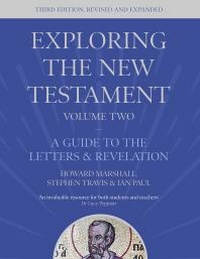
Exploring the New Testament, Volume 2
Description

'An invaluable resource for both students and teachers.'
Dr Lucy Peppiatt
Tried, tested and trusted by students and teachers across the world, this widely respected study guide enables the reader to engage with an array of essential topics, including:
· the Greco-Roman background to ancient letter writing
· the content and major themes of Paul's life, mission and theology
· issues of authorship, date and setting
· well established and newer methods of study
· the intersection of New Testament studies with contemporary issues of faith and culture
Now in its third edition, this popular textbook has been fully revised and updated, and includes new sections on:
· the theological links between Jesus and Paul
· major recent discussions on Pauline theology
· developments in scholarship of the New Testament
· updated bibliographies, highlighting the most important and influential works published in the past decade
Drawing on the authors' decades of experience in teaching these topics, this comprehensive textbook gives students a strong understanding and a solid foundation for further study.
More details
Other editions
Additional editions
Persons
Howard Marshall (1934-2015) was Professor Emeritus of New Testament Interpretation at the University of Aberdeen.
Ian Paul is Adjunct Professor of New Testament at Fuller Theological Seminary, California. His recent publications include The Book of Revelation Tyndale New Testament Commentaries (IVP, 2018) and How to Interpret the Bible (Grove, 2017).
Stephen Travis is a former Vice Principal and Lecturer in New Testament at St John's College, Nottingham. His recent publications include But What About God's Wrath? (IVP, 2019), co-authored with Kevin Kinghorn.
Content
- Intro
- Title Page
- Copyright Page
- Contents
- List of illustrations
- How to use this book
- A Setting the Scene
- 1. The world of first-century Christians
- How do we know what we know?
- The emergence of Roman power
- A century of civil conflict
- Augustus' successors
- The Julio-Claudian dynasty
- The Flavian dynasty
- Government of the empire
- The provinces
- Client kingdoms
- Cities and colonies
- The power of propaganda
- The army
- The legions
- Auxiliaries
- The praetorian guard
- Roman society
- Citizenship
- Classes
- Women
- Patrons and clients
- Honour and shame
- Language and culture
- Entertainment
- Religion and philosophy
- Traditional religion
- Healing cults
- Mystery religions
- Fate, astrology and magic
- The imperial cult
- Cynics, Stoics and Epicureans
- Romans, Jews and Christians
- Essay topics
- Further reading
- B. Paul and His Letters
- 2. Letters in the New Testament
- Ancient letter-writing
- The format of letters
- The format of Paul's letters
- Opening
- Thanksgiving
- Body
- Closing
- Letters or sermons?
- Letters of recommendation or introduction?
- Other New Testament letters
- Further reading
- 3. Paul, his letters and his life
- Where can we learn about Paul?
- Material from outside the New Testament
- The Acts of the Apostles
- The letters of Paul
- Difficulties in the Pauline letters
- Were the letters all written by Paul?
- Do we have the letters in their original form?
- Is Paul a reliable informant about himself?
- Early days
- Paul's call and conversion
- Paul as a missionary
- Paul the captive
- Problems of chronology
- Essay topics
- Further reading
- 4. The letter to the Galatians
- What led to the writing of the letter?
- The structure of the letter
- Paul's argument in the letter
- Was the letter effective?
- 'New perspective' readings of Paul
- To whom was the letter sent?
- When was the letter written?
- Consequences for the date of the letter
- For today's Galatians
- Essay topics
- Further reading
- 5. The letters to the Thessalonians
- Paul and Thessalonica
- The contents of 1 Thessalonians
- The contents of 2 Thessalonians
- Problems in 2 Thessalonians
- For today's Thessalonians
- Essay topics
- Further reading
- 6. The 'first' letter to the Corinthians
- Paul's mission
- The 'previous' letter
- Getting behind the second (first) letter
- Continuing immorality
- Party squabbles in the congregation
- The rich and the poor
- 'Strong' and 'weak' believers
- Spiritual superiority and inferiority
- Questions about the resurrection
- Surveying 1 Corinthians
- Party spirit
- Immorality and litigation
- Sexual and marital issues
- Food offered to idols
- Congregational meetings
- Spiritual gifts
- The resurrection
- In conclusion
- For today's Corinthians
- Essay topics
- Further reading
- 7. The 'second' letter to the Corinthians
- An overview of the problems
- The events leading up to 2 Corinthians 1-7
- Identifying the tearful letter
- Survey of 2 Corinthians 1-7
- Thanksgiving (Berakah)
- The rift with the congregation
- The nature of apostleship
- Resuming the story
- 2. Corinthians 8 and 9
- More fragmentary letters?
- The problem of 2 Corinthians 10-13
- The occasion of 2 Corinthians 10-13
- For today's Corinthians
- Essay topics
- Further reading
- 8. The letter to the Romans
- The purpose of the letter
- The nature of the argument in the letter
- An overview of the letter
- The opening (and the closing) (Rom. 1:1-15
- 15:14-16:27)
- The text is announced! (Rom. 1:16-17)
- Universal sin and guilt (Rom. 1:18-3:20)
- The main proposition (Rom. 3:21-31)
- Abraham as an example of faith (Rom. 4:1-25
- The results of justification (Rom. 5:1-11)
- Christ contrasted with Adam (Rom. 5:12-21)
- No longer under sin and under the law (Rom. 6:1-23)
- The law is good - but impotent (Rom. 7:1-25)
- New life by the Spirit (Rom. 8:1-39)
- The problem of Jewish unbelief in the gospel (Rom. 9-11)
- Practical implications of the new life (Rom. 12-13)
- Jews and Gentiles living together in the same congregation (Rom. 14:1-15:13)
- Paul's mission - to Rome and beyond (Rom. 15:14-33)
- Closing greetings (Rom. 16:1-27)
- Scribes do strange things
- Again - the purpose of the letter
- The composition of Romans
- The problems of Romans 16
- Two versions of one letter
- Two separate letters
- For today's Romans
- Essay topics
- Further reading
- 9. The letter to the Philippians
- Paul and the congregation at Philippi
- Paul's situation
- The situation and needs of the church
- Attacks on the church
- Tensions within the church
- A rival version of the gospel
- The structure of the letter
- Philippians as a letter
- Philippians as an example of rhetoric
- The development of the message
- Philippians - one letter or several fragments?
- For today's Philippians
- Essay topics
- Further reading
- 10. The letter to Philemon
- Paul, Philemon and Onesimus
- The structure of the letter
- The outcome
- For a twenty-first-century Philemon
- Essay topics
- Further reading
- 11. The letter to the Colossians
- The planting of the congregation
- Why was the letter written?
- The 'philosophy'
- The structure of the letter
- Paul's teaching in the letter
- Paul's circumstances
- Other possible places of origin
- Did Paul write Colossians?
- Arguments against Pauline authorship
- Arguments in favour of Pauline authorship
- For today's Colossians
- Essay topics
- Further reading
- 12. The letter to the Ephesians
- To whom was the letter sent?
- What is the letter?
- The unity of the church
- 'Power' language
- The structure of the letter
- A quick survey of the letter
- Who wrote the letter?
- Arguments against Pauline authorship
- Arguments for Pauline authorship
- Weighing the probabilities
- For today's Ephesians
- Essay topics
- Further reading
- 13. The letters to Timothy and Titus
- Letters that are somehow different
- The problem of non-Pauline authorship
- To whom were the letters written?
- When were the letters written?
- What are the letters about?
- The structure of the letter to Titus
- An overview of Titus
- The structure of 1 Timothy
- An overview of 1 Timothy
- The structure of 2 Timothy
- An overview of 2 Timothy
- What is the situation reflected in the letters?
- Opposition and heresy
- The development of church order
- Christian living and pastoral care
- Language and style
- The theology and the way it is expressed
- Evaluating the evidence
- Not by Paul?
- Written or dictated by Paul?
- A middle way?
- For today's congregational leaders
- Essay topics
- Further reading
- 14. Paul- the missionary theologian
- Paul as an apostle
- Humanity and its need
- Creation
- Human nature
- Sin
- Getting right with God
- Justification by works
- Covenantal nomism
- The marks of belonging
- Paul's radical alternative
- The language of salvation
- Sacrifice
- Justification
- Redemption
- Reconciliation
- Salvation
- Faith
- The new life of believers
- God as Father
- 'In Christ'
- The work of the Spirit
- Theological implications for Paul's understanding of God
- The community of believers
- Ministry and the functions of the church
- What principles shape Christian behaviour?
- Five general principles
- The new way of life
- Some specific areas of concern
- Relations between men and women
- Slavery
- The state
- Money and possessions
- The future for the world and believers
- The missionary obligation
- Essay topics
- Further reading
- 15. New Testament letters - interpretation and authorship
- Understanding what we read in New Testament letters
- Two related activities
- Speeches in the form of letters?
- Entering into the situation
- Getting the message
- Critical methods in the study of the New Testament
- Historical criticism
- Form criticism
- Source criticism
- Redaction criticism
- Textual criticism
- Canonical criticism
- Literary criticism
- Socio-rhetorical criticism
- Reception history and reader-response criticism
- Ideology criticism
- The question of pseudonymity
- The traditional view
- Alternative suggestions
- Further reactions
- Essay topics
- Further reading
- C. Letters by Other Church Leaders
- 16. The letter to the Hebrews
- Clues about the recipients
- What kind of a document?
- The structure and argument of Hebrews
- Theological themes of Hebrews
- The high priest and his sacrifice
- Other perspectives on Jesus
- Salvation and the Christian hope
- Discipleship
- Special issues
- The author's thought-world
- Is Hebrews anti-Jewish?
- Where were the readers located?
- Who wrote the letter?
- Some issues for today
- Essay topics
- Further reading
- 17. The letter of James
- The character of the letter of James
- James as exhortation or 'parenesis'
- James as wisdom
- James as a letter
- The structure of the letter
- Who wrote the letter?
- To whom was the letter addressed? Why, and when?
- Jewish Christians in Palestine?
- Jewish Christians in the Dispersion?
- James and the teaching of Jesus
- James and Paul
- Themes in James
- God
- Jesus
- Living with integrity
- The law
- The testing of faith
- Poverty and wealth
- Some issues for today
- Essay topics
- Further reading
- 18. The first letter of Peter
- Outline of the letter
- The situation of the recipients
- What was the nature of their suffering?
- The letter's message to the church
- Christian existence in a hostile environment
- The grace of God in Christ
- The household of God
- God's people
- Facing suffering
- Christian responsibilities
- Who wrote 1 Peter? Assessing the arguments
- Some issues for today
- Essay topics
- Further reading
- 19. The second letter of Peter and the letter of Jude
- What do these letters have in common?
- The letter of Jude - its purpose
- The false teachers
- Jude's strategy for advising his readers
- Who wrote this letter?
- 2 Peter - genre and outline
- 2 Peter - the problem of authorship
- The false teachers in 2 Peter
- The purpose and theology of 2 Peter The hope of Christ's coming
- Some issues for today
- Essay topics
- Further reading
- 20. The letters of John
- 1 John - background and authorship
- Is the author of 1 John the same as the author of the Fourth Gospel?
- The location of the author and his readers
- The circumstances addressed in 1 John The nature of the false teaching
- John's response to the false teaching
- The purpose and shape of 1 John
- Some issues for today
- 2 and 3 John - their relation to 1 John
- The context and content of 2 John Hospitality to missionaries
- The context and content of 3 John
- 3 John - evidence of an emerging pattern of church leadership?
- Essay topics
- Further reading
- D. Apocalyptic Literature
- 21. The Revelation to John
- Language and genre
- Historical context and dating
- Dating
- Authorship
- Context
- Theological perspectives
- God
- Jesus
- The Spirit
- The followers of the Lamb
- Mythological context and emperor worship
- Use of the Old Testament
- Some examples
- Structure and composition
- Numbers and their meaning
- Phrase repetition and word frequencies
- Numerology
- Words and their numbers
- The decoding of 666 (Rev. 13:18)
- Interpretative issues
- Traditional approaches
- Image, symbol and metaphor
- Some issues for today
- Essay topics
- Further reading
- Glossary
