

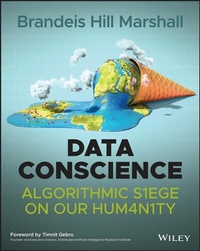
Data Conscience
Description

EXPLORE HOW D4TA STRUCTURES C4N HELP OR H1NDER SOC1AL EQU1TY
Data has enjoyed 'bystander' status as we've attempted to digitize responsibility and morality in tech. In fact, data's importance should earn it a spot at the center of our thinking and strategy around building a better, more ethical world. It's use--and misuse--lies at the heart of many of the racist, gendered, classist, and otherwise oppressive practices of modern tech.
In Data Conscience: Algorithmic Siege on our Humanity, computer science and data inclusivity thought leader Dr. Brandeis Hill Marshall delivers a call to action for rebel tech leaders, who acknowledge and are prepared to address the current limitations of software development. In the book, Dr. Brandeis Hill Marshall discusses how the philosophy of "move fast and break things" is, itself, broken, and requires change.
You'll learn about the ways that discrimination rears its ugly head in the digital data space and how to address them with several known algorithms, including social network analysis, and linear regression
A can't-miss resource for junior-level to senior-level software developers who have gotten their hands dirty with at least a handful of significant software development projects, Data Conscience also provides readers with:
* Discussions of the importance of transparency
* Explorations of computational thinking in practice
* Strategies for encouraging accountability in tech
* Ways to avoid double-edged data visualization
* Schemes for governing data structures with law and algorithms
More details
Other editions
Additional editions
Person
DR. BRANDEIS HILL MARSHALL, PhD, is a computer scientist, tech educator, and data equity consultant. She is a thought leader in broadening participating in data science and puts inclusivity and equity at the center of her work. She obtained her doctorate in Computer Science from Rensselaer Polytechnic Institute.
Content
Foreword xix
Introduction xxi
Part I Transparency 1
Chapter 1 Oppression By. . . 3
The Law 4
Slave Codes 5
Black Codes 5
The Rise of Jim Crow Laws 8
Breaking Open Jim Crow Laws 11
Overt Surveillance 12
Surveillance at Scale 13
The Science 16
Numbers 16
Anthropometry 18
Eugenics 19
Summary 23
Notes 23
Recommended Reading 25
Chapter 2 Morality 27
Data Is All Around Us 29
Morality and Technology 33
Defining Tech Ethics 33
Mapping Tech Ethics to Human Ethics 39
Squeezing in Data Ethics 45
Misconceptions of Data Ethics 49
Misconception 1: Goodness of Data, and
Tech by Proxy, Is Apolitical or Bipartisan 49
Misconception 2: Data Ethics Is Focused Solely on Laws Protecting Confidentiality and Privacy 50
Misconception 3: Implementing Data Ethics Practices Will Make Data Objective 52
Notable Misconception Mentions: Ethics and Diversity, Equity, and Inclusion (DEI) Are Interchangeable 53
Another Notable Mention: Software Developers Are Only Responsible for Societal Outcomes Stemming from Their Code 54
Limits of Tech and Data Ethics 55
Summary 57
Notes 57
Chapter 3 Bias 61
Types of Bias 62
Defining Bias 63
Concrete Example of Biases 65
The Bias Wheel 70
Before You Code 73
Case Study Scenario: Data Sourcing for an Employee Candidate Résumé Database 77
Case Study Scenario: Data Manipulation for an Employee Candidate Résumé Database 78
Case Study Scenario: Data Interpretation for an Employee
Candidate Résumé Database 82
Bias Messaging 83
Summary 83
Notes 84
Chapter 4 Computational Thinking in Practice 87
Ready to Code 88
The Shampoo Algorithm 89
Computational Thinking 91
Coding Environments 93
Algorithmic Justice Practice 95
Code Cloning 97
Socio-Techno-Ethical Review: app.py 101
Socio-Techno-Ethical Review: screen.py 103
Socio-Techno-Ethical Review: search.py 109
Summary 114
Notes 114
Part II Accountability 117
Chapter 5 Messy Gathering Grove 119
Ask the Why Question 120
Collection 124
Open Source Dataset Example: Deciding Data Ownership 127
Open Source Dataset Example: Considering Data Privacy 129
Reformat 133
Summary 139
Notes 139
Chapter 6 Inconsistent Storage Sanctuary 143
Ask the "What" Question 144
Files, Sheets, and the Cloud 146
Decisions in a Vacuum 149
Case Study: Black Twitter 150
Modeling Content Associations 153
Manipulating with SQL 158
Summary 160
Notes 161
Chapter 7 Circus of Misguided Analysis 163
Ask the "How" Question 164
Misevaluating the "Cleaned" Dataset 169
Overautomating k, K, and Thresholds 177
Deepfake Technology 179
Not Estimating Algorithmic Risk at Scale 185
Summary 187
Notes 187
Chapter 8 Double-Edged Visualization Sword 191
Ask the "When" Question 192
Critiquing Visual Construction 197
Disabilities in View 201
Pretty Picture Mirage 204
Case Study: SAT College Board Dataset 207
Summary 208
Notes 209
Part III Governance 213
Chapter 9 By the Law 215
Federal and State Legislation 216
International and Transatlantic Legislation 219
Regulating the Tech Sector 221
Summary 228
Notes 228
Chapter 10 By Algorithmic Influencers 231
Group (Re)Think 232
Flyaway Fairness 238
Algorithmic Fairness 239
Broadening Fairness 241
Moderation Modes 245
Double Standards 246
Calling Out Algorithmic Misogynoir 252
Data and Oversight 254
Summary 256
Notes 256
Chapter 11 By the Public 263
Freeing the Underestimated 264
Learning Data Civics 267
The State of the Data Industry 271
Living in the 21st Century 273
Condemning the Original Stain 277
Tech Safety in Numbers 279
Summary 283
Notes 283
Appendix A Code for app.py 287
A 287
B 288
C 288
D 289
Appendix B Code for screen.py 291
A 291
B 294
C 295
Appendix C Code for search.py 297
A 297
B 300
C 301
D 303
Appendix D Pseudocode for faceit.py 305
Appendix E The Data Visualisation Catalogue's Visualization Types 309
Appendix F Glossary 313
Index 315
Introduction
Source: https://twitter.com/csdoctorsister/status/1536343596336418821
My journey to data conscientiousness started when I was a kid as I rolled coins with my mom and helped my dad organize his job's employee resource group's annual membership rosters. My mom would bring out the big Welch's jar, about half full of loose change. Sitting on the living room floor, she'd dump all the coins on the carpet and we'd start separating them by denominations. Mom would bring out all the coin wrapper rolls she'd gotten from the bank. We'd stack the pennies, nickels, dimes, and quarters-and talk about whatever moms and daughters talk about. She taught me how many of each denomination goes into each coin wrapper roll: 50 pennies gives us 50 cents, 40 nickels gives us $2, 40 quarters gives us $10, and 50 dimes gives us $5. When we'd filled as many of the rolls as we could, we'd count up our earnings. Sometimes it would be $30, and other times it would be closer to $100.
At first, I simply liked the counting, the talking, and stuffing the coins in those small paper wrappings. As I grew up, I started to associate these coins as a resource to get what I wanted. That 50 cents could be put to excellent use to get some SweeTARTS. Two dollars in nickels would keep my candy stash stocked for a week. Five dollars would pay for my favorite order at Swenson's and I'd have change left over. In college, $10 in quarters was gold because no laundry would have been done otherwise. Looking back, I realize it was her way of having me practice my counting, learning the many ways to make a dollar using coins and the value of saving.
My dad, for more than a few years, had this annual huge task of verifying each chapter's membership rosters for his job's nationwide employee resource group. The first year or two or three, Mom and I watched him. Somewhere along the way, I started to help out when asked at first and even volunteered, maybe once. My recollection is fuzzy. What I remember vividly was that the amount of mail he received took down a few forests. There were endless printouts on standard perforated paper from those old dot-matrix printers. The basement became overrun with boxes of unopened envelopes of various sizes, from letter-sized to overstuffed legal-sized.
While my dad was figuring out which pile to tackle, opening each envelope started my supply chain of organization and sorting: record the chapter location and region, clip the membership roster to the envelope, highlight the number of chapter members, leave the chapter's membership dues checks in the envelope, and add this new envelope to the other envelopes in that region pile. And yes, each chapter printed and snail-mailed their membership rosters. The cross-checking of the mailed rosters year after year was dizzying. Some chapters used a great printer and had access to plenty of printer ink. Other chapters weren't so fortunate. My young eyes were called upon to read the smeared and faded letters.
Reconciling these membership rosters took weeks of shifting from one pile to the next. Some people changed chapters due to job relocations but didn't update their membership affiliation. Other people decided to not be part of the employee resource group anymore and didn't follow the member pause/deactivate process. The employee resource group finally created an online database-my dad had something to do with this, I'm sure.
Rolling coins introduced me to data as numbers, math, and financial literacy without being intimidating. Organizing chapter membership rosters introduced me to data as people, context. and guideposts to decisions. Armed with this understanding, I found that school was just one cool place where reading, math, and general exploration of data things happened.
But while roaming the computer science hallways at the University of Rochester I came to recognize how data was viewed by the world. The Year 2000 problem, the Y2K bug, dominated the headlines my junior year. Everyone seemed so concerned about the computing infrastructure and whether systems would "hold up" after the clock struck 12 a.m. on January 1st, 2000. Businesses were desperately trying to back up their data on file servers, zip drives. and 3.5-inch disks. My classmates began signing big money employment contracts with signing bonuses by that fall. They were focused on refining their computer systems and networking skills. That's what employers wanted. I predicted that this dotcom boom was about to bust, so I elected to pursue graduate studies.
I saw the additional concern that businesses feared of not having their data. Everything I could think of had a critical connection to data, particularly why, how, and what we digitally house in systems. And society was singularly focused on the systems themselves. I believed then, as I do now, that data runs the world. I decided to go all in on data in graduate school and my career.
Data gets a bad reputation as a pseudo demon spirit creature because all the numbers and math are deemed complicated, confusing, and not relatable. Data is not a tangible concept to many people-those in computing, tech, and data spaces and those who are not in those spaces. We all, to some degree, are in digital spaces where data lives. Critiquing data uses involves all of us, but for those of us in the data trenches, there's a bigger pressure to suss out the issues and course-correct before the tech product goes public.
This book is for the rebel tech talent, those who acknowledge and are ready to address the limitations of software development. They recognize that tech's philosophy and practice of "move fast, break things" is inherently problematic, and needs to be changed, and they want to pinpoint the ways discrimination exists in this digital data space. The primary reader for this book, however, is the entry-level software developer or data analyst. But frankly, it should be considered a reference guide to making more responsible and equitable data connections.
Data Conscience translates theory to practice. The gaps in our current data infrastructure are spotlighted so that data practitioners know more precisely where issues exists. And I'm centering the most vulnerable, ethical issues and resolutions to address social, political, and economic implications and not just computational ones like optimization, load balancing, and latency.
What you will read in this book is a blend of social sciences, humanities, and data management with tangible, real-world examples. Consider it a modern antemortem describing specific instances of where ethical flags are raised and how data structures help or hinder ethics resolutions. I focus on being preemptive in handling data operation for inclusion rather than conducting conversational (generic) autopsies of case studies and algorithmic audits.
The book is divided into three parts. Part I, "Transparency" (Chapters 1-4), takes you on the rollercoaster of how outcomes and impacts of data, code, algorithms, and systems are revealed to all of us by companies, organizations, and groups. Part II, "Accountability" (Chapters 5-8), covers ways in which data and software teams can critique and explore interventions to make responsible data connections during the tech building phase. And lastly, Part III, "Governance" (Chapters 9-11), reviews the action steps taken thus far and ends as a public accountability manifesto on what all of us can do to humanize our relationship to data.
Here's a brief chapter-by-chapter overview:
- Chapter 1 explores the role data has played in our society, particularly in the United States-how we've handled it and our relationship to handling it well. Oppression tactics, in the law and in the sciences, are mere social controls to enforce a hierarchy positioning that doesn't exist.
- Chapter 2 describes for those of us on the "inside" of tech how we're torn by this realization that the code we write is likely contributing to a cycle of harm that we don't know how to curtail, stop, or dislodge ourselves from. Reconciling-and more to the point accepting-imperfection in data and tech needs a place in tech. The choice between error or no error doesn't exist anymore. There's a third choice: nontech-solvable.
- Chapter 3 tackles the term "bias" and its multitude of interpretations head on. I describe how bias shows up and ways to shift our mindset on how we recognize and handle it, even before we write a single line of code. Getting overwhelmed and disengaging in combatting bias efforts is no longer an option.
- Chapter 4 stretches our minds about what we've accepted as computational thinking and standard discussion points to fold in a more intentional socio-ethical tech understanding. Coding requires a 360-degree panoramic view that requires more than coders in order to see, understand, capture, and partially address the social, technical, and ethical considerations.
- Chapter 5 focuses on asking the "why" questions, especially as part of data collection and reformat practices. Tech does a poor job of handling data collection and reformat. Learning to ask questions early, often, and with real people in mind streamlines how we manage data operations as a data, computing, and larger tech community.
- Chapter 6 focuses on asking the...
