

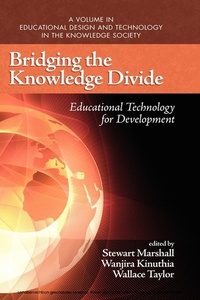
Bridging the Knowledge Divide
Educational Technology for Development
1st Edition
Published on 4. January 2009
473 pages
978-1-60752-183-9 (ISBN)
Description

In many international settings, developing economies are in danger of declining as the digital divide becomes the knowledge divide. This decline attacks the very fabric of cohesion and purpose for these regional societies delivering increased social, health, economic and sustainability problems. The examples in this book will provide leaders, policy developers, researchers, students and community with successful strategies and principles of ICT use in education to address these needs.
This book will discuss how educational technology can be used to transform education and assist developing communities to close the knowledge divide. It will provide comprehensive coverage of educational technology in development in different professions and parts of world. The book will provide examples of best practice, case studies and principles for educators, community leaders, researchers and policy advisers on the use of educational technology for development. In particular, it will provide examples of how education can be provided more flexibly in order to provide access to hitherto disadvantaged communities and individuals.
This book will discuss how educational technology can be used to transform education and assist developing communities to close the knowledge divide. It will provide comprehensive coverage of educational technology in development in different professions and parts of world. The book will provide examples of best practice, case studies and principles for educators, community leaders, researchers and policy advisers on the use of educational technology for development. In particular, it will provide examples of how education can be provided more flexibly in order to provide access to hitherto disadvantaged communities and individuals.
All prices
More details
Other editions
Additional editions
Stewart Marshall | Wanjira Kinuthia | Wallace Taylor
Bridging the Knowledge Divide
Educational Technology for Development
Book
03/2009
Information Age Publishing
€78.30
Article not available at the moment
Stewart Marshall | Wanjira Kinuthia | Wallace Taylor
Bridging the Knowledge Divide
Educational Technology for Development
Book
03/2009
Information Age Publishing
€129.20
Article not available at the moment
Content
- Intro
- Contents
- Foreword
- Biographical Notes on the Editors
- Biographical Notes on the Authors
- Acronyms
- Bridging the Knowledge Divide
- SECTION 1
- Flexible Education and Community Development
- Flexible Learning for Community Economic Development
- Contribution of the IDE in Promoting Gender Equality and in Empowering Women in Swaziland
- A Virtual Wheel of Fortune?
- Delivering Distance Education for the Civil Service in the UK
- SECTION 2
- Knowledge Management Strategies for Distance Education
- The Effectivenes of Mobile Short Mesaging Service ( SMS) Technologies in the Support of Selected Distance Education Students of Makerere University, Uganda
- The Impact of Video Conferencing on Distance Education Courses
- Open Resources for Open Learning in Developing Countries
- Freedom, Innovation, and Equity with Open Source Software
- Copyright Isues and their Impact on Flexible Education in Africa
- SECTION 3
- University Education for National Development
- Considerations for Higher Education Distance Education Policy for Development
- Blended Online and Face- to- Face Learning
- Evaluating the Impact of CABLE
- From Distance Learning to E- learning in Central and Northern Mozambique
- A Framework for the Delivery of Cross- Regional Distance Education to Profesionals in Developing Countries
- Distance Learning- Challenges and Opportunities for Postgraduate Medical Education
- SECTION 4
- Preservice Teacher Preparation and Effective eLearning
- Distance Teacher Training in Rwanda
- Beckoning E-Learners through Exploration of Computer Technology
- Educational Technology and Flexible Education in Nigeria
- Fostering Digital Literacy of Primary Teachers in Community Schools

