

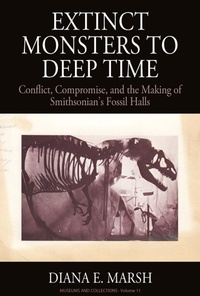
Extinct Monsters to Deep Time
Description

Via the Smithsonian Institution, an exploration of the growing friction between the research and outreach functions of museums in the 21st century.
Describing participant observation and historical research at the Smithsonian's National Museum of Natural History as it prepared for its largest-ever exhibit renovation, Deep Time, the author provides a grounded perspective on the inner-workings of the world's largest natural history museum and the social processes of communicating science to the public.
From the introduction:
In exhibit projects, the tension plays out between curatorial staff-academic, research, or scientific staff charged with content-and exhibitions, public engagement, or educational staff-which I broadly group together as "audience advocates" charged with translating content for a broader public. I have heard Kirk Johnson, Sant Director of the NMNH, say many times that if you look at dinosaur halls at different museums across the country, you can see whether the curators or the exhibits staff has "won." At the American Museum of Natural History in New York, it was the curators. The hall is stark white and organized by phylogeny-or the evolutionary relationships of species-with simple, albeit long, text panels. At the Field Museum of Natural History in Chicago, Johnson will tell you, it was the "exhibits people." The hall is story driven and chronologically organized, full of big graphic prints, bold fonts, immersive and interactive spaces, and touchscreens. At the Denver Museum of Nature and Science, where Johnson had previously been vice president and chief curator, "we actually fought to a draw." That, he says, is the best outcome; a win on either side skews the final product too extremely in one direction or the other. This creative tension, when based on mutual respect, is often what makes good exhibitions.
More details
Other editions
Additional editions
Person
Diana E. Marsh is an Assistant Professor of archives and digital curation at the University of Maryland's College of Information Studies (iSchool) who studies how heritage institutions share knowledge with communities and the public. Her current work focuses on improving discovery and access to colonially-held archives for Native American and Indigenous communities.
Content
List of Illustrations and Table
Foreward
Jennifer Shannon
Prologue: Fieldnotes from the Badlands
Acknowledgments
List of Abbreviations
Chronology A: Lists of Relevant Leadership
Chronology B: Geologic Time Scale
Chronology C: Fossil Exhibits Timeline
Introduction
Chapter 1. Increase and Diffusion: Early Fossil Exhibits and a History of Institutional Culture
Chapter 2. Group Dynamics: Exhibit Meetings and Expertise
Chapter 3. Group Dynamics: The Roots of Team Frictions and Complementarities
Chapter 4. Content Development: Debates about Interconnected Processes and Static Things
Chapter 5. Content Development: The Roots of Interpretive Frictions and Complementarities
Chapter 6. Diffusion and Increase: Shifts in Institutional Culture from Modernization to Now
Chapter 7. Conclusion
Chapter 8. Coda: The Nation's T-rex
Appendix A: Consent Form
Appendix B: Interview Questionnaires
Sample Team Interview Questionnaire
Sample Oral History Interview Questionnaire
Glossary
Bibliography
Index
