

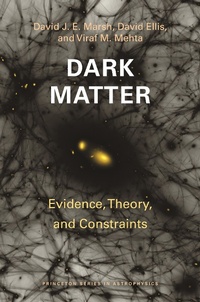
Dark Matter
Evidence, Theory, and Constraints
1st Edition
Published on 11. October 2024
352 pages
978-0-691-24971-1 (ISBN)
Description

A complete treatment of all aspects of dark matter physics
This book provides an incisive, self-contained introduction to one of the most intriguing subjects in modern physics, presenting the evidence we have from astrophysics for the existence of dark matter, the theories for what it could be, and the cutting-edge experimental and observational methods for testing them. It begins with a survey of the astrophysical phenomena, from rotation curves to lensing and cosmological structure formation. It goes on to offer the most comprehensive overview available of all three major theories, discussing weakly interacting massive particles (WIMPs), axions, and primordial black holes. The book explains the constraints on each theory, such as direct detection and indirect astrophysical limits, and enables students to build physical intuition using hands-on exercises and supplemental material. - The only book to treat extensively WIMPs, axions, and primordial black holes
- Provides balanced coverage of the evidence, theory, and testing for dark matter from astrophysics, particle physics, and experimental physics
- Includes original problems and short quizzes throughout
- Accompanied by Jupyter notebooks that give sample calculations and methods to reproduce key results and graphs
- An ideal textbook for advanced undergraduate and graduate students and an essential reference for researchers
This book provides an incisive, self-contained introduction to one of the most intriguing subjects in modern physics, presenting the evidence we have from astrophysics for the existence of dark matter, the theories for what it could be, and the cutting-edge experimental and observational methods for testing them. It begins with a survey of the astrophysical phenomena, from rotation curves to lensing and cosmological structure formation. It goes on to offer the most comprehensive overview available of all three major theories, discussing weakly interacting massive particles (WIMPs), axions, and primordial black holes. The book explains the constraints on each theory, such as direct detection and indirect astrophysical limits, and enables students to build physical intuition using hands-on exercises and supplemental material. - The only book to treat extensively WIMPs, axions, and primordial black holes
- Provides balanced coverage of the evidence, theory, and testing for dark matter from astrophysics, particle physics, and experimental physics
- Includes original problems and short quizzes throughout
- Accompanied by Jupyter notebooks that give sample calculations and methods to reproduce key results and graphs
- An ideal textbook for advanced undergraduate and graduate students and an essential reference for researchers
More details
Other editions
Additional editions
Book
10/2024
Princeton University Press
€126.50
Article exhausted; check different version
Book
10/2024
Princeton University Press
€68.50
Shipment within 10-20 days
Persons
David J. E. Marsh is an Ernest Rutherford Fellow and lecturer in the Department of Physics at King's College London. David Ellis holds a PhD in astrophysics from the University of Göttingen. Viraf M. Mehta was a postdoctoral researcher at the Institute for Astrophysics and Geophysics at the University of Göttingen and is now a physics teacher at the Browning School in New York City and visiting scholar at the Center for Cosmology and Particle Physics at New York University.
Content
- Cover
- Contents
- Common Abbreviations
- Chapter 1. Introduction
- 1.1. Dark Matter: The Greatest Mystery
- 1.2. Overview of This Book
- 1.3. Historical Note
- Warm-up Problems: Units
- Part I. Evidence for Dark Matter
- Chapter 2. Virial Theorem and Spherical Collapse
- 2.1. The Virial Theorem
- 2.1.1. Derivation
- 2.1.2. Zwicky and the Coma Cluster
- 2.2. Spherical Collapse
- Chapter 3. Rotation Curves
- 3.1. Measuring Orbital Velocities
- 3.2. Modelling the Visible Content
- 3.3. Dark Matter from vc(R)
- 3.4. Dark Matter in the Milky Way
- 3.4.1. General Remarks
- 3.4.2. The Milky Way Rotation Curve
- 3.5. Modified Gravity or Dark Matter?
- Chapter 4. Gravitational Lensing and X-Rays
- 4.1. Hydrostatic Equilibrium of Gas and Cluster Temperature
- 4.2. Gravitational Lensing
- 4.2.1. Recap of Special Relativity, and Introduction to General Relativity
- 4.2.2. Light Bending by Matter
- 4.2.3. Applying Lensing: The k Map
- 4.3. The Bullet Cluster
- Chapter 5. Cosmology Toolkit
- 5.1. The Hot Expanding Universe
- 5.1.1. Geometry
- 5.1.2. Einstein's Equations and Covariant Derivatives
- 5.1.3. Cosmic Inventory
- 5.1.4. The Dark Matter Relic Density
- 5.1.5. Cosmic Thermodynamics
- 5.1.6. Photon Decoupling and Recombination
- 5.2. Cosmological Perturbation Theory
- 5.2.1. Metric Perturbations and Einstein Equations
- 5.2.2. Matter Equations of Motion
- 5.2.3. The Energy-Momentum Tensor
- 5.3. Inflation
- 5.3.1. The Horizon Problem
- 5.3.2. Scalar Fields and Inflation
- 5.3.3. Quantum Fluctuations and the Primordial Power Spectrum
- Chapter 6. Cosmological Evidence for Dark Matter
- 6.1. Concordance, Flatness and the Baryon Budget
- 6.2. The Growth of Structure
- 6.2.1. Initial Conditions
- 6.2.2. Solutions of the Cosmological Perturbations
- 6.2.3. Baryons, Photons and the CMB
- 6.3. Dark Matter Halos
- 6.3.1. Halo Mass Function
- 6.3.2. NFW Profile
- 6.3.3. The Halo Model for the Non-Linear Power Spectrum
- 6.3.4. Simulations
- Color Plates
- Problems on Evidence for Dark Matter
- Part II. Theories of Dark Matter
- Chapter 7. Particle Physics and the Standard Model
- 7.1. Global and 'Gauge' Symmetries
- 7.2. Fermions, Chirality and Non-Abelian Symmetries
- 7.2.1. Fermions and Chirality
- 7.2.2. Symmetries of the Dirac Lagrangian
- 7.2.3. Non-Abelian Symmetries and the Standard Model Gauge Group
- 7.3. Particle Content of the Standard Model
- 7.3.1. Constructing the Lagrangian
- 7.3.2. Fermionic Spectrum and a Game of Indices
- 7.3.3. No Dirac Masses in the SM
- 7.3.4. The Higgs Mechanism
- Chapter 8. Massive Neutrinos as Dark Matter?
- 8.1. Massive Neutrinos
- 8.1.1. Higgs Mechanism for Fermions and the Problem with Neutrino Mass
- 8.1.2. Mass and Flavour Eigenstates
- 8.1.3. Observed Neutrino Masses
- 8.1.4. Constraints on Neutrino Mass
- 8.2. Neutrino Relic Abundance: Freeze-out
- Chapter 9. Weakly Interacting Massive Particles
- 9.1. Relic Density
- 9.1.1. Equilibrium
- 9.1.2. Freeze out of a Massive Particle
- 9.1.3. Velocity Dependence of the Cross Section
- 9.1.4. Estimating a Cross Section
- 9.2. Models of WIMPs
- 9.2.1. 'The WIMP Miracle'
- 9.2.2. Supersymmetry
- 9.2.3. Kaluza-Klein WIMPs
- Chapter 10. Axions: The Prototype of Wavelike DM
- 10.1. Vacuum Realignment Production
- 10.1.1. Scalar Field Lagrangian
- 10.1.2. Axion Relic Density
- 10.1.3. Initial Conditions: Spontaneous Symmetry Breaking
- 10.1.4. The Axion Mass
- 10.2. Models of Axions
- 10.2.1. QCD Axion
- 10.2.2. Axion-Like Particles
- 10.2.3. ALPs from String Theory
- 10.3. Structure Formation with Scalar Fields
- 10.3.1. The Non-Relativistic Limit
- 10.3.2. Some Schrödinger-Poisson Physics
- Chapter 11. Primordial Black Holes
- 11.1. Collapse of Curvature Perturbations
- 11.2. Relic Abundance
- 11.2.1. PBH Density and Mass
- 11.3. Inflationary Model for PBHs
- 11.3.1. Sketch of the Model
- 11.3.2. Computing the Collapse Fraction
- Problems on Theories of Dark Matter
- Part III. Testing Dark Matter
- Chapter 12. WIMP Direct Detection
- 12.1. WIMP Nuclear Recoil
- 12.2. Cross-Section Estimates
- 12.3. Homestake Mine Experiment
- 12.4. Modern Direct Detection Techniques
- 12.4.1. Detectors
- 12.4.2. Backgrounds
- 12.5. The Neutrino Fog
- Chapter 13. WIMP Astrophysics and Indirect Detection
- 13.1. WIMP Mass Lower Bound
- 13.1.1. Fermions and the Tremaine-Gunn Bound
- 13.1.2. Warm Dark Matter
- 13.2. Annihilations and Indirect Detection
- 13.2.1. Gamma Ray Flux Production
- 13.2.2. Diffusion-Loss Equation
- 13.2.3. Limits from Gamma Ray Telescopes
- 13.2.4. Other Indirect Detection Probes
- Chapter 14. Axion Direct Detection
- 14.1. The Axion-Photon Coupling
- 14.1.1. Lagrangian for Axion-Photon Coupling
- 14.1.2. Axion-Maxwell Equations
- 14.2. Axion Cavity 'Haloscope'
- 14.2.1. Axion Dark Matter Experiment (ADMX)
- 14.3. Other Axion Experiments and Couplings
- 14.3.1. Other Couplings
- 14.3.2. QUAX
- 14.3.3. CASPEr
- Chapter 15. Astrophysical Axion Bounds
- 15.1. Ultralight Axions and Fuzzy Dark Matter
- 15.1.1. Bounds from Structure Formation
- 15.1.2. 'Quasiparticle Heating'
- 15.1.3. Bounds on ULA Fraction
- 15.2. Black Hole Superradiance
- 15.3. Bounds from Stellar Production of Axions
- 15.3.1. Horizontal Branch Stars
- 15.3.2. SN1987A
- 15.4. Decay and Conversion of Axion DM
- 15.4.1. X-Rays and Axion Decays
- 15.4.2. Neutron Star Magnetospheres
- Chapter 16. Constraints on PBHs
- 16.1. Hawking Radiation
- 16.2. Lower Bound from Gamma Rays
- 16.3. Upper Bound from Galaxy Formation
- 16.4. Microlensing
- 16.4.1. EROS and MACHO
- 16.4.2. Subaru-HSC
- 16.4.3. Estimating Constraints
- Problems on Testing Dark Matter
- Chapter 17. Epilogue: The DM Candidate Zoo
- Acknowledgements
- Appendix A. Reading List
- A.1. Books and Review Articles
- A.2. Evidence for Dark Matter
- A.2.1. Galactic Scales
- A.2.2. Cosmology
- A.3. Theories of Dark Matter
- A.3.1. The Standard Model and Quantum Field Theory
- A.3.2. WIMPs, SUSY and Other Thermal Relics
- A.3.3. Axions
- A.3.4. Primordial Black Holes
- A.4. Tests of Dark Matter
- A.4.1. WIMPs
- A.4.2. Axions
- A.4.3. Primordial Black Holes
- Bibliography
- Index
