

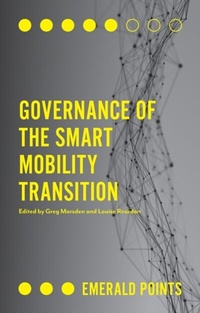
Governance of the Smart Mobility Transition
1st Edition
Published on 13. March 2018
192 pages
978-1-78754-317-1 (ISBN)
Description

Rapid changes are underway in mobility systems worldwide, including the introduction of shared mobility solutions, Mobility as a Service and the testing of automated vehicles. These changes are driven by the development and application of 'smart' technologies. Transition to these technologies present significant opportunities for countries, cities and rural areas alike, offering the tempting prospect of economic benefit whilst resolving today's safety, congestion, and pollution problems.
Yet while there is a wealth of research considering how these new technologies may impact on travel behaviour, improve safety and help the environment, there is a dearth of research exploring the key governance questions that the transition to these technologies pose in their disruption of the status quo, and changes to governance that may be required for the achievement of positive social outcomes. This book aims to step into this void and in doing so presents an agenda for future research and policy action.
Bringing together a collection of internationally recognised scholars, drawing on case studies from around the world, authors critically reflect on three primary governance considerations. First, the changing role of the state both during and post-transition. Second, identifying the voices shaping the smart mobility discourse. And third, analysing the implications for the state's capacity to steer networks and outcomes as a result of these transitions. The authors argue that at present there exists a critical window of opportunity for researchers and practitioners to shape transitions and that this opportunity must be seized upon before it is too late.
Yet while there is a wealth of research considering how these new technologies may impact on travel behaviour, improve safety and help the environment, there is a dearth of research exploring the key governance questions that the transition to these technologies pose in their disruption of the status quo, and changes to governance that may be required for the achievement of positive social outcomes. This book aims to step into this void and in doing so presents an agenda for future research and policy action.
Bringing together a collection of internationally recognised scholars, drawing on case studies from around the world, authors critically reflect on three primary governance considerations. First, the changing role of the state both during and post-transition. Second, identifying the voices shaping the smart mobility discourse. And third, analysing the implications for the state's capacity to steer networks and outcomes as a result of these transitions. The authors argue that at present there exists a critical window of opportunity for researchers and practitioners to shape transitions and that this opportunity must be seized upon before it is too late.
Reviews / Votes
Researchers in transportation, city planning, architecture, and similar fields explore ways to understand the challenge of governing the transition of mobility away from automobiles. Their topics include the case of mobility as a service: a critical reflection on challenges for urban transport and mobility governance, whether smart mobility is disrupting transport governance, who benefits from smart mobility: the social construction of winners and loses in the connected bikes projects in the Netherlands, planning for disruptive transport technologies: how prepared Australian transport agencies are, and whether governance matters: an international scenarios exercise. -- Annotation (c)2018 * (protoview.com) *More details
Series
Language
English
Place of publication
Bingley
United Kingdom
Target group
Professional and scholarly
File size
1,70 MB
ISBN-13
978-1-78754-317-1 (9781787543171)
Copyright in bibliographic data and cover images is held by Nielsen Book Services Limited or by the publishers or by their respective licensors: all rights reserved.
Schweitzer Classification
Other editions
Additional editions
Greg Marsden | Louise Reardon
Governance of the Smart Mobility Transition
Book
03/2018
Emerald Publishing Limited
€76.10
Shipment within 10-20 days
Persons
Greg Marsden is Professor of Transport Governance at the Institute for Transport Studies at the University of Leeds, UK. Dr Louise Reardon is a lecturer at the Institute of Local Government Studies (INLOGOV), University of Birmingham, UK.
Content
Introduction; Greg Marsden and Louise Reardon Section One: Navigating the Role of the State
Chapters
1. New Governance Challenges in the Era of 'Smart' Mobility; Iain Docherty
2. The Case of Mobility as a Service: A Critical Reflection on Challenges for Urban Transport and Mobility Governance; Kate Pangbourne, Dominic Stead, Milos Mladenovic and Dimitris Milakis
Section Two: Whose Voices are in the Smart Mobility Debate?
3. Smart Mobility: Disrupting Transport Governance?; Robyn Dowling
4. Governing the Race to Automation; Debbie Hopkins and Tim Schwanen
5. Who benefits from smart mobility policies? The Social Construction of Winners and Losers in the Connected Bikes Projects in the Netherlands; Edgar Salas Girones and Darja Vrscaj
Section Three: State Capacity
6. Governmental Capacity and the Smart Mobility Transition; Diane Davis
7. Planning for Disruptive Transport Technologies: How Prepared Are Australian Transport Agencies?; John Stone, David Ashmore, Jan Scheurer, Crystal Legacy and Carey Curtis
8. Does Governance Matter? An International Scenarios Exercise; Greg Marsden and Louise Reardon
Section Four: Conclusion
9. Conclusion: A Window of Opportunity; Louise Reardon and Greg Marsden
Chapters
1. New Governance Challenges in the Era of 'Smart' Mobility; Iain Docherty
2. The Case of Mobility as a Service: A Critical Reflection on Challenges for Urban Transport and Mobility Governance; Kate Pangbourne, Dominic Stead, Milos Mladenovic and Dimitris Milakis
Section Two: Whose Voices are in the Smart Mobility Debate?
3. Smart Mobility: Disrupting Transport Governance?; Robyn Dowling
4. Governing the Race to Automation; Debbie Hopkins and Tim Schwanen
5. Who benefits from smart mobility policies? The Social Construction of Winners and Losers in the Connected Bikes Projects in the Netherlands; Edgar Salas Girones and Darja Vrscaj
Section Three: State Capacity
6. Governmental Capacity and the Smart Mobility Transition; Diane Davis
7. Planning for Disruptive Transport Technologies: How Prepared Are Australian Transport Agencies?; John Stone, David Ashmore, Jan Scheurer, Crystal Legacy and Carey Curtis
8. Does Governance Matter? An International Scenarios Exercise; Greg Marsden and Louise Reardon
Section Four: Conclusion
9. Conclusion: A Window of Opportunity; Louise Reardon and Greg Marsden
