

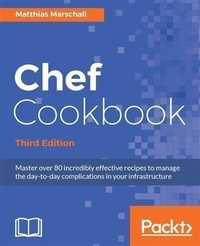
Chef Cookbook
Achieve powerful IT infrastructure management and automation
3rd Edition
Published on 8. July 2025
268 pages
978-1-78646-566-5 (ISBN)
Description

Master over 80 incredibly effective recipes to manage the day-to-day complications in your infrastructure
Key Features
[*] Immediately apply Devops techniques and methods, then combine them with powerful Chef tools to manage and automate your infrastructure
[*] Address the growing challenges of code management, cloud, and virtualization with Chef quickly
[*] Explore and implement the important aspects of Chef Automate using this recipe-based guide
Book DescriptionChef is a configuration management tool that lets you automate your more cumbersome IT infrastructure processes and control a large network of computers (and virtual machines) from one master server. This book will help you solve everyday problems with your IT infrastructure with Chef. It will start with recipes that show you how to effectively manage your infrastructure and solve problems with users, applications, and automation. You will then come across a new testing framework, InSpec, to test any node in your infrastructure. Further on, you will learn to customize plugins and write cross-platform cookbooks depending on the platform. You will also install packages from a third-party repository and learn how to manage users and applications. Toward the end, you will build high-availability services and explore what Habitat is and how you can implement it. What you will learn
[*] Test your cookbooks with Test Kitchen
[*] Manage cookbook dependencies with Berkshelf
[*] Use reporting to keep track of what happens during the execution of chef-client runs across all of the machines
[*] Create custom Ohai and Knife plugins
[*] Build a high-availability service using Heartbeat
[*] Use a HAProxy to load-balance multiple web servers
Who this book is forThis book is for system engineers and administrators who have a fundamental understanding of information management systems and infrastructure. It is also for DevOps Engineers, IT professionals, and organizations who want to automate and gain greater control of their infrastructures with Chef. No experience with Chef is needed, but may help.
Key Features
[*] Immediately apply Devops techniques and methods, then combine them with powerful Chef tools to manage and automate your infrastructure
[*] Address the growing challenges of code management, cloud, and virtualization with Chef quickly
[*] Explore and implement the important aspects of Chef Automate using this recipe-based guide
Book DescriptionChef is a configuration management tool that lets you automate your more cumbersome IT infrastructure processes and control a large network of computers (and virtual machines) from one master server. This book will help you solve everyday problems with your IT infrastructure with Chef. It will start with recipes that show you how to effectively manage your infrastructure and solve problems with users, applications, and automation. You will then come across a new testing framework, InSpec, to test any node in your infrastructure. Further on, you will learn to customize plugins and write cross-platform cookbooks depending on the platform. You will also install packages from a third-party repository and learn how to manage users and applications. Toward the end, you will build high-availability services and explore what Habitat is and how you can implement it. What you will learn
[*] Test your cookbooks with Test Kitchen
[*] Manage cookbook dependencies with Berkshelf
[*] Use reporting to keep track of what happens during the execution of chef-client runs across all of the machines
[*] Create custom Ohai and Knife plugins
[*] Build a high-availability service using Heartbeat
[*] Use a HAProxy to load-balance multiple web servers
Who this book is forThis book is for system engineers and administrators who have a fundamental understanding of information management systems and infrastructure. It is also for DevOps Engineers, IT professionals, and organizations who want to automate and gain greater control of their infrastructures with Chef. No experience with Chef is needed, but may help.
More details
Edition
3rd Revised edition
Language
English
Place of publication
Birmingham
United Kingdom
Target group
Professional and scholarly
US School Grade: College Graduate Student
Edition type
Revised edition
File size
1,91 MB
ISBN-13
978-1-78646-566-5 (9781786465665)
Copyright in bibliographic data and cover images is held by Nielsen Book Services Limited or by the publishers or by their respective licensors: all rights reserved.
Schweitzer Classification
Other editions
Additional editions
Matthias Marschall
Chef Cookbook, Third Edition
Book
02/2017
Packt Publishing
€55.80
Shipment within 3-4 weeks
Person
Marschall Matthias :
Matthias Marschall is a Software Engineer "made in Germany". His four children make sure that he feels comfortable in lively environments, and stays in control of chaotic situations. A lean and agile engineering lead, he's passionate about continuous delivery, infrastructure automation, and all things DevOps. In recent years, Matthias has helped build several web-based businesses, first with Java and then with Ruby on Rails. He quickly grew into system administration, writing his own configuration management tool before migrating his whole infrastructure to Chef in its early days. In 2008, he started a blog (http://www.agileweboperations.com) together with Dan Ackerson. There, they have shared their ideas about DevOps since the early days of the continually emerging movement. You can find him on Twitter as @mmarschall. Matthias holds a Master's degree in Computer Science (Dipl.-Inf. (FH)) and teaches courses on Agile Software Development at the University of Augsburg. When not writing or coding, Matthias enjoys drawing cartoons and playing Go. He lives near Munich, Germany.
Matthias Marschall is a Software Engineer "made in Germany". His four children make sure that he feels comfortable in lively environments, and stays in control of chaotic situations. A lean and agile engineering lead, he's passionate about continuous delivery, infrastructure automation, and all things DevOps. In recent years, Matthias has helped build several web-based businesses, first with Java and then with Ruby on Rails. He quickly grew into system administration, writing his own configuration management tool before migrating his whole infrastructure to Chef in its early days. In 2008, he started a blog (http://www.agileweboperations.com) together with Dan Ackerson. There, they have shared their ideas about DevOps since the early days of the continually emerging movement. You can find him on Twitter as @mmarschall. Matthias holds a Master's degree in Computer Science (Dipl.-Inf. (FH)) and teaches courses on Agile Software Development at the University of Augsburg. When not writing or coding, Matthias enjoys drawing cartoons and playing Go. He lives near Munich, Germany.
Content
Table of Contents
Chef Infrastructure
Evaluating and Troubleshooting Cookbooks and Chef Runs
Chef Language and Style
Writing Better Cookbooks
Working with Files and Packages
Users and Applications
Servers and Cloud Infrastructure
Chef Infrastructure
Evaluating and Troubleshooting Cookbooks and Chef Runs
Chef Language and Style
Writing Better Cookbooks
Working with Files and Packages
Users and Applications
Servers and Cloud Infrastructure
