

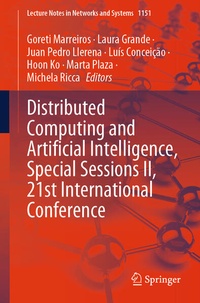
Distributed Computing and Artificial Intelligence, Special Sessions II, 21st International Conference
Description

DCAI 2024 serves as a forum to present applications of innovative techniques for studying and solving complex problems in artificial intelligence and computing. This edition brings together experience, current work, and promising future trends related to distributed computing, artificial intelligence, and their applications to provide efficient solutions to real-world problems. Given the conference's success, this edition features twelve special sessions covering a wide range of topics related to AI and other areas of interest. These sessions were carefully curated to address the latest advancements and challenges in fields such as machine learning, neural networks, IoT, big data, and blockchain, among others. The accepted papers from these sessions are presented in two volumes, showcasing the diverse and innovative research being conducted in these domains. This is the first volume, which includes the sessions: Advanced AI-based Data Annotation Tools (AI-DAT), Digital Heritage Contents (DHC), female technopreneurs and early career researchers in distributed computing and AI organised by the Gendered Innovation Living Labs (GILL), New perspectives and solutions in Cultural Heritage (TECTONIC), Artificial Intelligence trends in Health & Care (AItHeC) & Doctoral Consortiums), each focusing on specific themes within the broader scope of AI and its applications. The DCAI'24 technical program has selected 74 papers in special sessions and, as in past editions, it will be special issues in ranked journals. This symposium is organized by the University of Salamanca (Spain). We would like to thank all the contributing authors, the Program Committee members, National Associations (AEPIA, APPIA, LASI), and the sponsors (AIR Institute).
More details
Other editions
Additional editions
Content
.- AI-Boosted Video Annotation: Exploring Pre-Labeling with Cross-Modalities.
.- How Does Speech Quality Impact the Data Transcription Process.
.- Enhancing Image Annotation Through Attention Mining: A Grounded SAM Approach.
.- Can Large Sound Event Detection models be accurately adapted to specific acoustic scenarios.
.- Innovative Quality Metrics for Enhanced Interpretation of Instance Segmentation in Complex Image Scenarios, etc.
