

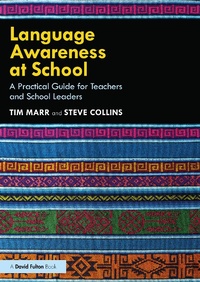
Language Awareness at School
A Practical Guide for Teachers and School Leaders
1st Edition
Published on 2. May 2023
166 pages
978-1-000-87105-0 (ISBN)
Description

All too often, schools make decisions about language without a proper understanding of the issues involved. Language Awareness at School addresses this problem by exploring a range of topics related to language, helping teachers to make informed choices about how to best support their students in becoming more confident, aware speakers and writers.
Written in collaboration by an academic linguist and an experienced teacher, this essential book combines professional experience and academic expertise to demonstrate how a language-aware approach to education has the potential to transform both whole-school policy and classroom practice.
Chapters explore such questions as the misconceptions surrounding the use of 'Standard English', teachers' and students' local accents, the development of cross-curricular speaking and writing skills and how to reinvigorate Modern Foreign Languages. This book also works to undo damaging prejudices about how students speak, instead highlighting opportunities to encourage students to notice, examine and debate language issues.
Language Awareness at School is a crucial read for all teachers, trainee teachers and school leadership teams who want to make more informed decisions regarding language issues in schools.
Written in collaboration by an academic linguist and an experienced teacher, this essential book combines professional experience and academic expertise to demonstrate how a language-aware approach to education has the potential to transform both whole-school policy and classroom practice.
Chapters explore such questions as the misconceptions surrounding the use of 'Standard English', teachers' and students' local accents, the development of cross-curricular speaking and writing skills and how to reinvigorate Modern Foreign Languages. This book also works to undo damaging prejudices about how students speak, instead highlighting opportunities to encourage students to notice, examine and debate language issues.
Language Awareness at School is a crucial read for all teachers, trainee teachers and school leadership teams who want to make more informed decisions regarding language issues in schools.
Reviews / Votes
'It's refreshing to read such a coherent and informed vision of what language teaching can and should look like in our schools - be it in English classrooms, foreign language lessons or across the whole curriculum. Not a gap or a deficit in sight! Instead, Marr and Collins offer and exemplify a compelling argument for the kind of language-informed practice that will benefit students everywhere.I'd recommend this book to all teachers looking to raise their own language awareness. School leaders, in particular, will find it an invaluable resource to help them navigate a path that moves schools beyond misleading and damaging gap and deficit narratives.'
Andrew McCallum, Director of the English and Media Centre, London
'Drawing on a range of historical and recent research and using a number of topical and well-presented examples, Marr and Collins examine debates about the use of Standard English, zero-tolerance approaches to language use through word bans, misconceptions such as 'correct English', the place of linguistics in the English curriculum, and the value of learning languages other than English. The book offers a very useful reference point for teachers interested in developing their own linguistic knowledge in order to make their classrooms more inclusive, and for middle and senior leaders looking to raise language awareness at whole-school level.'
Marcello Giovanelli, Reader in Literary Linguistics, Aston University, UK
'A precise balance of linguistic principles and practical direction, this highly readable work convincingly shows that literacy must go hand-in-hand with language awareness. A strong command of these skills forms the gateway to social mobility, and our young people deserve nothing less. If only this inspiring book had been available at the start of my career, it would have saved me years of experimentation.'
Mark Arnull, Headteacher, Q3 Academy Great Barr, West Midlands, UK
More details
Edition
1. Auflage
Language
English
Place of publication
London
United Kingdom
Publishing group
Taylor & Francis Ltd
Target group
Professional and scholarly
Illustrations
8 Line drawings, black and white; 3 Halftones, black and white; 11 Illustrations, black and white
ISBN-13
978-1-000-87105-0 (9781000871050)
Copyright in bibliographic data and cover images is held by Nielsen Book Services Limited or by the publishers or by their respective licensors: all rights reserved.
Schweitzer Classification
Other editions
Additional editions
Tim Marr | Steve Collins
Language Awareness at School
A Practical Guide for Teachers and School Leaders
Book
05/2023
1st Edition
Routledge
€195.70
Shipment within 10-20 days
Tim Marr | Steve Collins
Language Awareness at School
A Practical Guide for Teachers and School Leaders
Book
05/2023
1st Edition
Routledge
€36.70
Shipment within 10-20 days
Persons
Tim Marr is Visiting Professor in Applied Linguistics at Universidad Icesi, Cali, Colombia. He was formerly director of the MA TESOL programme at London Metropolitan University and has over 30 years' experience in teaching and researching language and linguistics, as well as training language teachers. He has co-authored several books on linguistics and TESOL.
Steve Collins is Head of English at Bishop Luffa School, Chichester, where he teaches Key Stages 3 to 5, specialising in A Level English Language. He has taught in secondary schools for 20 years, and also taught EFL in Peru and the UK. He contributed a chapter on sentence-level analysis to the Routledge book Teaching English Language and Literature 16-19.
Steve Collins is Head of English at Bishop Luffa School, Chichester, where he teaches Key Stages 3 to 5, specialising in A Level English Language. He has taught in secondary schools for 20 years, and also taught EFL in Peru and the UK. He contributed a chapter on sentence-level analysis to the Routledge book Teaching English Language and Literature 16-19.
Content
1. Introduction: Why We're Talking About Language; 2. What People Get Wrong About Language; 3. Why Every Teacher is a Language Teacher; 4. What Language Awareness Looks Like; 5. What We Teach When We Teach English; 6. Why Should We Teach Modern Foreign Languages?; 7. Which MFL? And Is Earlier Really Better?; 8. In Conclusion: What We Can Do To Promote Language Awareness At School
