

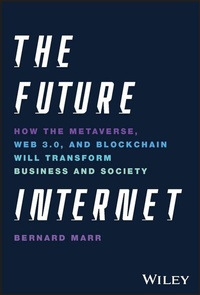
The Future Internet
Description

In The Future Internet: How the Metaverse, Web3, and NFTs Will Transform Business & Society, acclaimed futurist, author, and digital strategist Bernard Marr delivers a compelling and engaging discussion of the technologies driving the impending--and ongoing--transformation of the internet, including blockchain, augmented reality (AR), and more. In the book, you'll explore the risks and opportunities presented by these game-changing techs and how they might impact you, your organisation, and community.
The author explains how various sectors will be revolutionised by the future internet, as industries like sports, retail, energy, healthcare, education, and others feel the effects of paradigm-shifting developments in society and technology. He also discusses:
* Strategies for individuals seeking to leverage the coming changes in technology, employment, and culture
* The potential impact of the unprecedented combination of blockchain and AR technologies
* Techniques for getting in on the ground floor of a new internet that places a heavy premium on participation and immersive experiences
An essential and incisive exploration of what our tomorrows might bring, The Future Internet is perfect for executives, managers, and other business leaders doing their best to get a head start on tomorrow's digital economy.
More details
Other editions
Additional editions
Person
Content
The Future Internet and the Next Digital Revolution 5
Chapter 1 The Metaverse and a More Immersive Online Experience 7
Chapter 2 Web3 and the Rise of Decentralization 25
Chapter 3 When and How Will this Future Internet Play Out? Exploring Timelines, Future Trends, and Challenges 39
Part II How the Future Internet Will Change Our World 57
Chapter 4 How Creative and Entertainment Industries Are Finding New Ways to Engage with Their Audiences 59
Chapter 5 How Fashion and Retail Brands Are Preparing for a More Immersive World 85
Chapter 6 Overhauling How We Learn (At All Stages of Life) 99
Chapter 7 Disrupting Finance, IT, and Other Service Industries 111
Chapter 8 Metaverse Hospitals and More: Healthcare in the Future Internet 127
Chapter 9 Innovating Industry, Streamlining Supply Chains: What the Future Looks Like for Manufacturing, Energy, and Other Industrial Organizations 141
Chapter 10 How Governments and Public Services Will Harness the Future Internet 155
Chapter 11 Everyday Life and Leisure in the Future Internet 167
Part III Leveraging the Future Internet in Your Business 183
Chapter 12 Rethinking Products and Services 185
Chapter 13 Rethinking Business Operations 197
Chapter 14 Attracting, Developing, and Retaining the Right Skills for the Future Internet 209
Chapter 15 Creating the Right Culture for Success 219
Chapter 16 Developing a Future Internet Strategy 235
Chapter 17 Final Words 245
About the Author 249
Index 251
CHAPTER 1
THE METAVERSE AND A MORE IMMERSIVE ONLINE EXPERIENCE
Welcome to a day in the life of you. Future you, that is. You begin your working day with a virtual team meeting-with realistic avatars of you and your colleagues gathering in a virtual meeting space to discuss your newest project. There's a gorgeous mountain scene outside the meeting room window, even though you're in Birmingham or Boston, or wherever you are in the real world. At lunchtime you go for a walk in your local park and see a dog walker wearing a jacket you like. Your augmented reality sunglasses tell you the brand, product name, and price. So, you hop on your phone and have your shopping avatar-which matches your measurements perfectly-"try on" the jacket in the store's virtual changing room. (It looks great on you, by the way. You should definitely buy it.) Back in your home office, you spend the afternoon collaborating with a remote colleague on a new product design, exploring different options in 3D format, "walking around" the design to explore it from every angle and manipulating it to your specifications in front of your eyes.
After work, you and your partner have your weekly virtual reality (VR) tennis lesson. Then, because you're renovating your home, it's time to decide on a new bathroom suite. So, you head to the DIY store's app, which uses augmented reality (AR) technology to digitally place different bathroom suites in your room. You spend a happy half-hour "placing" lots of different bathtubs, sinks, and showers in your bathroom, seeing which fit and generally weighing up which look best. It's so much easier than heading to the store with a measuring tape, as you did with your first home. Later, you don your VR headset to catch up with a friend who recently moved to the other side of the country, meeting in an online platform and watching your favourite band play a virtual gig together.
Okay, maybe a day in the life of future you won't be exactly like this. But it's a taste of what I mean by a more immersive internet-that is, an online experience that is more realistic (seeing things in 3D rather than 2D, for example) and generally more engaging. And at the heart of this immersive, realistic, engaging internet lies a key concept: the metaverse.
How the Metaverse Will Change Our World
I have a confession to make. I don't love the term "metaverse". It just makes most people think of Meta (formerly Facebook Company). And for others, they think it's all just about virtual reality and living in a fantasy virtual world, like in Ready Player One.
But the metaverse is so much more than that. Or rather, it will be. For me, the metaverse represents the future merging of digital (i.e. online) activities with virtual (i.e. simulated) worlds, and, yes, the physical world around us. The metaverse will make the digital world and virtual experiences more realistic, more immersive, and, dare I say, more human. Social media companies, brands, employers, schools, and individuals will operate their own virtual worlds where people can come and work, learn, game, exercise, or just hang out. For this reason, I'd argue that the metaverse will end up bigger than the real world.
But the metaverse will also make the physical, real world around us more accessible, exciting, and interactive. That's a crucial point to understand-the metaverse isn't just going to revolutionize our experience of life online; it'll change how we view and interact with the real world around us. Experiences in the real world will be more exciting because of the metaverse. Whether it's choosing a new bathtub, going on a walk, buying clothes, or whatever.
But I'm getting ahead of myself. What actually is the metaverse?
A beginner's guide to the metaverse
The metaverse concept is all about persistent, shared virtual worlds. Mark Zuckerberg, who says he's been contemplating the metaverse since before he came up with Facebook, describes it as an "internet that you're inside of, rather than just looking at", which is a brilliantly concise description. (Although it does neglect how the metaverse will influence the real world around us.)
In these shared virtual worlds, we'll theoretically be able to do and be anything we want. We can take on whatever personality or form we want, or just be ourselves. We'll be able to work and socialize with people on the other side of the globe in a way that's more realistic and engaging than Zoom calls or social media chats. We'll enjoy a better online shopping experience. Gaming will be more immersive and realistic than ever. More gigs will take place in virtual spaces. Students learning remotely will feel like they're in the lecture hall with their teacher. And so on, and so on. Basically, thanks to the metaverse, more and more of everyday life will take place in shared virtual worlds-and these worlds will feel much more engaging and immersive than our current experiences of, for example, going online, using social media, or VR gaming.
The concept of the metaverse has existed for a while. In the Matrix movies, where humans are locked into a shared virtual world created by machines, that's essentially a (disturbing) depiction of a metaverse. The same with Ready Player One (a book and film in which people take refuge from our dystopian future world in a massive online role-playing game and virtual society, complete with its own currency), and the countless other stories, movies, and shows where people spend their lives in virtual worlds. So, it's not a new concept invented by Mark Zuckerberg, despite Facebook's clever rebrand to Meta. (In fact, the term "metaverse" first appeared in Neal Stephenson's 1992 cyberpunk novel Snow Crash.) This is a concept that society has been building towards for a while-ever since the emergence of the internet, social media, virtual reality, and early attempts at creating shared digital environments, like Second Life (the online 3D environment where users engage in an alternative life and assume an alter ego).
Many experts-myself included-believe the metaverse will be integral to the next evolution of the internet. It will be the next generation of the internet.
If this all sounds a bit exaggerated, consider how many people have found themselves living more of their lives online since the COVID-19 pandemic. We're becoming increasingly used to working, learning, shopping, and socializing online. In recent years, the Fortnite gaming universe has expanded so much it now hosts social events and huge concerts, featuring stars like Ariana Grande. So, the idea of bringing all these strands together as "the metaverse" is not such a wild leap after all. Sure, it's not going to happen overnight (more on this in Chapter 3), but it is going to happen.
Is this the same as the multiverse?
No, the metaverse isn't the same as the multiverse, although you'll hear both terms bandied around a lot these days.
In tech language, the multiverse is an ecosystem of many virtual worlds. The Fortnite game is a good example of such a virtual world-one that's expanded beyond pure gaming to a virtual hub where people come to hang out with others or be entertained. Platforms like Fortnite are part of a new multiverse era that's emerging in the tech world, largely driven by gaming (which makes sense when you think about it, because the gaming industry has loads of experience of creating immersive virtual worlds). According to TechCrunch's Eric Peckham, "Multiverse virtual worlds will come to function almost like new countries in our society, countries that exist in cyberspace rather than physical locations, but have complex economic and political systems that interact with the physical world". But, crucially, these virtual worlds in the multiverse aren't (yet) interconnected. They're separate "countries" that you can visit, if you will.
The metaverse concept is different because it will be a persistent, shared digital environment. You'll-in theory-be able to move from activity to activity and environment to environment and take your avatar, preferences, and digital assets with you. So, while the multiverse is fairly disconnected, the metaverse will-in the future-offer a connected virtual world with a unified user experience, whatever you're doing and wherever you're going. So, if the multiverse is like a collection of separate virtual countries, the metaverse will be more like a virtual European Union, where you can seamlessly travel from country to country, taking your one currency with you.
In the future, some or all of these disparate virtual worlds-such as Fortnite-may well become interconnected parts of the metaverse. That's the ultimate promise of the metaverse.
Interoperability is key
Importantly, then, your future metaverse life won't be limited to one platform, like Facebook or Fortnite. Rather, it's all about enjoying a shared, continuous experience. So, you may move from an immersive VR game, to a work meeting in a 3D meeting space rendered on your laptop screen, to 2D applications on your mobile phone (shopping, for example). But all the while, you'll be able to enjoy continuity between the different...
