

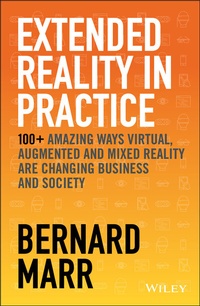
Extended Reality in Practice
Description

As one of the leading business trends today, extended reality (XR) promises to revolutionize the way consumers experience their encounters with brands and products of all kinds. Top brands from Pepsi and Uber to Boeing and the U.S. Army are creating immersive digital experiences that capture the interest and imaginations of their target markets.
In Extended Reality in Practice: 100+ Amazing Ways Virtual, Augmented and Mixed Reality are Changing Business and Society, celebrated futurist, technologist, speaker, and author Bernard Marr delivers a robust and accessible explanation of how all kinds of firms are developing innovative XR solutions to business problems. You'll discover the new ways that companies are harnessing virtual, augmented, and mixed reality to improve consumers' perception of their brands. You'll also find out why there are likely to be no industries that will remain untouched by the use of XR, and why these technologies are popular across the commercial, governmental, and non-profit spectrums.
Perfect for Chief Executive Officers, business owners, leaders, managers, and professionals working in business development, Extended Reality in Practice will also earn a place in the libraries of professionals working within innovation teams seeking an accessible resource on the possibilities and potential created by augmented, virtual, and mixed reality technologies.
An insightful exploration of extended reality from a renowned thought leader, technologist, and futurist
Extended Reality in Practice: 100+ Amazing Ways Virtual, Augmented and Mixed Reality are Changing Business and Society offers readers a front-row seat to one of the most exciting and impactful business trends to find traction in years. Celebrated futurist and author Bernard Marr walks you through the ins and outs of XR, or extended reality, and how it promises to revolutionize everything from the experience of walking through an airport or shopping mall to grabbing a burger at a fast-food restaurant.
Discover insightful and illuminating case studies from businesses and organizations in a variety of industries, including Burger King, BMW, Boeing, and the U.S. Army, and see how they're turning virtual, mixed, and augmented reality experiences into big wins for their stakeholders.
You'll also find out about how XR can help businesses tackle the problems of lackluster engagement and lukewarm customer loyalty with reinvigorated consumer experiences.
Ideal for executives, founders, business leaders and owners, and professionals of all sorts, Extended Reality in Practice is an indispensable guide to an indispensable new technology. The book is the leading resource for anyone seeking a one-stop reference for augmented, virtual, and mixed reality tech and their limitless potential for enterprise.
More details
Other editions
Additional editions
Person
Content
1 What Is Extended Reality? 11
2 The Amazing Evolution of XR: A Brief History 23
3 Challenges with XR 33
4 XR in Everyday Life and Business 47
5 Customer Engagement and Retail 61
6 Training and Education 91
7 Healthcare 113
8 Entertainment and Sport 139
9 Real Estate and Construction 165
10 Travel and Hospitality 181
11 Industry and Manufacturing 197
12 Law Enforcement and the Military 217
13 A Look into the Future 231
Acknowledgments 243
About the Author 245
Index 247
INTRODUCTION
Why XR Is a Trend on the Rise
I've always wondered whether other people see the world in the same way as me. And I mean that literally, not figuratively. Do other people see the color green in the same way as I see it, for example? Do I see things exactly the same as everyone else, or am I experiencing something unique to me? After all, what is reality, anyway? Isn't "reality" different for all of us?
I may never know for sure whether I see the color green in exactly the same way as others. But what I can do - what we can all increasingly do - is embrace this notion of a reality that's unique to me. This is possible thanks to extended reality (or XR for short).
XR blurs the boundaries between the real world and the digital world, meaning it can be used to create more personalized, unique experiences. For now, this is mostly used to create immersive experiences in marketing, education, tourism and the like. But in the future, it could extend to all aspects of life as we know it - to the point where each one of us could potentially transform the real world around us into something personalized, using special glasses, headsets, or maybe even contact lenses and implants. Let's say you hate the garish paint job your neighbors have done on the exterior of their home. In the future, your glasses could change it for you, and you'll see whatever color house you choose. Or let's say you see an impressive building and want to know who designed it and when it was built. Your glasses will be able to tell you, overlaying the info directly in front of your eyes (or you'll be able to point your phone camera at the building and see the relevant info onscreen).
Increasingly, our experience of the world will take place in this blurred area between the real world and the digital one. If you think of the time people spend on social media, crafting their online persona, it's clear the line between the digital world and the real one has already become pretty porous. XR will accelerate this. If that sounds a little ominous, it's not. I believe XR is going to change our world and transform our businesses for the better. As the examples in this book show, it's already happening.
To be clear, this isn't a tech book. It's not about how to build XR experiences. It's about real-world applications, and the incredible possibilities of XR, now and in the future. It looks at how XR is already being used in practice, across a range of different industries, and what these state-of-the-art applications might mean for the future. I've therefore written the book with business leaders in mind, but hope that anyone interested in this huge tech trend will find inspiring food for thought in these pages.
Why This Book, and Why Now?
As a futurist, it's my job to look ahead, identify transformative tech trends and tell people about those trends as they begin to burst into the mainstream. It's something I've done before with key trends like artificial intelligence (AI) and big data. Given that XR is predicted to become a $209 billion market by 2022,i I'd earmarked it as another burgeoning trend to watch closely.
That's to say I planned this book before the coronavirus crisis hit, and started writing while under lockdown in the UK. During lockdown, it became even more obvious that XR is a tech trend rapidly on the rise - and that the technology will now be fast-tracked by many companies.
In the pandemic, our lives moved further online
What was already a trend before COVID-19 quickly became a way of life for many, giving businesses a vital way to maintain connections between people, from the comfort (and safety) of their homes. Pretty much overnight, people who had previously gone to work in an office were conducting daily video calls from home (with increasingly impressive virtual backgrounds), and new tools surfaced that simulate the experience of working in an office environment. Argodesign's artificial window concept is just one example. It's an LCD screen that goes on the wall and looks like a window with the shade pulled down - but if you pull up the shade, you see a colleague (or colleagues) through the "window." You can even chit-chat and make awkward eye contact, just like in a real office.
Virtual conferences are another good example. As traveling to in-person conferences was suddenly no longer an option, virtual conference experiences - like those provided by VirBELA - stepped in to bridge the gap with immersive online conferences, right down to the breakout sessions.
Work, as we know it, may never be the same
Many experts, myself included, believe coronavirus will change the very nature of work, tipping the balance in favor of more remote working. Which means our lives will become ever more digital, and those digital experiences will need to become even more realistic. Interactions between the real world and the digital world will become all the more seamless. The boundaries between the real and the virtual will further blur.
In the future, then, we'll be able to have our business meetings and team-building sessions in whatever virtual settings we want - around a campfire in the middle of a gorgeous wildlife resort, in a futuristic office, on a beach, or even on the Moon. Why not? XR makes anything possible. And we won't even need to leave our homes to do it. You could prepare for that big presentation in front of a virtual audience before you present it in the real world. And after that big presentation, the team could let off steam by going to a (virtual) Rolling Stones gig, or watching a Manchester United or Dallas Cowboys game from your (virtual) corporate VIP box.
Evolving relationships with customers
The pandemic also gave us a taste of how XR will alter the customer experience. Unable to connect with customers in the real world, lockdown presented many businesses with a stark choice: adapt or die. Again, XR provided a way to maintain those connections with customers and give them a unique, memorable experience. One great example comes from Barcelona-based bridal company, Pronovias Group, which launched a virtual showroom and virtual appointments, allowing customers to shop the latest bridal collections at home. Going forward, XR could deliver many more opportunities to immerse customers in the brands they love, and support the in-person customer experience.
A "perfect storm" of technology
There's another reason this book is so timely: we're entering a new industrial revolution - the fourth industrial revolution - where innovation is being driven, in particular, by AI and big data. These technologies feed into and enhance XR technologies, as do other tech trends like 5G, cloud computing and edge computing (processing data close to the source of where it is generated). This perfect storm of technology will aid the development of new XR solutions and make XR experiences even more powerful in the very near future.
Introducing the Extended Reality Spectrum
I delve more into the technology itself in Part 1, but, for now, let's take a brief look at what XR means. XR is in fact an umbrella term for a range of immersive technologies, spanning the ones we already have today - virtual reality, augmented reality and mixed reality - plus those that are yet to be created. In terms of the current technology, we have:
- Virtual reality (VR), which offers an experience that is fully immersive. Here, the user effectively blanks out the real world and enters a computer-simulated environment - typically using a special headset or glasses, like the Oculus Rift headset.
- Augmented reality (AR), which blends the real world and the digital world by overlaying digital objects or information onto the real world. (Think of the addictive Pokémon GO game, where players could "see" Pokémon characters on the street, and you get the idea.) So, while VR creates a simulated environment, AR is very much rooted in the real world. And unlike VR, AR doesn't require specialist equipment - a simple smartphone with a camera will do.
- Mixed reality (MR), which sits somewhere in between the two to create a hybrid reality, where digital and real-life objects can interact with each other. So, for example, the user can move or manipulate virtual elements as if they were right in front of them. This differs from AR, where the user can't interact with the objects or information being overlayed.
Clearly, then, XR represents a spectrum, with some of the technologies being way more advanced and impressive than others. Some require specific hardware, while others harness the capabilities of the average smartphone. The interfaces are constantly evolving, and it's likely we'll experience XR in completely new ways in future. But, across the spectrum, all the different XR technologies have one thing in common: they enhance or extend the reality we experience, whether it's by blending the virtual and real worlds together or by creating a fully immersive digital experience that feels as authentic as the real world.
This ability to create more immersive digital experiences or enhance the experience of the real world around us is going to transform many businesses and industries. It will provide companies with new ways to connect and engage with their customers,...
