

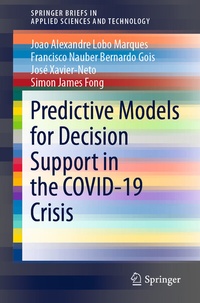
Predictive Models for Decision Support in the COVID-19 Crisis
Description

Readers from both healthcare industries and academia can gain unique insights on how predictive models were designed and applied on epidemic data. Taking COVID19 as a case study and showcasing the lessons learnt, this book will enable readers to be better prepared in the event of virus epidemics or pandemics in the future.
Reviews / Votes
"This book is . of great interest for mathematical modelers--it nicely summarizes many important tools, with concrete examples, that could be adapted for other situations. . I strongly recommend this book to advanced undergraduate engineers and mathematicians as well as specialists dealing with dynamical system modeling." (Arturo Ortiz-Tapia, Computing Reviews, July 26, 2022)More details
Other editions
Additional editions
Persons
Professor Francisco Nauber Bernardo Gois is an adjunct professor at the Federal University of Ceará. He holds a master's degree and a PhD from the University of Fortaleza, gained in 2010 and 2017 respectively. He has experience in computer science, with emphasis on machine learning and software testing, deep learning, continuous integration, testing and extreme programming.
Dr José Xavier Neto holds a medical degree from Federal University of Ceará and a PhD from the University of São Paulo, which he gained in 1989 and 1993 respectively. He has worked in medical research for decades, including his current role as the Chief Health Scientist of Ceará and a Visiting Professor at the Federal University of Ceará. He has been involved in creating an experimental model for developmental neuropathy induced by the Zika virus, as well as leading a multidisciplinary team which described the first fossilised heart.
Professor Simon James Fong gained his master's degree and PhD from La Trobe University in 1994 and 1998 respectively. He has worked in several academic positions, including his current role as Associate Professor at the University of Macau. He has been on the committee for several conferences, including acting as chair, and has worked as a book series editor. His research interests include data mining, artificial intelligence, machine learning, and biomedical applications.
