

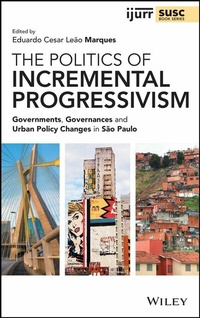
The Politics of Incremental Progressivism
Description

'Ungovernable neoliberal post politics assemblage metropolis from the South? No.
This book shows innovative redistributive policies, regulation, and social participation recently in São Paulo, although gradually, slowly, and contentiously, and despite failures and inequalities. This great one-city-many-policies comparison departs from high quality empirically grounded research to show that collective action and public policies are back in town. In São Paulo, they have made a difference.'
Patrick Le Galès, Sciences Po CNRS research Professor, Dean Sciences Po Urban School, France
'For anyone interested in urban governance, The Politics of Incremental Progressivism is a must-read. Nowhere in the world have cities faced greater challenges yet been more innovative in tackling the problems of urban poverty and exclusion than in Brazil. One could not ask for a more incisive, detailed and groundbreaking set of studies on urban transformation and the politics of change.'
Patrick Heller, Lyn Cross Professor of Social Sciences, Brown University, USA
Large metropolises of the Global South are usually portrayed as ungovernable. The Politics of Incremental Progressivism analyzes urban policies in São Paulo - one of the biggest and most complex Southern cities - not only challenging those views, but showing the recent occurrence of progressive change. This book develops the first detailed and systematic account of the policies and politics that construct, maintain and operate a large Southern metropolis. The chapters cover the policies of bus and subway transportation, traffic control, waste collection, development licensing, public housing and large urban projects, additionally to budgeting, electoral results and government formation and dynamics.
This important book contributes to the understanding of how the city is governed, what kinds of policies its governments construct and deliver and, more importantly, under what conditions it produces redistributive change in the direction of policies that reduce its striking social and urban inequalities.
More details
Other editions
Additional editions
Person
Content
List of Abbreviations and Acronyms ix
Series Editors' Preface x
Acknowledgments xi
Introduction 1
Eduardo Cesar Leão Marques
Part I Urban Politics and Political Institutions 43
1 Governments, Mayors and Policies 45
Eduardo Cesar Leão Marques and Telma Hoyler
2 The Politics of Executive-Legislative Relations 69
Eduardo Cesar Leão Marques and Telma Hoyler
3 The Politics of Municipal Budgets 92
Ursula Dias Peres
Part II Governing Urban Services 117
4 Struggling to Replace the Car Paradigm: Politics and Mobility Change 119
Carolina Requena
5 Increasingly Governing Bus Services Through Policy Instruments 136
Marcos Lopes Campos
6 Technocratic Decisions and Financial Arrangements in Subway Services 155
Daniela Costanzo
7 The Incremental Politics of Waste Management Regulation 175
Samuel Ralize de Godoy
Part III Governing Land and Housing 193
8 Continuities and Changes in the Diversification of Public Housing 195
Eduardo Cesar Leão Marques and Magaly Marques Pulhez
9 Developers and Politicians in the Institutionalizing of Development Regulation 217
Telma Hoyler
10 Conflicts and Incremental Change in Urban Renewal Instruments 235
Betina Sarue and Stefano Pagin
11 Circulation of Institutional Formats in Urban Regeneration: From São Paulo to Porto Maravilha 257
Betina Sarue
Conclusion: The Political Production of Incremental Progressivism 278
Eduardo Cesar Leão Marques
Index 287
Introduction
Eduardo Cesar Leão Marques
Chensiyuan, https://commons.wikimedia.org/wiki/File:1_aerial_photo_sao_paulo_brazil.JPG. CC BY SA-4.0,3.0,2.5,2.0,1.0
This book analyses government and public policies in São Paulo, one of the largest and most complex cities in the world. We are interested in understanding how this city is governed, what kinds of policies and services its governments construct and deliver, and, more importantly, under what conditions they produce policies to reduce its striking social and urban inequalities. In more general terms, what explains the emergence and production of redistributive change in a vast Southern metropolis like São Paulo?
As Ugalde and Le Galès (2017) discuss at length, large cities have usually been considered ungovernable, or almost, even in cases known for their robust policies and excellent average urban conditions, such as New York (Yates 1977), Boston and San Francisco (Ferman 1985), London (Gordon and Travers 2010) and European metropolises (Lefebvre 2010). Authors have highlighted deficits in the political authority and coordination capacity of city governments, advocating institutional reforms that could provide them with stronger powers. Interestingly enough, the excessive power of mayors was at the heart of political machine critiques in the United States. Transferring their power to councils and managers was the goal of urban reform in the early 1900s (Stewart 1950).
In large metropolises of poor and middle-income countries, the theme of ungovernability is not cyclical nor framed as a question of institutional reform, but prevalent and generalized. Ungovernability in these cases is supposedly due to their excessive sizes, inequalities, urban precarity, fragile political institutions, incapable bureaucracies, and corrupt and clientelist politicians, leading to precarious services, lack of planning, weak governments, policy failures and low policy innovation (Gilbert and Gugler 1982; Reddy and Rao 1985; Auyero 2000; Keefer 2005; Zunino 2006; Gilbert 2013; Oliveros 2016; Novaes 2018). For some, these challenges could be resolved through decentralization (Faguet and Pöschl 2015), increased participation (Goldfrank 2011), accepting these cities' informalities (Roy and Al Sayyad 2004), applying policy solutions produced elsewhere (Campbell 1997), or changing voting behaviors or political elites themselves (Gilbert 2013).
Indeed, the challenges of governing a city such as São Paulo are not small. In 2019, it had a population of 11.8 million inhabitants in a metropolitan region of 39 municipalities with just over 21 million inhabitants (about 10% of the country), roughly the size of metropolitan Mexico City or New York. Although it is the biggest and most important in the country, it has never been Brazil's national capital and was of little importance until the 1930s. Its urban inequalities are striking, with more than 3 million people living in favelas and irregular settlements, as well as extended peripheries with inadequate quality services and terrible accessibility conditions (Caldeira 2016; Marques 2016a; IBGE 2020). A similar scale is present in the daily tasks of policy provision: 20 100 tons of solid waste to collect, 7000 km of streets to sweep, 9.4 million bus journeys to provide (in almost 15 000 buses), around 110 km of traffic jams every afternoon and 2.9 million children to teach (in around 2700 public schools).1
In order to face these challenges, the city maintains a sizable administrative machine, which in 2018 amounted to approximately 122,600 active employees, most of them undertrained and underpaid. In fact, although its municipal budget is the largest of all Brazilian cities (corresponding to US$ 14 billion in 2020), this represents 17% of New York City's expenditure (US$ 82 billion in 2017) or 45% of what the London boroughs receive (US$ 30 billion in 2016) for much smaller populations of around 8.5 million inhabitants each.2 Institutional responsibilities indeed vary, but municipal responsibilities in Brazil are higher than in the United Kingdom or the United States due to its decentralized federalism. Additionally, political coordination is difficult considering the three tiers of government, as well as the horizontal negotiations between the 39 municipalities of the metropolitan region of São Paulo, not to mention the highly fragmented party system that amounted to no less than 17 political parties on the São Paulo municipal council in 2020.3
However, regardless of the many challenges faced by large-scale metropolises such as São Paulo, they are governed day-to-day, and their governments deliver policies regularly, albeit with quite different qualities, periodicities, and coverage. Additionally, governments very often do not only govern but also produce and change policies in directions that help reduce inequalities, as well as increase government capacities, even if through conflictual, slow, and incremental trajectories. These involve not only State actors, but also several others who - simultaneously - govern the city through policy-specific governance patterns (Le Galès 2011).
This has been the case of São Paulo since the country's return to democracy in the mid-1980s. The consideration of a broad set of urban policies and their programs over almost four decades shows a slow but incremental process of policy change that has allowed a reduction in inequality and a building of State capacity, although with different rhythms by policy area, despite the city's many urban, political and institutional challenges. This path of change becomes even more impressive when we consider that it happened in a relatively politically conservative city.
This book aims to understand these trajectories of change, as well as the processes and actors that produced them. To investigate this, we provide a broad account of the policies and politics that construct, maintain and operate a massive Southern metropolis, covering bus and subway transportation, traffic control, waste collection, development licensing, public housing and large urban projects, in addition to the topics of budgeting, electoral results and government formation. These policies are mainly developed by the municipality of São Paulo, except for the subway, presently developed by a state-level public company. We also examine the large-scale regeneration project Porto Maravilha in Rio de Janeiro. We included former policy among the ones examined here due to its importance to the construction of São Paulo's urban structure, while the latter comprises Brazil's most significant urban renovation project, developed mainly on instruments created in São Paulo (and discussed in a separate chapter). These two cases allow us to understand better the effects of the variation of political and institutional conditions in the municipality of São Paulo.
The list of policies studied omits some critical State actions usually performed by local governments such as education and healthcare, as well as by state governments such as policing. We took this decision for two reasons. First, we decided to focus on policies in which local governments exert ample discretion, leaving aside policies that are intensely regulated by the federal government through federal policy systems in Brazil as we will see later in this introduction, even if with essential municipal participation. Additionally, we decided to center the book on the policies directly associated with the production of the urban fabric itself, to be able to explore better the relationships between politics and policies on the one hand, and space on the other. As a result, we analyze through the book the main State activities developed worldwide for the construction and operation of cities.
These policies form a heterogeneous group that varies substantially in terms of its general features (regulatory frameworks, service provision and space production), financing (budget, fees, and fares), relations with urban land (creating demand for land or not) and formats of provision (directly implemented, through contracts, concessions, among others). These policies vary considering the actors, institutions and governance patterns that produce them, as well as the legacies that have shaped them. Irrespective of these differences, however, they all share the specificity of being embedded in urban spaces through locations, contiguities, and distances, embedding them in historically constructed spatial configurations. These spatial elements specify urban policies and politics concerning the national level, but also other scales of subnational politics (Le Galès 2020) since they interact with spatialized interests forged by the city's segregation patterns in path-dependent ways. In the case of urban politics, Harold Lasswell's 1936 formulation of politics as the process that defines "who gets what when and how" needs to be complemented with a "where" (Marques 2017). Studying this broad set of policies allows us to investigate their general trajectory in a large metropolis and the effects of their variation simultaneously.
In the following pages of this introduction, we establish the book's main points of departure and discuss its findings in dialogue with existing debates, as well as summarize its...
