

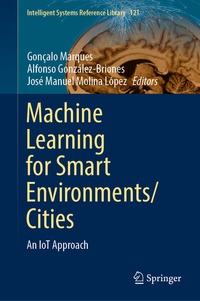
Machine Learning for Smart Environments/Cities
Description

This book introduces machine learning and its applications in smart environments/cities. At this stage, a comprehensive understanding of smart environment/city applications is critical for supporting future research. This book includes chapters written by researchers from different countries across the globe and identifies critical threads in research and also gaps that open up new and challenging lines of research for the future. Recent advances are discussed, and thorough reviews introduce readers to critical domains. The discussion on key research topics presented in this book accelerates smart city and smart environment implementations based on IoT technologies. Consequently, this book supports future research activities aimed at developing future IoT architectures for smart environments/cities.
More details
Other editions
Additional editions
Persons
Gonçalo Marques holds a Ph.D. in Computer Science Engineering and is Member of the Portuguese Engineering Association (Ordemdos Engenheiros). He is currently working as Assistant Professor lecturing courses on programming, multimedia, and database systems. Furthermore, he worked as Software Engineer in the Innovation and Development Unit of Groupe PSA automotive industry from 2016 to 2017 and in the IBM group from 2018 to 2019. His current research interests include Internet of things, enhanced living environments, machine learning, e-health, telemedicine, medical and healthcare systems, indoor air quality monitoring and assessment, and wireless sensor networks. He has more than 80 publications in international journals and conferences, is Frequent Reviewer of journals and international conferences, and is also involved in several edited books projects.
Alfonso González Briones holds a Ph.D. in Computer Engineering from the University of Salamanca since 2018, his thesis obtained the second place in the 1st SENSORS+CIRTI Award for the best national thesis in smart cities (CAEPIA 2018). At the same university, he obtained his Bachelor of Technical Engineer in Computer Engineering (2012), Degree in Computer Engineering (2013), and Masters in Intelligent Systems (2014). Alfonso was Project Manager of Industry 4.0 and IoT projects in the AIR Institute, Lecturer at the International University of La Rioja (UNIR), and also "Juan De La Cierva" Postdoc at University Complutense of Madrid. Currently, he is Assistant Professor at the University of Salamanca in the Department of Computer Science and Automatics. He has published more than 30 articles in journals, more than 60 articles in books and international congresses and has participated in 10 international research projects. He is also Member of the scientific committee of the Advances in Distributed Computing and Artificial Intelligence Journal (ADCAIJ) and British Journal of Applied Science & Technology (BJAST) and Reviewer of international journals (Supercomputing Journal, Journal of King Saud University, Energies, Sensors, Electronics or Applied Sciences, among others). He has participated as Chair and Member of the technical committee of prestigious international congresses (AIPES, HAIS, FODERTICS, PAAMS, KDIR).
José M. Molina is Full Professor at the Universidad Carlos III de Madrid. He joined the Computer Science Department of the Universidad Carlos III de Madrid in 1993. Currently, he coordinates the Applied Artificial Intelligence Group (GIAA). His current research focuses on the application of soft computing techniques (NN, Evolutionary Computation, Fuzzy Logic and Multiagent Systems) to radar data processing, air traffic management, e-commerce, and ambient intelligence. He has authored up to 100 journal papers and 200 conference papers. He received a degree in Telecommunications Engineering in 1993 and a Ph.D. degree in 1997 both from the Universidad Politécnica de Madrid.
