

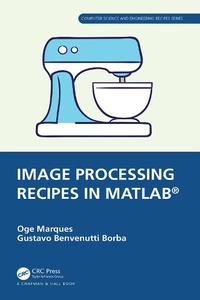
Image Processing Recipes in MATLAB (R)
1st Edition
Published on 16. May 2024
262 pages
978-1-040-02403-4 (ISBN)
Description

Leveraging the latest developments in MATLAB and its image processing toolbox, this 'cookbook' is a collection of 30 practical recipes for image processing, ranging from foundational techniques to recently published algorithms. Presented in a clear and meaningful sequence, these recipes are prepared with the reader in mind, allowing one to focus on particular topics or read as a whole from cover to cover.
Key Features:
A practical, user-friendly guide that equips researchers and practitioners with the tools to implement efficient image processing workflows in MATLAB.
Each recipe is presented through clear, step-by-step instructions and rich visual examples.
Each recipe contains its own source code, explanations, and figures, making the book an excellent standalone resource for quick reference.
Strategically structured to aid sequential learning, yet with self-contained chapters for those seeking solutions to specific image processing challenges.
The book serves as a concise and readable practical reference to deploy image processing pipelines in MATLAB quickly and efficiently. With its accessible and practical approach, the book is a valuable guide for those who navigate this evolving area, including researchers, students, developers, and practitioners in the fields of image processing, computer vision, and image analysis.
Key Features:
A practical, user-friendly guide that equips researchers and practitioners with the tools to implement efficient image processing workflows in MATLAB.
Each recipe is presented through clear, step-by-step instructions and rich visual examples.
Each recipe contains its own source code, explanations, and figures, making the book an excellent standalone resource for quick reference.
Strategically structured to aid sequential learning, yet with self-contained chapters for those seeking solutions to specific image processing challenges.
The book serves as a concise and readable practical reference to deploy image processing pipelines in MATLAB quickly and efficiently. With its accessible and practical approach, the book is a valuable guide for those who navigate this evolving area, including researchers, students, developers, and practitioners in the fields of image processing, computer vision, and image analysis.
More details
Series
Edition
1. Auflage
Language
English
Place of publication
London
United Kingdom
Publishing group
Taylor & Francis Ltd
Target group
Professional and scholarly
Illustrations
4 Tables, black and white; 6 Line drawings, color; 5 Line drawings, black and white; 84 Halftones, color; 35 Halftones, black and white; 90 Illustrations, color; 40 Illustrations, black and white
ISBN-13
978-1-040-02403-4 (9781040024034)
Copyright in bibliographic data and cover images is held by Nielsen Book Services Limited or by the publishers or by their respective licensors: all rights reserved.
Schweitzer Classification
Other editions
Additional editions

Oge Marques
Image Processing Recipes in MATLAB
Book
07/2024
CRC Press
Unfortunately, price unknown
Article exhausted; check different version
Oge Marques | Gustavo Benvenutti Borba
Image Processing Recipes in MATLAB (R)
Book
05/2024
1st Edition
Chapman & Hall/CRC
€85.00
Shipment within 15-20 days
Oge Marques | Gustavo Benvenutti Borba
Image Processing Recipes in MATLAB (R)
Book
05/2024
1st Edition
Chapman & Hall/CRC
€116.00
Shipment within 15-20 days
Persons
Oge Marques, PhD is a Professor of Computer Science and Engineering in the College of Engineering and Computer Science, a Professor of Biomedical Science (Secondary) in the Charles E. Schmidt College of Medicine, and a Professor of Information Technology (by courtesy), in the College of Business at Florida Atlantic University (FAU) (Boca Raton, FL).
He is the author of 12 technical books, one patent, and more than 130 refereed scientific articles on image processing, medical image analysis, computer vision, artificial intelligence, and machine learning.
Dr. Marques is a Senior Member of both the IEEE (Institute of Electrical and Electronics Engineers) and the ACM (Association for Computing Machinery), Fellow of the NIH AIM-AHEAD Consortium, Fellow of the Leshner Leadership Institute of the American Association for the Advancement of Science (AAAS), Tau Beta Pi Eminent Engineer, and member of the honor societies of Sigma Xi, Phi Kappa Phi, and Upsilon Pi Epsilon.
Gustavo Benvenutti Borba, PhD is an Associate Professor in the Department of Electronics and the Graduate School on Biomedical Engineering at the Federal University of Technology-Parana (UTFPR) (Curitiba, Brazil).
He obtained his PhD in Electrical Engineering from UTFPR. He is the author of more than 30 refereed scientific articles on image processing, image retrieval, and related topics.
He is the author of 12 technical books, one patent, and more than 130 refereed scientific articles on image processing, medical image analysis, computer vision, artificial intelligence, and machine learning.
Dr. Marques is a Senior Member of both the IEEE (Institute of Electrical and Electronics Engineers) and the ACM (Association for Computing Machinery), Fellow of the NIH AIM-AHEAD Consortium, Fellow of the Leshner Leadership Institute of the American Association for the Advancement of Science (AAAS), Tau Beta Pi Eminent Engineer, and member of the honor societies of Sigma Xi, Phi Kappa Phi, and Upsilon Pi Epsilon.
Gustavo Benvenutti Borba, PhD is an Associate Professor in the Department of Electronics and the Graduate School on Biomedical Engineering at the Federal University of Technology-Parana (UTFPR) (Curitiba, Brazil).
He obtained his PhD in Electrical Engineering from UTFPR. He is the author of more than 30 refereed scientific articles on image processing, image retrieval, and related topics.
Content
I Basic Image Processing: Acquisition and Visualisation
Recipe 1: Loading, Displayng and Savng Images
Recipe 2: Image Conversion
Recipe 3: Image Acquisition Using a Webcam
Recipe 4: Browsing Through Images
II Geometric Operations
Recipe 5: Geometric Transformations
Recipe 6: Image Warping
III Histograms
Recipe 7: Histograms and Statistcs of Grayscale Images
Recipe 8: Histogram Equalization and Histogram Matching
Recipe 9: Individual Channel Histograms of Color Images
Recipe 10: Combined Color Histograms and Dominant Colors in an Image
IV Point Transformations
Recipe 11: Intensity Transformation Functions
Recipe 12: Custom Point Transformation Functions
Recipe 13: Gamma Corrections
Recipe 14: Leveling Non-Uniform Illumination
V Spatial Filtering and Special Effects
Recipe 15: Smoothing Filters
Recipe 16: Sharpening Filters
Recipe 17: Other Image Filters and Special Effects
VI Image Segmentation
Recipe 18: Image Binarization
Recipe 19: Region-Based Segmentation
Recipe 20: Image Segmentation Using K-Means Clustering
Recipe 21: Superpixel Oversegmentation Using SLIC
Recipe 22: Graph-based Segmentation
VII Binary Image Analysis
Recipe 23: Finding, Counting and Accessing Connected Components in Binary Images
Recipe 24: Basic Morphological Operations
Recipe 25: Computing COnnected Components' Features
VIII Color Image Processing
Recipe 26: Converting Among Different Color Spaces
Recipe 27: Color Image Adjustments
Recipe 28: Image Pseudocoloring
IX Batch Processing and Handling Large Images
Recipe 29: Processing Very Large Images
Recipe 30: Batch Processing a Set of Images
Recipe 1: Loading, Displayng and Savng Images
Recipe 2: Image Conversion
Recipe 3: Image Acquisition Using a Webcam
Recipe 4: Browsing Through Images
II Geometric Operations
Recipe 5: Geometric Transformations
Recipe 6: Image Warping
III Histograms
Recipe 7: Histograms and Statistcs of Grayscale Images
Recipe 8: Histogram Equalization and Histogram Matching
Recipe 9: Individual Channel Histograms of Color Images
Recipe 10: Combined Color Histograms and Dominant Colors in an Image
IV Point Transformations
Recipe 11: Intensity Transformation Functions
Recipe 12: Custom Point Transformation Functions
Recipe 13: Gamma Corrections
Recipe 14: Leveling Non-Uniform Illumination
V Spatial Filtering and Special Effects
Recipe 15: Smoothing Filters
Recipe 16: Sharpening Filters
Recipe 17: Other Image Filters and Special Effects
VI Image Segmentation
Recipe 18: Image Binarization
Recipe 19: Region-Based Segmentation
Recipe 20: Image Segmentation Using K-Means Clustering
Recipe 21: Superpixel Oversegmentation Using SLIC
Recipe 22: Graph-based Segmentation
VII Binary Image Analysis
Recipe 23: Finding, Counting and Accessing Connected Components in Binary Images
Recipe 24: Basic Morphological Operations
Recipe 25: Computing COnnected Components' Features
VIII Color Image Processing
Recipe 26: Converting Among Different Color Spaces
Recipe 27: Color Image Adjustments
Recipe 28: Image Pseudocoloring
IX Batch Processing and Handling Large Images
Recipe 29: Processing Very Large Images
Recipe 30: Batch Processing a Set of Images
