

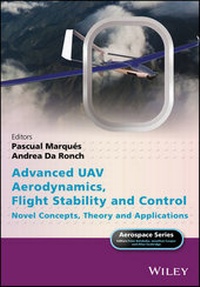
Advanced UAV Aerodynamics, Flight Stability and Control
Description

More details
Other editions
Additional editions
Persons
Content
1
Advanced UAV Aerodynamics, Flight Stability and Control: An Introduction
Pascual Marqués
Marques Aviation Ltd, Southport, UK
'For some years I have been afflicted with the belief that flight is possible to man.'
Wilbur Wright, 13 May 1900.
This introductory chapter is divided into two main sections: Section 1.1 on unmanned aircraft aerodynamics and Section 1.2 on flight stability, and control. The chapter addresses fundamental principles of aerodynamics, flight stability and control and forms a knowledge base for the student of aerospace engineering before proceeding to more advanced chapters in this book. The chapter includes classroom problems.
1.1 Unmanned Aircraft Aerodynamics
1.1.1 Introduction: UAV Categories and Configurations
Unmanned aerial vehicle (UAV) size categories range from nano air vehicles (NAV) with a wing span of only 4 cm to high-altitude long-endurance (HALE) aircraft with a wing span of 35 m or more. In between, UAV categories include micro (MAV), mini, close-range, medium-range or tactical and medium-altitude long-endurance (Figure 1.1). The fluid medium in which an NAV operates is highly viscous, whereas the fluid flow around large (normally manned) aircraft is dominated by inertial effects. Consequently, aerodynamic characteristics vary considerably according to the size of the vehicle.
Figure 1.1 General Atomics RQ-1A Predator.
(Photo: USAF Museum).
The aeronautical configuration of a UAV is closely related to its operational mission requirements and dictated by airspeed, endurance and operational range. Whether the vehicle is fixed-wing or rotary-wing is determined by the speed requirements. HALE surveillance aircraft necessitate a high aspect ratio (AR) wing for flight at high altitude. In contrast, Unmanned Combat Air Vehicles (UCAVs) operate at high airspeed and perform rapid manoeuvers and therefore have low AR wings. Civilian or military applications that involve operation from off-board a ship benefit from vertical take-off and landing capability of the aircraft. Fixed-wing configurations include tailplane aft, tailplane forward or canard, and tailless types.
The conventional tailplane aft designs usually have the horizontal stabiliser positioned aft on the fuselage or connected to the wings by booms. The aircraft's centre of gravity (CG) is often forward of the aerodynamic centre (AC), which creates a nose-down pitching moment. To this negative moment must be added the nose-down moment characteristic of cambered wings. The net nose-down moment is balanced by a down-load on the tailplane.
In a canard configuration, both the foreplane and the CG are located forward of the wing. Equilibrium in pitch is achieved by the positive lift generated by the foreplane. The canard design is aerodynamically more efficient than the tailplane aft design, as both the horizontal stabiliser and the wing produce positive lift.
Tailless types include the flying wing and delta configurations. Tailless types have sweptback wings and an effective tail. The airfoils at the wingtips are set at a lower incidence than the airfoils of the inner wing, in a washout configuration to provide stability in pitch. The absence of a horizontal stabiliser reduces profile drag. However, wing sweepback in the flying wing leads to poor lift distribution, high induced drag and negative lift at high airspeeds. Delta wings have a low AR, poor lift distribution and higher induced drag caused by high span loading.
In the majority of UAVs, the powerplant is mounted at the rear of the fuselage. This arrangement makes the front of the aircraft available for the installation of a payload and allows an unobstructed view forward. There are also aerodynamic advantages when using a rear-mounted propeller. The friction drag induced by the slipstream ahead of the pusher propeller is less than the drag generated by a front-mounted tractor propeller. Ubiquitous types of rotary-wing UAVs are the single-main rotor and quad rotor (Figure 1.2). Other alternatives in design are the co-axial rotor and hybrid configurations such as the tilt-rotor and tilt-wing.
Figure 1.2 Aeryon Scout VTOL MAV with gyro-stabilized camera payload.
Photo: Dkroetsch CC-BY-3.0.
1.1.2 Theoretical Aerodynamics
Aerodynamic analysis of novel concepts in UAV design can be conducted using a number of methodologies that range from traditional aerodynamic theories to modern computational fluid dynamics (CFD). Thin-airfoil theory is an analytical method that predicts lift as a function of angle of attack and assumes idealised incompressible inviscid flow. The theory can be applied to airfoils of thickness no greater than 12% of the chord (c) at low angles of attack (below the stall). Thin-airfoil theory was developed by German-American mathematician Max Munk and further refined by British aerodynamicist Hermann Glauert in the 1920s. The theory provides a sound theoretical foundation for modern aerodynamic theories. Prandtl's lifting-line theory is a mathematical model for the prediction of the lift distribution along the span of a three-dimensional wing (Figure 1.3). In the model, the vortex strength varies elliptically along the wingspan and the loss in vortex strength is shed as a vortex-sheet from the trailing edge. Lift distribution is obtained from the wing geometry (constituent airfoil, taper, twist) and freestream conditions; that is, air density and flow velocity. Modified versions of the classical lifting-line theory are used to compute the lift distribution in geometrically- or aerodynamically-twisted wings.
Figure 1.3 Prandtl's classical lifting-line theory. L´, lift per unit span; ?8 , air density; V 8, freestream velocity; G(y), circulation; Di , induced drag.
The vortex panel method is a numerical method that permits the computation of airfoil lift assuming ideal flow in which the effects of compressibility and viscosity are negligible. In this method, the shape of the airfoil surface is reconstructed using a series of vortex panels or line segments arranged to form a closed polygon. Vortex sheets mimic the boundary layer around the airfoil. The vortex sheets represent miniature vortices that give rise to circulation, hence lift.
1.1.3 Flight Regimes and Reynolds Number
The Reynolds number (Re) is a dimensionless number that indicates the ratio of inertial forces to viscous forces for given flow conditions. The concept is named after Osborne Reynolds who introduced its use in 1883. The Re characterizes different flow regimes. Laminar flow occurs at low Res, where viscous forces dominate. Turbulent flow occurs at high Res where inertial forces predominate. Small UAVs operate in the Re regime between 3 × 10⁴ and 5 × 10⁵. For operation at low Re, the design of efficient airfoils is critical. At 3 × 104 = Re = 7 × 10⁴, relatively thick airfoils (=6% thickness) can experience considerable hysteresis as a result of the lift and drag forces caused by laminar separation and transition to turbulent flow. Below Re values of 5 × 10⁴, laminar separation occurs and the flow does not transition and it does not reattach to the airfoil surface. At 7 × 104 = Re = 2 × 10⁵, extensive laminar flow over the surfaces of the airfoil can be attained, which reduces airfoil drag. However, in some airfoils a laminar separation bubble forms in this flight regime. At Re values above 2 × 10⁵, airfoils become more efficient. The bubble is shorter and parasite drag decreases. The flight regime of large UAVs is in the region of Re = 3 × 10⁶. At high Re values, the laminar boundary layer transitions to turbulent a short distance downstream of the wing's leading edge. Laminar separation and separation bubbles do not occur.
1.1.4 Airfoils for UAVs
The cost of operation of a UAV can be reduced with airfoil optimization and improvements in the vehicle's aerodynamic efficiency. Considerations when selecting an airfoil for a UAV include a high maximum lift coefficient (c lmax), high lift-to-drag ratio (cl /c d), high endurance factor (c l 3/2/c d), effectiveness at low Re values, low pitching moment coefficient to minimize the load on the tail, mild stall characteristics, insensitivity to surface roughness caused by rain or dust, good flap performance, and minimal airfoil complexity for ease of manufacture. Airfoils originally designed for operation at high Re for manned aircraft (3 × 106 = Re = 6 × 10⁶) are often adapted for UAVs that operate in the low-Re flight regime (e.g., 5 × 105 = Re = 1.5 × 10⁶). The...
