

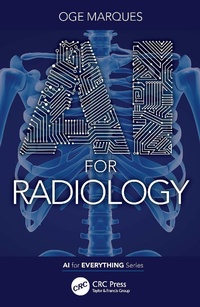
AI for Radiology
1st Edition
Published on 12. February 2024
236 pages
978-1-003-83639-1 (ISBN)
Description

Artificial intelligence (AI) has revolutionized many areas of medicine and is increasingly being embraced. This book focuses on the integral role of AI in radiology, shedding light on how this technology can enhance patient care and streamline professional workflows.
This book reviews, explains, and contextualizes some of the most current, practical, and relevant developments in artificial intelligence and deep learning in radiology and medical image analysis. AI for Radiology presents a balanced viewpoint of the impact of AI in these fields, underscoring that AI technologies are not intended to replace radiologists but rather to augment their capabilities, freeing professionals to focus on more complex cases. This book guides readers from the basic principles of AI to their practical applications in radiology, moving from the role of data in AI to the ethical and regulatory considerations of using AI in radiology and concluding with a selection of resources for further exploration.
This book has been crafted with a diverse readership in mind. It is a valuable asset for medical professionals eager to stay up to date with AI developments, computer scientists curious about AI's clinical applications, and anyone interested in the intersection of healthcare and technology.
This book reviews, explains, and contextualizes some of the most current, practical, and relevant developments in artificial intelligence and deep learning in radiology and medical image analysis. AI for Radiology presents a balanced viewpoint of the impact of AI in these fields, underscoring that AI technologies are not intended to replace radiologists but rather to augment their capabilities, freeing professionals to focus on more complex cases. This book guides readers from the basic principles of AI to their practical applications in radiology, moving from the role of data in AI to the ethical and regulatory considerations of using AI in radiology and concluding with a selection of resources for further exploration.
This book has been crafted with a diverse readership in mind. It is a valuable asset for medical professionals eager to stay up to date with AI developments, computer scientists curious about AI's clinical applications, and anyone interested in the intersection of healthcare and technology.
Reviews / Votes
"The book is not just about the present state of affairs. It offers a vision, exploring the future trajectories of AI in radiology, addressing challenges, controversies, and the endless possibilities on the horizon.Having witnessed Oge's dedication and forward-thinking approach firsthand, I am confident that this book will serve as an invaluable resource. For those stepping into the realm of AI in radiology or seeking to deepen their knowledge, this book provides a holistic, scientifically rigorous, and practical guide...I wholeheartedly believe that it will stand as a cornerstone for all enthusiasts eager to delve into the world of AI in Radiology."
--Felipe Kitamura, MD, PhD
Director of Applied Innovation and AI at Dasa
Affiliated Professor of Radiology at Universidade Federal de Sao Paulo
More details
Series
Edition
1. Auflage
Language
English
Place of publication
London
United Kingdom
Publishing group
Taylor & Francis Ebooks
Target group
Professional and scholarly
Illustrations
1 Tables, black and white; 2 Line drawings, color; 4 Line drawings, black and white; 2 Illustrations, color; 4 Illustrations, black and white
ISBN-13
978-1-003-83639-1 (9781003836391)
Copyright in bibliographic data and cover images is held by Nielsen Book Services Limited or by the publishers or by their respective licensors: all rights reserved.
Schweitzer Classification
Other editions
Additional editions
Person
Oge Marques, PhD, is Professor of Computer Science and Engineering in the College of Engineering and Computer Science, Professor of Biomedical Science (Secondary) in the Charles E. Schmidt College of Medicine, and Professor of Information Technology (by courtesy), in the College of Business at Florida Atlantic University (Boca Raton, FL - USA).
He is the author of 12 technical books, one patent, and more than 130 refereed scientific articles on image processing, medical image analysis, computer vision, artificial intelligence, and machine learning. He is a senior member of both the Institute of Electrical and Electronics Engineers and the Association for Computing Machinery, Fellow of the National Institutes of Health AIM-AHEAD Consortium, Fellow of the Leshner Leadership Institute of the American Association for the Advancement of Science, Tau Beta Pi Eminent Engineer, and member of the honor societies of Sigma Xi, Phi Kappa Phi, and Upsilon Pi Epsilon.
He is the author of 12 technical books, one patent, and more than 130 refereed scientific articles on image processing, medical image analysis, computer vision, artificial intelligence, and machine learning. He is a senior member of both the Institute of Electrical and Electronics Engineers and the Association for Computing Machinery, Fellow of the National Institutes of Health AIM-AHEAD Consortium, Fellow of the Leshner Leadership Institute of the American Association for the Advancement of Science, Tau Beta Pi Eminent Engineer, and member of the honor societies of Sigma Xi, Phi Kappa Phi, and Upsilon Pi Epsilon.
Content
1 Artificial Intelligence and Medicine: The Big Picture
2 AI in Radiology: From Fear to Leadership
3 Fundamentals of Machine Learning and Deep Learning
4 Fundamentals of Medical Image Analysis
5 Data: The Essential Ingredient in AI Solutions
6 Clinical Applications of AI in Radiology
7 Harnessing AI in Radiology Education and Training
8 Getting Started with Deep Learning in Medical Imaging
9 The Future of AI in Radiology
10 Resources for Further Learning
2 AI in Radiology: From Fear to Leadership
3 Fundamentals of Machine Learning and Deep Learning
4 Fundamentals of Medical Image Analysis
5 Data: The Essential Ingredient in AI Solutions
6 Clinical Applications of AI in Radiology
7 Harnessing AI in Radiology Education and Training
8 Getting Started with Deep Learning in Medical Imaging
9 The Future of AI in Radiology
10 Resources for Further Learning
