

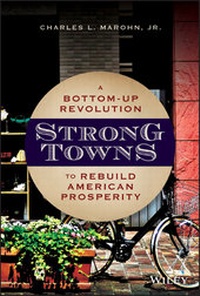
Strong Towns
A Bottom-Up Revolution to Rebuild American Prosperity
1st Edition
Published on 25. September 2019
256 pages
978-1-119-56515-4 (ISBN)
Description

A new way forward for sustainable quality of life in cities of all sizes
Strong Towns: A Bottom-Up Revolution to Build American Prosperity is a book of forward-thinking ideas that breaks with modern wisdom to present a new vision of urban development in the United States. Presenting the foundational ideas of the Strong Towns movement he co-founded, Charles Marohn explains why cities of all sizes continue to struggle to meet their basic needs, and reveals the new paradigm that can solve this longstanding problem.
Inside, you'll learn why inducing growth and development has been the conventional response to urban financial struggles--and why it just doesn't work. New development and high-risk investing don't generate enough wealth to support itself, and cities continue to struggle. Read this book to find out how cities large and small can focus on bottom-up investments to minimize risk and maximize their ability to strengthen the community financially and improve citizens' quality of life.
* Develop in-depth knowledge of the underlying logic behind the "traditional" search for never-ending urban growth
* Learn practical solutions for ameliorating financial struggles through low-risk investment and a grassroots focus
* Gain insights and tools that can stop the vicious cycle of budget shortfalls and unexpected downturns
* Become a part of the Strong Towns revolution by shifting the focus away from top-down growth toward rebuilding American prosperity
Strong Towns acknowledges that there is a problem with the American approach to growth and shows community leaders a new way forward. The Strong Towns response is a revolution in how we assemble the places we live.
Strong Towns: A Bottom-Up Revolution to Build American Prosperity is a book of forward-thinking ideas that breaks with modern wisdom to present a new vision of urban development in the United States. Presenting the foundational ideas of the Strong Towns movement he co-founded, Charles Marohn explains why cities of all sizes continue to struggle to meet their basic needs, and reveals the new paradigm that can solve this longstanding problem.
Inside, you'll learn why inducing growth and development has been the conventional response to urban financial struggles--and why it just doesn't work. New development and high-risk investing don't generate enough wealth to support itself, and cities continue to struggle. Read this book to find out how cities large and small can focus on bottom-up investments to minimize risk and maximize their ability to strengthen the community financially and improve citizens' quality of life.
* Develop in-depth knowledge of the underlying logic behind the "traditional" search for never-ending urban growth
* Learn practical solutions for ameliorating financial struggles through low-risk investment and a grassroots focus
* Gain insights and tools that can stop the vicious cycle of budget shortfalls and unexpected downturns
* Become a part of the Strong Towns revolution by shifting the focus away from top-down growth toward rebuilding American prosperity
Strong Towns acknowledges that there is a problem with the American approach to growth and shows community leaders a new way forward. The Strong Towns response is a revolution in how we assemble the places we live.
More details
Other editions
Additional editions
Charles Marohn
Strong Towns: A Bottom-Up Revolution to Rebuild American Prosperity
A Bottom-Up Revolution to Rebuild American Prosperity
Book
11/2019
1st Edition
Wiley
€25.00
Shipment within 15-20 days
Content
- Intro
- Strong Towns
- Contents
- Foreword
- Chapter 1: Human Habitat
- Complex, Adaptive Systems
- Spooky Wisdom
- Systems That Are Merely Complicated
- Notes
- Chapter 2: Incremental Growth
- Complex versus Complicated Buildings
- Neighborhood Renewal
- The Stifling Nature of High Land Values
- Private and Public Investment
- The Party Analogy
- Note
- Chapter 3: An Infinite Game
- An Infinite Game
- Revenues and Expenses
- Infrastructure Not as a Means, but as an End
- The Municipal Ponzi Scheme
- The Illusion of Wealth
- Understanding Detroit
- Notes
- Chapter 4: The Infrastructure Cult
- The American Society of Civil Engineers
- Real Investment, Paper Returns
- Accounting for Infrastructure
- Assuming Secondary Effects
- A Real Return on Investment
- The Data Doesn't Lie
- Notes
- Chapter 5: Growth or Stability
- Where Does Strength Come From?
- Depression Economics
- The Last Country Standing
- The Post-War Boom
- Struggling with Constraints
- Going All In on Debt
- Does Growth Serve Us?
- The Difference Between Growth and Wealth
- A Paradox of Thrift or Avarice?
- Notes
- Chapter 6: Rational Responses
- A Long Decline
- Restoration of Normal
- Making Difficult Decisions within a Complex, Adaptive System
- Notes
- Chapter 7: Productive Places
- A Simple Math Problem
- The Financial Strength of the Old and Blighted
- Downtown versus the Edge
- Value per Acre
- Lafayette's Return on Investment
- Personal Preferences
- Notes
- Chapter 8: Making Strong Investments
- The Barbell Investment Approach
- Low-Risk Investments with Steady Returns
- Little Bets
- Filling in the Gaps
- Prudent Constraints
- Suburban Retrofit
- Notes
- Chapter 9: Place-Oriented Government
- The Local Government Response to Hardship
- Designed for Efficiency
- A Focus on Broad Wealth Creation
- Celebrate Maintenance
- Recognizing Our Confirmation Bias
- Understanding Debt
- Negative Knowledge
- Subsidiarity
- Notes
- Chapter 10: An Intentional Life
- Moving to a Neighborhood
- A Good, Long Walk
- Talking to Each Other
- A Life of Meaning
- Notes
- Afterword
- Acknowledgments
- About Strong Towns
- Get Involved in the Strong Towns Movement
- About the Author
- Index
- EULA
