

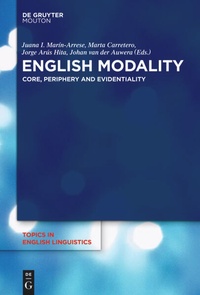
English Modality
Description

The book presents new issues and areas of work in modality and evidentiality in English(es), and in relation to other European languages (French, Galician, Lithuanian, Spanish). Given the complexity of the relations among modal and evidential expressions, their constant diachronic evolution, and the variation found in different English-speaking areas, and in different genres and discourse domains, the volume addresses the following issues: the conceptual nature of modality, the relationship between the domains of modality and evidentiality, the evolution and current status of the modal auxiliaries and other modal expressions, the relationship with neighbouring grammatical categories (tense, aspect, mood), and the variation in different discourse domains and genres, in modelling stance and discourse identities.
More details
Other editions
Additional editions
Persons
Content
- Intro
- Acknowledgements
- List of contributors
- Part I: Core modality
- Modals: Striving for control
- Contemporary change in modal usage in spoken British English: mapping the impact of "genre"
- Where have all the modals gone? An essay on the declining frequency of core modal auxiliaries in recent standard English
- Part II: Peripheral modality
- Had better, 'd better and better: Diachronic and transatlantic variation
- Grammatical colloquialism and the English quasi-modals: a comparative study
- Modal necessity and impersonality in English and Galician
- Modal uses of the English present progressive
- On the generic argument for the modality of will
- Part III: Evidentiality and Modality
- REALITY and related concepts: towards a semantic-pragmatic map of English adverbs
- A cross-linguistic look at the multifunctionality of the English verb seem
- Annotating English adverbials for the categories of epistemic modality and evidentiality
- Part IV: Evidentiality and Modality in Discourse
- Modal verbs in news-related blogs: When the blogger counts
- Modality and personal pronouns as indexical markers of stance: Intersubjective positioning and construction of public identity in media interviews
- Stancetaking and inter/subjectivity in the Iraq Inquiry: Blair vs. Brown
- Subject index
