

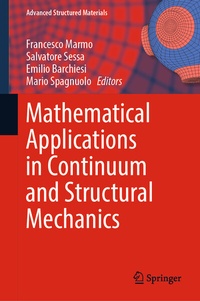
Mathematical Applications in Continuum and Structural Mechanics
Description

This book presents a range of research projects focusing on innovative numerical and modeling strategies for the nonlinear analysis of structures and metamaterials. The topics covered concern various analysis approaches based on classical finite element solutions, structural optimization, and analytical solutions in order to present a comprehensive overview of the latest scientific advances. Although based on pioneering research, the contributions are focused on immediate and direct application in practice, providing valuable tools for researchers and practicing professionals alike.
More details
Other editions
Additional editions
Persons
Francesco Marmo, Ph.D., is an assistant professor of Structural and Continuum Mechanics at the University of Naples Federico II. His research interests concern a broad variety of topics including nonlinear analysis of structures with finite elements and limit analysis of structures with a particular focus on masonry vaults, stairs, and domes. More recently, he has investigated structural shape optimization problems and bio-inspired topologies. He teaches undergraduate and graduate courses on continuum mechanics and finite element structural analysis.
Salvatore Sessa, Ph.D., is an assistant professor of Structural and Continuum Mechanics at the University of Naples Federico II. His research activities are focused on nonlinear analysis of structures and inverse identification and stochastic dynamics. Recently, he has also explored shell finite elements and transverse confinement solutions for masonry structures. He teaches undergraduate courses on Structural and Continuum Mechanics for the university's bachelor program in Architecture.
Dr. Emilio Barchiesi received his master's degree in Mathematical Engineering from the University of L'Aquila, completed his Ph.D. in Theoretical and Applied Mechanics at the University of Rome La Sapienza, and has been a visiting researcher at the Institute of Mechanics, TU BERLIN. His research activities are focused on generalized continua and microstructured materials, especially homogenization procedures for obtaining the second gradient continua.Dr. Mario Spagnuolo received his master's degree in Theoretical Physics from the University of Naples Federico II and completed his Ph.D. in Mechanics of Materials at the University Paris XIII, funded by the European Union's Horizon 2020 research and innovation program under a Marie Sklodowska-Curie Grant. His research activities are focused on generalized continua, microstructured materials, and various kinds of homogenization procedures.
