

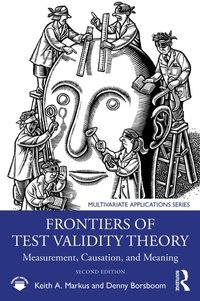
Frontiers of Test Validity Theory
Measurement, Causation, and Meaning
2nd Edition
Published on 30. December 2024
444 pages
978-1-040-14889-1 (ISBN)
Description

Now in its second edition, this important book examines test validity in the behavioral, social, and educational sciences by exploring three fundamental problems: measurement, causation, and meaning. Psychometric and philosophical perspectives and unresolved issues receive attention, as the authors explore how measurement is conceived from both the classical and modern perspectives.
Split into three accessible sections, the first contrasts theories of measurement as applied to the validity of behavioral science measures, and the second considers causal theories of measurement as well as alternative theories of causation. The final section explores the meaning and interpretation of test scores as they apply to test validity, offering a conceptual overview of the field and its current state. Each carefully revised chapter begins with an overview of key theories and literature, concludes with a list of suggested readings, and features boxes with real-life situations that connect theory to practice. Examples of specific issues include:
How tests can assess an attribute without measuring it.
The role of values in test validity.
Interpreting responses to the same question in different languages.
Researchers, practitioners, and policy makers interested in test validity or developing tests will appreciate the book's cutting-edge review of test validity. Focusing on both the underlying concepts, as well as practical challenges of test construction and use, it also serves as a supplement in graduate or advanced undergraduate courses on test validity, psychometrics, testing, or measurement taught in psychology, education, sociology, social work, political science, business, criminal justice, and other fields. The book does not assume a background in measurement.
Split into three accessible sections, the first contrasts theories of measurement as applied to the validity of behavioral science measures, and the second considers causal theories of measurement as well as alternative theories of causation. The final section explores the meaning and interpretation of test scores as they apply to test validity, offering a conceptual overview of the field and its current state. Each carefully revised chapter begins with an overview of key theories and literature, concludes with a list of suggested readings, and features boxes with real-life situations that connect theory to practice. Examples of specific issues include:
How tests can assess an attribute without measuring it.
The role of values in test validity.
Interpreting responses to the same question in different languages.
Researchers, practitioners, and policy makers interested in test validity or developing tests will appreciate the book's cutting-edge review of test validity. Focusing on both the underlying concepts, as well as practical challenges of test construction and use, it also serves as a supplement in graduate or advanced undergraduate courses on test validity, psychometrics, testing, or measurement taught in psychology, education, sociology, social work, political science, business, criminal justice, and other fields. The book does not assume a background in measurement.
More details
Series
Edition
2nd edition
Language
English
Place of publication
London
United Kingdom
Publishing group
Taylor & Francis Ltd
Target group
Professional and scholarly
Illustrations
5 Tables, black and white; 31 Line drawings, black and white; 31 Illustrations, black and white
File size
6,31 MB
ISBN-13
978-1-040-14889-1 (9781040148891)
Copyright in bibliographic data and cover images is held by Nielsen Book Services Limited or by the publishers or by their respective licensors: all rights reserved.
Schweitzer Classification
Other editions
Additional editions
Keith A. Markus | Denny Borsboom
Frontiers of Test Validity Theory
Measurement, Causation, and Meaning
Book
12/2024
2nd Edition
Routledge
€81.90
Shipment within 10-20 days
Keith A. Markus | Denny Borsboom
Frontiers of Test Validity Theory
Measurement, Causation, and Meaning
Book
12/2024
2nd Edition
Routledge
€197.70
Shipment within 10-20 days
Persons
Keith A. Markus is a Professor in the Department of Psychology at John Jay College of Criminal Justice of The City University of New York (CUNY), USA.
Denny Borsboom is a Professor in the Department of Psychology at the University of Amsterdam, The Netherlands.
Denny Borsboom is a Professor in the Department of Psychology at the University of Amsterdam, The Netherlands.
Content
1. Introduction: Surveying the Field of Test Validity Theory
Part I. Measurement
2. Philosophical Theories of Measurement
3. Psychometric Models
4. Open Issues in Measurement Theory and Psychometrics
Part II. Causation
5. Test Scores as Samples: Behavior Domain Theory
6. Causality in Measurement
7. Causation, Correlation, and Reflective Measurement Models
8. Problems in Causation and Validity: Formative Measurement, Networks, and Individual Differences
Part III. Meaning
9. Interpreting Test Responses: Validity, Values, and Evaluation
10. A Model of Test Score Interpretation
11. Open Questions About Test Score Meaning
Part IV. Conclusion
12. An Integrative View of Test Validity
13. Epilogue as Dialog: The Future of Test Validity Theory
Part I. Measurement
2. Philosophical Theories of Measurement
3. Psychometric Models
4. Open Issues in Measurement Theory and Psychometrics
Part II. Causation
5. Test Scores as Samples: Behavior Domain Theory
6. Causality in Measurement
7. Causation, Correlation, and Reflective Measurement Models
8. Problems in Causation and Validity: Formative Measurement, Networks, and Individual Differences
Part III. Meaning
9. Interpreting Test Responses: Validity, Values, and Evaluation
10. A Model of Test Score Interpretation
11. Open Questions About Test Score Meaning
Part IV. Conclusion
12. An Integrative View of Test Validity
13. Epilogue as Dialog: The Future of Test Validity Theory
