

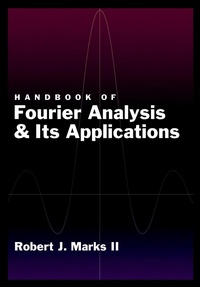
Handbook of Fourier Analysis & Its Applications
Published on 8. January 2009
799 pages
978-0-19-804430-7 (ISBN)
Description

Fourier analysis has many scientific applications - in physics, number theory, combinatorics, signal processing, probability theory, statistics, option pricing, cryptography, acoustics, oceanography, optics and diffraction, geometry, and other areas. In signal processing and related fields, Fourier analysis is typically thought of as decomposing a signal into its component frequencies and their amplitudes.
This practical, applications-based professional handbook comprehensively covers the theory and applications of Fourier Analysis, spanning topics from engineering mathematics, signal processing and related multidimensional transform theory, and quantum physics to elementary deterministic finance and even the foundations of western music theory.
As a definitive text on Fourier Analysis, Handbook of Fourier Analysis and Its Applications is meant to replace several less comprehensive volumes on the subject, such as Processing of Multifimensional Signals by Alexandre Smirnov, Modern Sampling Theory by John J. Benedetto and Paulo J.S.G. Ferreira, Vector Space Projections by Henry Stark and Yongyi Yang and Fourier Analysis and Imaging by Ronald N. Bracewell. In addition to being primarily used as a professional handbook, it includes sample problems and their solutions at the end of each section and thus serves as a textbook for advanced undergraduate students and beginning graduate students in courses such as: Multidimensional Signals and Systems, Signal Analysis, Introduction to Shannon Sampling and Interpolation Theory, Random Variables and Stochastic Processes, and Signals and Linear Systems.
More details
Other editions
Additional editions
Robert J. Marks II
Handbook of Fourier Analysis & Its Applications
Book
01/2009
Oxford University Press Inc
€194.20
Shipment within 15-20 days
Person
Robert J. Marks II, Ph.D., is Distinguished Professor of Engineering in the Department of Engineering at Baylor University. He came to Baylor University after 26 years at the University of Washington in Seattle. Robert J. Marks II has eight books (author, co-author, editor or co-editor) published by IEEE, MIT Press and Oxford University Press, three patents, over 50 supervised doctoral dissertations and masters theses, and over 300 publications.
Content
- Intro
- Contents
- Preface
- Acronym List
- Notation
- 1 Introduction
- 1.1 Ubiquitous Fourier Analysis
- 1.2 Jean Baptiste Joseph Fourier
- 1.3 This Book
- 1.3.1 Surveying the Contents
- 2 Fundamentals of Fourier Analysis
- 2.1 Introduction
- 2.2 Signal Classes
- 2.3 The Fourier Transform
- 2.3.1 The Continuous Time Fourier Transform
- 2.3.2 The Fourier Series
- 2.3.3 Relationship Between Fourier and Laplace Transforms
- 2.3.4 Some Continuous Time Fourier Transform Theorems
- 2.3.5 Some Continuous Time Fourier Transform Pairs
- 2.3.6 Other Properties of the Continuous Time Fourier Transform
- 2.4 Orthogonal Basis Functions
- 2.4.1 Parseval's Theorem for an Orthonormal Basis
- 2.4.2 Examples
- 2.5 The Discrete Time Fourier Transform
- 2.5.1 Relation of the DFT to the Continuous Time Fourier Transform
- 2.6 The Discrete Fourier Transform
- 2.6.1 Circular Convolution
- 2.6.2 Relation to the Continuous Time Fourier Transform
- 2.6.3 DFT Leakage
- 2.7 Related Transforms
- 2.7.1 The Cosine Transform?
- 2.7.2 The Sine Transform?
- 2.7.3 The Hartley Transform
- 2.7.4 The z Transforms
- 2.8 Exercises
- 2.9 Solutions for Selected Chapter 2 Exercises
- 3 Fourier Analysis in Systems Theory
- 3.1 Introduction
- 3.2 System Classes
- 3.2.1 System Types
- 3.2.2 Example Systems
- 3.3 System Characterization
- 3.3.1 Linear System Characterization
- 3.3.2 Causal Linear Systems
- 3.3.3 Linear Time Invariant (LTI) Systems
- 3.4 Amplitude Modulation
- 3.4.1 Coherent Demodulation
- 3.4.2 Envelope Demodulation
- 3.5 Goertzel's Algorithm for Computing the DFT
- 3.6 Fractional Fourier Transforms
- 3.6.1 Periodicity of the Fourier Transform Operator
- 3.6.2 Fractional Fourier Transform Criteria
- 3.6.3 The Weighted Fractional Fourier Transform
- 3.7 Approximating a Linear System with LTI Systems
- 3.7.1 Examples of the Piecewise Invariant Approximation
- 3.8 Exercises
- 3.9 Solutions for Selected Chapter 3 Exercises
- 4 Fourier Transforms in Probability, Random Variables and Stochastic Processes
- 4.1 Introduction
- 4.2 Random Variables
- 4.2.1 Probability Density Functions, Expectation, and Characteristic Functions
- 4.2.2 Example Probability Functions, Characteristic Functions, Means and Variances
- 4.2.3 Distributions of Sums of Random Variables
- 4.2.4 The Law of Large Numbers
- 4.2.5 The Central Limit Theorem
- 4.3 Uncertainty in Wave Equations
- 4.4 Stochastic Processes
- 4.4.1 First and Second Order Statistics
- 4.4.2 Power Spectral Density
- 4.4.3 Some Stationary Noise Models
- 4.4.4 Linear Systems with Stationary Stochastic Inputs
- 4.4.5 Properties of the Power Spectral Density
- 4.5 Exercises
- 4.6 Solutions for Selected Chapter 4 Exercises
- 5 The Sampling Theorem
- 5.1 Introduction
- 5.1.1 The Cardinal Series
- 5.1.2 History
- 5.2 Interpretation
- 5.3 Proofs
- 5.3.1 Using Comb Functions
- 5.3.2 Fourier Series Proof
- 5.3.3 Papoulis' Proof
- 5.4 Properties
- 5.4.1 Convergence
- 5.4.2 Trapezoidal Integration
- 5.4.3 The Time-Bandwidth Product
- 5.5 Application to Spectra Containing Distributions
- 5.6 Application to Bandlimited Stochastic Processes
- 5.7 Exercises
- 5.8 Solutions for Selected Chapter 5 Exercises
- 6 Generalizations of the Sampling Theorem
- 6.1 Introduction
- 6.2 Generalized Interpolation Functions
- 6.2.1 Oversampling
- 6.2.2 Restoration of Lost Samples
- 6.2.3 Criteria for Generalized Interpolation Functions
- 6.2.4 Reconstruction from a Filtered Signal's Samples
- 6.3 Papoulis' Generalization
- 6.3.1 Derivation
- 6.3.2 Interpolation Function Computation
- 6.3.3 Example Applications
- 6.4 Derivative Interpolation
- 6.4.1 Properties of the Derivative Kernel
- 6.5 A Relation Between the Taylor and Cardinal Series
- 6.6 Sampling Trigonometric Polynomials
- 6.7 Sampling Theory for Bandpass Functions
- 6.7.1 Heterodyned Sampling
- 6.7.2 Direct Bandpass Sampling
- 6.8 A Summary of Sampling Theorems for Directly Sampled Signals
- 6.9 Lagrangian Interpolation
- 6.10 Kramer's Generalization
- 6.11 Exercises
- 6.12 Solutions for Selected Chapter 6 Exercises
- 7 Noise and Error Effects
- 7.1 Introduction
- 7.2 Effects of Additive Data Noise
- 7.2.1 On Cardinal Series Interpolation
- 7.2.2 Interpolation Noise Variance for Directly Sampled Signals
- 7.2.3 On Papoulis' Generalization
- 7.2.4 On Derivative Interpolation
- 7.2.5 A Lower Bound on the NINV
- 7.3 Jitter
- 7.4 Filtered Cardinal Series Interpolation
- 7.4.1 Unbiased Interpolation from Jittered Samples
- 7.4.2 Effects of Jitter In Stochastic Bandlimited Signal Interpolation
- 7.5 Truncation Error
- 7.5.1 An Error Bound
- 7.6 Exercises
- 7.7 Solutions for Selected Chapter 7 Exercises
- 8 Multidimensional Signal Analysis
- 8.1 Introduction
- 8.2 Notation
- 8.3 Visualizing Higher Dimensions
- 8.3.1 N Dimensional Tic Tac Toe
- 8.3.2 Vectorization
- 8.4 Continuous Time Multidimensional Fourier Analysis
- 8.4.1 Linearity
- 8.4.2 The Shift Theorem
- 8.4.3 Multidimensional Convolution
- 8.4.4 Separability
- 8.4.5 Rotation, Scale and Transposition
- 8.4.6 Fourier Transformation of Circularly Symmetric Functions
- 8.5 Characterization of Signals from their Tomographic Projections
- 8.5.1 The Abel Transform and Its Inverse
- 8.5.2 The Central Slice Theorem
- 8.5.3 The Radon Transform and Its Inverse
- 8.6 Fourier Series
- 8.6.1 Multidimensional Periodicity
- 8.6.2 The Multidimensional Fourier Series Expansion
- 8.6.3 Multidimensional Discrete Fourier Transforms
- 8.7 Discrete Cosine Transform-Based Image Coding
- 8.7.1 DCT Basis Functions
- 8.7.2 The DCT in Image Compression
- 8.8 McClellan Transformation for Filter Design
- 8.8.1 Modular Implementation of the McClellan Transform
- 8.8.2 Implementation Issues
- 8.9 The Multidimensional Sampling Theorem
- 8.9.1 The Nyquist Density
- 8.9.2 Generalized Interpolation Functions
- 8.10 Restoring Lost Samples
- 8.10.1 Restoration Formulae
- 8.10.2 Noise Sensitivity
- 8.11 Periodic Sample Decimation and Restoration
- 8.11.1 Preliminaries
- 8.11.2 First Order Decimated Sample Restoration
- 8.11.3 Sampling Below the Nyquist Density
- 8.11.4 Higher Order Decimation
- 8.12 Raster Sampling
- 8.12.1 Bandwidth Equivalence of Line Samples
- 8.13 Exercises
- 8.14 Solutions for Selected Chapter 8 Exercises
- 9 Time-Frequency Representations
- 9.1 Introduction
- 9.2 Short Time Fourier Transforms and Spectrograms
- 9.3 Filter Banks
- 9.3.1 Commonly Used Windows
- 9.3.2 Spectrograms
- 9.3.3 The Mechanics of Short Time Fourier Transformation
- 9.3.4 Computational Architectures
- 9.4 Generalized Time-Frequency Representations
- 9.4.1 GTFR Mechanics
- 9.4.2 Kernel Properties
- 9.4.3 Marginals
- 9.4.4 Example GTFR's
- 9.5 Exercises
- 9.6 Solutions for Selected Chapter 9 Exercises
- 10 Signal Recovery
- 10.1 Introduction
- 10.2 Continuous Sampling
- 10.3 Interpolation From Periodic Continuous Samples
- 10.3.1 The Restoration Algorithm
- 10.3.2 Observations
- 10.4 Interpolation of Discrete Periodic Nonuniform Decimation
- 10.4.1 Problem Description
- 10.4.2 The Periodic Functions, ?[sub(M)](v)
- 10.4.3 Quadrature Version
- 10.5 Prolate Spheroidal Wave Functions
- 10.5.1 Properties
- 10.5.2 Application to Extrapolation
- 10.5.3 Application to Interval Interpolation
- 10.6 The Papoulis-Gerchberg Algorithm
- 10.6.1 The Basic Algorithm
- 10.6.2 Proof of the PGA using PSWF's
- 10.6.3 Remarks
- 10.7 Exercises
- 10.8 Solutions for Selected Chapter 10 Exercises
- 11 Signal and Image Synthesis: Alternating Projections Onto Convex Sets
- 11.1 Introduction
- 11.2 Geometical POCS
- 11.2.1 Geometrical Convex Sets
- 11.2.2 Projecting onto a Convex Set
- 11.2.3 POCS
- 11.3 Convex Sets of Signals
- 11.3.1 The Hilbert Space
- 11.3.2 Some Commonly Used Convex Sets of Signals
- 11.4 Example Applications of POCS
- 11.4.1 Von Neumann's Alternating Projection Theorem
- 11.4.2 Solution of Simultaneous Equations
- 11.4.3 The Papoulis-Gerchberg Algorithm
- 11.4.4 Howard's Minimum-Negativity-Constraint Algorithm
- 11.4.5 Associative Memory
- 11.4.6 Recovery of Lost Image Blocks
- 11.4.7 Subpixel Resolution
- 11.4.8 Reconstruction of Images from Tomographic Projections
- 11.4.9 Correcting Quantization Error for Oversampled Bandlimited Signals
- 11.4.10 Kernel Synthesis for GTFR's
- 11.4.11 Application to Conformal Radiotherapy
- 11.5 Generalizations
- 11.5.1 Iteration Relaxation
- 11.5.2 Contractive and Nonexpansive Operators
- 11.6 Exercises
- 11.7 Solutions for Selected Chapter 11 Exercises
- 12 Mathematical Morphology and Fourier Analysis on Time Scales
- 12.1 Introduction
- 12.2 Mathematical Morphology Fundamentals
- 12.2.1 Minkowski Arithmetic
- 12.2.2 Relation of Convolution Support to the Operation of Dilation
- 12.2.3 Other Morphological Operations
- 12.2.4 Minkowski Algebra
- 12.3 Fourier and Signal Analysis on Time Scales
- 12.3.1 Background
- 12.3.2 Fourier Transforms on a Time Scale
- 12.3.3 The Minkowski Sum of Time Scales
- 12.3.4 Convolution on a Time Scale
- 12.3.5 Additively Idempotent Time Scales
- 12.3.6 Discrete Convolution of AITS'
- 12.3.7 Multidimensional AITS Time Scales
- 12.4 Exercises
- 12.5 Solutions for Selected Chapter 12 Exercises
- 13 Applications
- 13.1 The Wave Equation, Its Fourier Solution and Harmony in Western Music
- 13.1.1 The Wave Equation
- 13.1.2 The Fourier Series Solution
- 13.1.3 The Fourier Series and Western Harmony
- 13.1.4 Pythagorean Harmony
- 13.1.5 Harmonics Expansions Produce Major Chords and the Major Scale
- 13.1.6 Fret Calibration
- 13.2 Fourier Transforms in Optics and Wave Propagation
- 13.2.1 Scalar Model for Wave Propagation
- 13.2.2 The Angular Spectrum
- 13.2.3 Rayleigh-Sommerfield Diffraction
- 13.2.4 A One Lens System
- 13.2.5 Beamforming
- 13.3 Heisenberg's Uncertainty Principle
- 13.4 Elementary Deterministic Finance
- 13.4.1 Some Preliminary Math
- 13.4.2 Compound Interest on a One Time Deposit
- 13.4.3 Compound Interest With Constant Periodic Deposits
- 13.4.4 Loan and Mortgage Payments
- 13.5 Exercises
- 13.6 Solutions for Selected Chapter 13 Exercises
- 14 Appendices
- 14.1 Schwarz's Inequality
- 14.2 Leibniz's Rule
- 14.3 A Useful Limit
- 14.4 Series
- 14.4.1 Binomial Series
- 14.4.2 Geometric Series
- 14.5 Ill-Conditioned Matrices
- 14.6 Other Commonly Used Random Variables
- 14.6.1 The Pareto Random Variable
- 14.6.2 The Weibull Random Variable
- 14.6.3 The Chi Random Variable
- 14.6.4 The Noncentral Chi-Squared Random Variable
- 14.6.5 The Half Normal Random Variable
- 14.6.6 The Rayleigh Random Variable
- 14.6.7 The Maxwell Random Variable
- 14.6.8 The Log Random Variable
- 14.6.9 The Von Mises Variable
- 14.6.10 The Uniform Product Variable
- 14.6.11 The Uniform Ratio Variable
- 14.6.12 The Logistic Random Variable
- 14.6.13 The Gibrat Random Variable
- 14.6.14 The F Random Variable
- 14.6.15 The Noncentral F Random Variable
- 14.6.16 The Fisher-Tippett Random Variable
- 14.6.17 The Gumbel Random Variable
- 14.6.18 The Student's t Random Variable
- 14.6.19 The Noncentral Student's t Random Variable
- 14.6.20 The Rice Random Variable
- 14.6.21 The Planck's Radiation Random Variable
- 14.6.22 The Generalized Gaussian Random Variable
- 14.6.23 The Generalized Cauchy Random Variable
- 15 References
- Index
- A
- B
- C
- D
- E
- F
- G
- H
- I
- J
- K
- L
- M
- N
- O
- P
- Q
- R
- S
- T
- U
- V
- W
- X
- Y
- Z
