

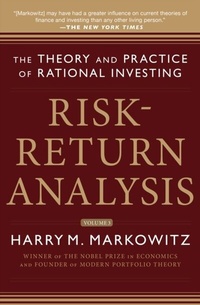
Risk-Return Analysis Volume 3
1st Edition
Published on 7. April 2020
224 pages
978-0-07-181833-9 (ISBN)
Description

The man who created investing as we know it provides critical insights, knowledge, and tools for generating steady profits in today s economy. When Harry Markowitz introduced the concept of examining and purchasing a range of diverse stocks in essence, the practice of creating a portfolio he transformed the world of investing. The idea was novel, even radical, when he presented it in 1952 for his dissertation. Today, it s second-nature to the majority of investors worldwide. Now, the legendary economist returns with the third volume of his groundbreaking four-volume Risk-Return Analysis series, where he corrects common misperceptions about Modern Portfolio Theory (MPT) and provides critical insight into the practice of MPT over the last 60 years. He guides you through process of making rational decisions in the face of uncertainty making this a critical guide to investing in today s economy. From the Laffer Curve to RDM Reasoning to Finite Ordinal Arithmetic to the ideas and concepts of some of history s most influential thinkers, Markowitz provides a wealth and depth of financial knowledge, wisdom, and insights you would be hard pressed to find elsewhere. This deep dive into the theories and practices of the investing legend is what you need to master strategic portfolio management designed to generate profits in good times and bad.
More details
Other editions
Additional editions
Harry M. Markowitz
Risk-Return Analysis Volume 3
Book
07/2020
McGraw-Hill Inc.,US
€66.70
Shipment within 15-20 days
Content
- Cover
- Title Page
- Copyright Page
- Contents
- Preface
- The Rational Decision Maker
- Words of Wisdom
- John von Neumann
- Acknowledgments
- 13. Predecessors
- Introduction
- René Descartes
- There Is No "Is," Only "Was" and "Will Be"
- Working Hypotheses
- RDM Reasoning
- David Hume
- Eudaimonia
- Financial Economic Discoveries
- Economic Analyses That Have Stood the Test of Time
- Constructive Skepticism
- Isaac Newton, Philosopher
- Fields Other Than Physics
- Karl Popper
- Mysticism
- Caveats
- Charles Peirce
- Immanuel Kant
- What an RDM Can Know A Priori
- 14. Deduction First Principles
- Introduction
- The Great Debate
- One More Reason for Studying Cantor's Set Theory
- "Very Few Understood It"
- Finite Cardinal Arithmetic
- Relative Sizes of Finite Sets
- Finite Ordinal Arithmetic
- Standard Ordered Sets (SOSs)
- Finite Cardinal and Ordinal Numbers
- Cantor (101)
- Theorem
- Proof
- Corollary
- Proof
- Transfinite Cardinal Numbers
- The Continuum Hypothesis
- Transfinite Cardinal Arithmetic
- Lemma
- Transfinite Ordinal Numbers
- Examples of Well-Ordered and Not Well-Ordered Sets
- Transfinite Ordinal Arithmetic
- Extended SOSs
- Lemma
- Proof
- The Paradoxes (a.k.a. Antimonies)
- Three Directions
- From Aristotle to Hume to Hilbert
- British Empiricism versus Continental Rationalism
- Who Created What?
- Cantor Reconsidered
- Brouwer's Objections
- Axiomatic Set Theory
- Peano's Axioms (PAs)
- Hilbert's Programs
- Whitehead and Russell
- Zermelo's Axioms
- The "Axiom of Choice"
- The Trichotomy Equivalent to the Axiom of Choice
- Kurt Gödel (1906-1978)
- Thoralf Skolem (1887-1863)
- 15. Logic is Programming is Logic
- Introduction
- Terminology
- Number Systems and the EAS Structures Built on Them
- Deductive Systems as Programming Languages
- A Variety of Deductive DSSs
- Alternative Rules of Inference
- "Ladders" and "Fire Escapes"
- Organon 2000: From Ancient Greek to "Symbolic Logic"
- So, What's New?
- Immediate Consequences
- Two Types of Set Ownership
- Modeling Modeling
- EAS-E Deduction: Status
- 16. The Infinite and The Infinitesimal
- Points and Lines
- Fields
- Constructing the Infinitesimals
- Infinite-Dimensional Utility Analysis
- The Algebraic Structure Called "A Field"
- 17. Induction Theory
- Introduction
- The Story Thus Far
- Concepts
- Basic Relationships
- Examples
- "Objective" Probability
- The Formal M59 Model
- Initial Consequences
- Bayes's Rule
- A Bayesian View of MVA
- Judgment, Approximation and Axiom III
- (1) A Philosophical Difference between S54 and M59
- Examples of Clearly "Objective" Probabilities"
- Propositions about Propositions
- A Problem with Axiom II
- Are the pj Probabilities the Scaling of the pj?
- The pj "Mix on a Par" with Objective Probabilities
- 18. Induction Practice
- Introduction
- R. A. Fisher and Neyman-Pearson Hypothesis Tests
- The Likelihood Principle
- Andrei Kolmogorov
- A Model of Models
- The R.A. Fisher Argument
- Bayesian Conjugate Prior Procedures
- 19. Eudaimonia
- Review
- Eudaimonia for the Masses
- Notes
- References
- Index
