

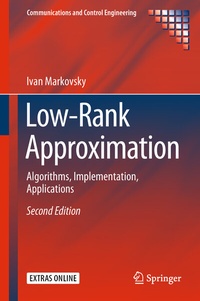
Low-Rank Approximation
Description

The second edition of /Low-Rank Approximation/ is a thoroughly edited and extensively rewritten revision. It contains new chapters and sections that introduce the topics of:
variable projection for structured low-rank approximation; missing data estimation; data-driven filtering and control; stochastic model representation and identification; identification of polynomial time-invariant systems; and blind identification with deterministic input model.
The book is complemented by a software implementation of the methods presented, which makes the theory directly applicable in practice. In particular, all numerical examples in the book are included in demonstration files and can be reproduced by the reader. This gives hands-on experience with the theory and methods detailed. In addition, exercises and MATLAB^® /Octave examples will assist the reader quickly to assimilate the theory on a chapter-by-chapter basis.
"Each chapter is completed with a new section of exercises to which complete solutions are provided."
Low-Rank Approximation (second edition) is a broad survey of the Low-Rank Approximation theory and applications of its field which will be of direct interest to researchers in system identification, control and systems theory, numerical linear algebra and optimization. The supplementary problems and solutions render it suitable for use in teaching graduate courses in those subjects as well.
Reviews / Votes
"Exercises in each section and the corresponding solutions provided will help the reader to practice with the presented algorithms. There is a great deal of well-established approximation methods and algorithms in data science. This book may prepare the reader in finding the appropriate approaches for solving the particular problems of interest. It can be recommended to both Ph.D. researchers and experienced scientists working on processing and analysis of large complex data." (Boris N. Khoromskij, SIAM Review, Vol. 63 (4), December, 2021)
"Markovsky's book is certainly well suited for graduate students and more experienced readers, and should also be useful to people who need to apply LRA methods in their daily work." (Kai Diethelm, Computing Reviews, July 18, 2019)
More details
Other editions
Additional editions
Person
Ivan Markovsky
obtained Ph.D. in Electrical Engineering from the Katholieke Universiteit Leuven in 2005. Since then, he is teaching and doing research in control and system theory at the School of Electronics and Computer Science (ECS) of the University of Southampton and the Department of Fundamental Electricity and Instrumentation (ELEC) of the Vrije Universiteit Brussel, where he is currently an associate processor. His research interests are structured low-rank approximation, system identification, and data-driven control, topics on which he has published 70 peer-reviewed papers, 7 book chapters, and 2 monographs. He is an associate editor of the
International Journal of Control
and the
SIAM Journal of Matrix Analysis and Applications
. In 2011, Ivan Markovsky was awarded an ERC starting grant on the topic of structured low-rank approximation.
Content
Chapter 1. Introduction.- Part I: Linear modeling problems.- Chapter 2. From data to models.- Chapter 3. Exact modelling.- Chapter 4. Approximate modelling.- Part II: Applications and generalizations.- Chapter 5. Applications.- Chapter 6. Data-driven ?ltering and control.- Chapter 7. Nonlinear modeling problems.- Chapter 8. Dealing with prior knowledge.- Index.
