

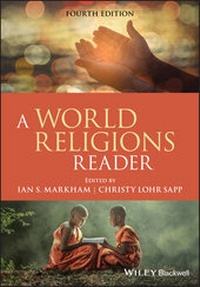
A World Religions Reader
Description

A comprehensive and accessible textbook which explores the traditions and beliefs of the world's living religions - the fully updated and revised new edition
The World Religions Reader is an inclusive, student-friendly examination of the history, teaching, practices, and appeal of the world's major religions. Covering both the fundamentals and complexities of each religious tradition, this popular textbook brings together significant texts from scriptures and scholars, as well as writings from philosophers and other significant thinkers throughout history. Students are provided with an introduction and overview of the tradition, taken through its primary texts, and presented with a text which seeks to persuade the student of the tradition's merits.
This new edition has been thoroughly updated to be even more accessible for students new to interreligious engagement and to reflect current trends and developments in religions worldwide. Every chapter opens with a substantial overview which orients the new student and then flows into a carefully chosen set of texts - a regular textbook is now combined with a Reader. New content examines areas such as the Rastafarian tradition, while revised chapters cover secular humanism and indigenous and emerging religious traditions. The methodology of the book focuses on an empathetic approach - representing each tradition from the perspective of a conventional adherent - enabling students to develop understanding of each tradition and appreciate similarities and differences in their most typical forms.
- Invites students to study each tradition from the perspective of a follower, aiming to understand why the tradition is popular and powerful
- Explores representative passages, world-views, rituals and institutions, ethical expressions and modern outlooks for each religion
- Features discussions of interfaith perspectives on the role of women in religious traditions and the impact of world events and politics on interfaith communication
- Encourages students to consider questions of truth, the relation of religion and society, and the changing nature of a tradition in the modern world
- Includes a complete set of pedagogical tools and instructor resources, including end-of-chapter fact sheets, topic summaries, key term sections, and essay and discussion questions
The World Religions Reader, Fourth Edition is an ideal textbook for undergraduate and graduate courses in religion, especially for liberal arts and non-affiliated colleges, as well as general readers wishing to increase their knowledge of the world's religious traditions.
More details
Other editions
Additional editions
Persons
IAN S. MARKHAM is Dean and President of Virginia Theological Seminary and Professor of Theology and Ethics. He has written extensively in the areas of interreligious dialogue and social ethics. His work includes Understanding Christian Doctrine and Do Morals Matter?
CHRISTY LOHR SAPP is Pastor of St. Andrew's Lutheran Church in Hickory, NC the "College Church" of Lenoir-Rhyne University. She has held various staff and leadership positions in international interfaith organizations and local ecumenical networks.
Content
List of Maps xiii
Preface to the Fourth Edition xv
Acknowledgments xvii
1 Purpose and Method 1
The Purpose 2
Defining Religion 3
Competing Methodologies 5
Defending This Approach 9
Use in the Classroom 10
2 Secular Humanism 13
Survey 14
Readings in Secular Humanism 15
The Secular Mind 15
Worldviews 16
Ethical Expression 24
Modern Expression 34
Fact Sheets 42
3 Indigenous Religions 45
Survey 46
Readings in Indigenous Religions 48
The Indigenous Mind 48
Worldviews 49
Institutions and Rituals 51
Ethical Expression 55
Modern Expression 58
Fact Sheets 63
4 Hinduism 65
Survey 66
Readings in Hinduism 71
The Hindu Mind 71
Worldviews 71
Institutions and Rituals 87
Ethical Expression 88
Modern Expression 97
Fact Sheets 102
5 Jainism 105
Survey 106
Readings in Jainism 107
The Jain Mind 107
Worldviews 108
Institutions and Rituals 109
Ethical Expression 110
Modern Expression 111
Fact Sheets 112
6 Buddhism 115
Survey 116
Readings in Buddhism 119
The Buddhist Mind 119
Worldviews 119
Institutions and Rituals 133
Ethical Expression 137
Modern Expression 140
Fact Sheets 143
7 Chinese Religion 147
Survey 148
Readings in Chinese Religion 151
The Chinese Mind 151
Worldviews 152
Institutions and Rituals 159
Ethical Expression 162
Modern Expression 168
Fact Sheets 175
8 Shintoism 179
Survey 180
Readings in Shintoism 182
The Shinto Mind 182
Worldviews 182
Institutions and Rituals 185
Ethical Expression 189
Modern Expression 197
Fact Sheets 202
9 Zoroastrianism 205
Survey 206
Readings in Zoroastrianism 207
The Zoroastrian Mind 207
Zoroastrian Worldview 207
Institutions and Rituals 210
Ethical Expression 211
Modern Expression 212
Fact Sheets 213
10 Judaism 217
Survey 218
Readings in Judaism 220
The Jewish Mind 220
Worldviews 221
Institutions and Rituals 224
Ethical Expression 227
Modern Expression 237
Fact Sheets 243
11 Christianity 247
Survey 248
Readings in Christianity 250
The Christian Mind 250
Worldviews 250
Institutions and Rituals 254
Ethical Expression 257
Modern Expression 260
Fact Sheets 266
12 Islam 271
Survey 272
Readings in Islam 275
The Muslim Mind 275
Worldviews 275
Institutions and Rituals 282
Ethical Expression 284
Modern Expression 286
Fact Sheets 295
13 Sikhism 299
Survey 300
Readings in Sikhism 302
The Sikh Mind 302
Worldviews 312
Institutions and Rituals 313
Ethical Expression 316
Modern Expression 320
Fact Sheets 325
14 Emerging Religions 329
Church of Jesus Christ of Latter-Day Saints 331
Survey 331
Readings in the Church of Jesus Christ of Latter-Day Saints 333
Mormon Mind 333
Worldview 333
Institutions and Rituals 335
Modern Expression 336
Baha'i Faith 337
Survey 337
Readings in the Baha'i Faith 338
The Baha'i Mind 338
Worldview 338
Institutions and Rituals 339
Ethical Expression 340
Rastafarianism 341
Survey 341
Readings in Rastafarianism 342
Rasta Mind 342
Worldviews 344
Institutions and Rituals 346
Modern Expression 347
Fact Sheets 349
Worldwide Adherents of All Religions by Six Continental Areas, Mid-2010 353
Annotated Bibliography 357
Credits 367
Index 379
1
PURPOSE AND METHOD
Prophets of secularism keep on predicting the demise of religion: given the dramatic discoveries of science, they argue, it is only a matter of time before religion disappears. Yet each obituary seems a little premature. Neanderthal humans living 150,000 years ago were intensely religious and, despite all the progress and numerous differences between then and now, they share this characteristic with the majority of citizens in the United States today. Religion continues to survive and thrive despite its secular opponents.
Yet religious people in the secular West cannot ignore the challenge of secularism. So many assumptions made in our schools, colleges, and universities constantly question the value of religion. Can one affirm scientific discoveries and still be religious? Is it possible to be tolerant of diversity and be religious? Does everyday common sense make religion plausible or practical? This is a reader intended for those who find themselves interested in religion, yet aware of and wanting to engage with these questions.
The next chapter will explore the case for secular humanism. Science, philosophy, and concern for a tolerant society all come together to insist that religion is both untrue and damaging. The rest of the book invites each of the major religious traditions in turn to explain how the given tradition is coherent and helpful to society. Each chapter invites the reader to enter into dialogue by empathising with each religion in turn. Each attempts to present its tradition in a sympathetic light. You do not have to agree, but you will be invited to understand.
This opening chapter is intended to explain the interpretative structure and method that will be used in this reader. So first, we shall outline what this book is not. Second, we shall attempt to define the subject matter of this reader. Here we shall examine briefly the thorny question of the definition of 'religion'. Third, we shall define the approach adopted here against alternative approaches used in other comparable texts and defend it against possible criticism. And, finally, we shall explain how best to use the text in the classroom. Much that follows will be quite demanding and it is required reading for those planning to use the text in teaching. However, for those simply interested in religion, it is perfectly possible to skip the rest of this chapter and move to the next chapter.
The Purpose
To start with, this book is a gentle introduction. It is possible simply to use the first section of each chapter, where the student is invited to understand the history, teaching, practices, shadow side, and appeal of each religion. We have kept technical language to a minimum. We want all students to find this world accessible. Then the book becomes a reader. To understand a tradition, one needs to access the sources that define or typify that tradition. Ideally one needs to learn the necessary language(s), and then read the scriptures or other texts of the tradition in the original. But most of us do not have the time (let alone the skill) to master all the relevant languages. So turning to good translations can provide a helpful way in (though translations can never be perfect and free from interpretations). This is still called a reader because it brings together significant texts. At the end of each chapter one must be sensitive to the complexities of each tradition. Every one of them has had a long and enormously complex history. Many thousands of people have grappled with these texts for entire lifetimes; no course in the study of religion would be satisfactory if it did not leave the student slightly confused.
The vantage point that is taken is of a faithful adherent of a tradition; we have sought to identify the 'mainstream' Muslim or Buddhist. We have attempted to find representative conversation partners for each tradition. However, it must be recognised that this book is not a systematic survey of all the strands of each tradition. Put two humans together, and disagreements seem inevitable. Each tradition divides again into numerous subdivisions. So Christianity divides into Orthodoxy, Roman Catholicism, and Protestantism. Protestants divide into Anglicans, Baptists, Lutherans, Presbyterians, and Methodists - to name but a few. Major divisions of each tradition are taken account of (e.g. Roman Catholicism and Protestantism within Christianity, Sunni and Shia within Islam). But for more detail about the different schools, one needs to refer to a history or encyclopedia of religion.
The combination of the gentle introduction and the primary texts enables the student both to get an overview and, simultaneously, grasp the complexity of each tradition. The overview is important because it is the way in for those who are unfamiliar. The complexity is important because it is all too easy to imagine that one understands that which is often very alien and very different. Working with the primary text is an important skill to learn. These are texts from scriptures, texts from authorities, texts from scholars, and texts from converts. There is hard work. Most of the texts were not written with the expectation that they would be studied in a twenty-first-century classroom. Inconsistencies were never ironed out. Ambiguous points were not clarified. St. Paul did not expect his letter to the Roman church to become a foundational text for the Christian Church and therefore subject to centuries of argument. Religion would be much easier if one could ignore the messiness of the primary texts. But this would miss so much. The primary texts expose both the brilliance and the bumbling confusion that lie at the heart of most innovation. It is the brilliance that justifies the study; it is the confusion that makes the study so hard.
This then is the invitation. Enjoy easing into our conversation partners and then learn to struggle with the primary texts. Now as a 'World Religions Reader', we need to examine precisely what this is a reader of. In other words, what do we mean by the word 'religion'?
Defining Religion
Consider the following definition of religion:
The real characteristic of religious phenomena is that they always suppose a bipartite division of the whole universe, known and knowable, into two classes which embrace all that exists, but which radically exclude each other. Sacred things are those which the interdictions protect and isolate; profane things, those to which these interdictions are applied and which must remain at a distance from the first. Religious beliefs are the representations which express the nature of sacred things and the relations which they sustain, either with each other or with profane things.1
Emile Durkheim, the brilliant sociologist, offered this definition after his careful study of primitive societies. It is a definition that stresses the distinction between the sacred and the profane. This definition highlights, implicitly, the rituals and practices of a religion, and indicates that these overt religious practices are justified by a sense of the sacred. Now although this distinction is an important feature of much religion, it is by no means universal. Confucianism, for example, is not primarily preoccupied with it. Furthermore, Durkheim's definition enabled him to reduce the significance of religion to its societal role. For example, the sense of the sacred is evoked within the individual by needs and conditions imposed by the greater entity - society as a whole. In other words, Durkheim's definition stresses that feature of religion that served his academic interests and purposes. He has ensured that sociology should be the paramount discipline for understanding religion. Freud defined religion in terms of transference and illusion, and hidden in his definition was the assumption that psychology is the key to illuminate the nature of religion.2
Even more overtly theological definitions of religion end up making the same mistake. So Paul Tillich, for example, defines religion thus:
Religion is the state of being grasped by an ultimate concern, a concern which qualifies all other concerns as preliminary and which itself contains the answer to the question of the meaning of our life. Therefore this concern is unconditionally serious and shows a willingness to sacrifice any finite concern which is in conflict with it.3
This is a major theme found throughout Tillich's work and he may well have identified correctly the attitude of most committed religious people. However, as a definition, it ignores all those who are nominal in their allegiances. Such people might still consider themselves religious but do not feel it requires what they would probably see as a fanatical identification with a tradition. Furthermore, this definition ignores the content of religion (no mention of any beliefs in the supernatural); it simply concentrates on the attitude of religious people. The problem is that the same attitude can be found in politics or the arts. Some Marxists, for example, treat their commitment to the Revolution as their 'ultimate concern', but they would certainly not want to be described as religious.4 This tendency to define religion in such a way that one picks out what one thinks matters most is almost universal....
