

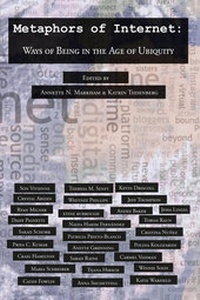
Metaphors of Internet
Description

Reviews / Votes
"The Internet has disappeared. This exceptional book brings it back into focus-through richly illustrated histories, artworks, and reflections. It is both a historical document and an exploration of possible futures. On top of that, Annette and Katrin have given us a profoundly inspirational glimpse of what truly creative scholarship looks like."-Mark Deuze, Professor of Journalism and Media Culture, University of Amsterdam, author of Media LifeMore details
Other editions
Additional editions
Persons
Content
List of Figures and Table - Acknowledgments - Introducing the Metaphors of the Internet - Annette N. Markham: Ways of Being in the Digital Age - Katrin Tiidenberg: A Wormhole, a Home, an Unavoidable Place. Introduction to "Metaphors of the Internet" - Kevin Driscoll: Losing Your Internet: Narratives of Decline among Long-Time Users - Ways of Doing - Nadia Hakim-Fernández: Workplace-Making among Mobile Freelancers - Jeff Thompson: Turker Computers - Tijana Hirsch: Migration of Self - Whitney Phillips: Pinball Machines, Cardboard Cutouts, and Private Parties: Three Metaphors for Conceptualizing Memetic Spread - Katrin Tiidenberg: 'Instagrammable' as a Metaphor for Looking and Showing in Visual Social Media - Crystal Abidin: Growing Up and Growing Old on the Internet: Influencer Life Courses and the Internet as Home - Andee Baker: Remixing the Music Fan Experience: Rock Concerts in Person and Online - Cathy Fowley: Chronotope - Anette Grønning: Ecologies for Connecting across Generations - Priya C. Kumar: The Unavoidable Place: How Parents Manage the Socially Mediated Visibility of Their Young Children Ways of Becoming - Son Vivienne: Trans-being - Craig Hamilton/Sarah Raine: Popular Music Reception: Tools of Future-Making, Spaces, and Possibilities of Being - Maria Schreiber/Patricia Prieto-Blanco: Co-becoming Hybrid Entities through Collaboration - Interview with Artist Cristina Nuñez - Katie Warfield: Trans-constituting Place Online - Ways of Being With - Tobias Raun: Facebook as a Wormhole between Life and Death - xtine burrough: A Vigil for Some Bodies - Sarah Schorr/Winnie Soon: Screenshooting Life Online: Two Artworks - Daisy Pignetti: Hurricane Season: Annual Assessments of Loss - Theresa M. Senft: Complicating the Internet as a Way of Being: The Case of Cloud Intimacy - Annette N. Markham: Echolocating the Digital Self - Whose Internet? Whose Metaphors? - Carmel Vaisman: Metaphoric Meltdowns: Debates over the Meaning of Blogging on Israblog - Jessa Lingel: Political Ideologies of Online Spaces: Anarchist Models for Boundary Making - Polina Kolozaridi/Anna Shchetvina/Katrin Tiidenberg: No Country for IT-Men: Post-Soviet Internet Metaphors of Who and How Interacts with the Internet - Ryan M. Milner: Remixed into Existence: Life Online as The Internet Comes of Age - References - About the Authors - Index
