

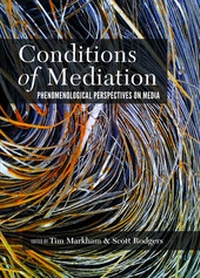
Conditions of Mediation
Description

Phenomenology has become one of the most important philosophical traditions underpinning recent theory and research on new media, whether or not the word is used explicitly. Conditions of Mediation brings together, for the first time in a single publication, the diversity of phenomenological media research-from social platforms and wearable media to diasporic identity formation and the ethics of consumer technologies.
The new orthodoxy in media studies emphasizes the experience of media-whether as forms, texts, technics or protocols-marking a departure from traditional approaches preoccupied with media content or its structural contexts. But phenomenologically informed approaches go beyond merely asking what people do with media. They ask a more profound question: what constitutes the conditions of mediated experience in the first place?
Beginning with an accessible introduction, this book invites readers to explore a wide range of phenomenological perspectives on media via two critical dialogues involving key thinkers alongside a series of theoretically sophisticated and empirically grounded chapters. In so doing, interdisciplinary media studies is brought into conversation with the work of philosophers such as Edmund Husserl, Martin Heidegger and Maurice Merleau-Ponty, as well as phenomenologically-inspired thinkers such as Erving Goffman, Pierre Bourdieu, Tim Ingold, Henri Lefebvre, Friedrich Kittler, Marshall McLuhan and Bernard Stiegler.
More details
Other editions
Additional editions
Persons
Content
List of Figures - Tim Markham/Scott Rodgers: Introduction: Theorizing Media Phenomenologically - Graham Harman: McLuhan and Phenomenology - Lisa Parks: Signal Territories: Broadcast Infrastructure, Google Earth, and Phenomenology - Paddy Scannell: To the Things Themselves: Thoughts on the Phenomenology of Media - Shaun Moores: Digital Orientations: Movement, Dwelling, and Media Use - Nick Couldry: Phenomenology and Critique: Why We Need a Phenomenology of the Digital World - David M. Berry: Phenomenological Approaches to the Computal: Some Reflections on Computation - Shane Denson: Chapter One: Techno-Phenomenology, Medium as Interface, and the Metaphysics of Change - Eve Forrest: What Does the Body know of Photography? - Ingrid Richardson/Rowan Wilken: Mobile Media and Mediation: The Relational Ontology of Google Glass - Tim Barker: Media In and Out of Time: German Media Science and the Concept of Time - Daniel M . Sutko: Conducting Medial Wills to Power: A Phenomenological Critique of Intellectual Property - Joel McKim: Structures of Experience: Media, Phenomenology, Architecture - Zlatan Krajina: From Non-Place to Place: A Phenomenological Geography of Everyday Living in Media Cities - Eyal Lavi: Mediated Orientation: Phenomenology and the Ambivalence of Everyday (Diasporic) Space - Kenzie Burchell: Finding Time for Goffman: When Absence Is More Telling Than Presence - Brenton J . Malin: Chickens that Like Pink Floyd: Media Physicalism and the Experience of New Technology - Roy Bendor: Interactive World Disclosure (or, an Interface Is Not a Hammer) - Catalin Brylla: Mediating Subjectivity Through Materiality in Documentary Practice .- Matthew F . Jordan: Becoming Quiet: On Mediation, Noise Cancellation, and Commodity Quietness - Contributor Biographies - Index.
