

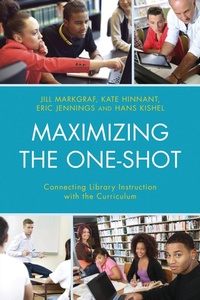
Maximizing the One-Shot
Connecting Library Instruction with the Curriculum
1st Edition
Published on 8. April 2015
188 pages
978-1-4422-3867-1 (ISBN)
Description

Designed for librarians who offer library instruction within the constraints of the hour-long one-shot, this book proposes a method for redesigning one-shot instruction that is both realistic and integrated into the larger curriculum.
Working with faculty teams from academic departments, the authors used the collaborative Lesson Study method to redesign undergraduate research instruction. They describe how to winnow the one-shot down to a manageable active learning experience while simultaneously augmenting it with extra-sessional prerequisites and learning activities. They also discuss how to conceptualize the role of the one-shot within a course, a curriculum, and the larger information literacy goals of the institution. This book offers customizable strategies, sample lesson plans, and generalized observations based on the experiences of the authors.
Maximizing the One-Shot: Connecting Library Instruction with the Curriculum covers the following aspects of one-shot development:
Understanding the role of the one-shot institutionally and its limits. Setting realistic goals.The Lesson Study approach.Collaborating with departmental faculty.Assessment of the one-shot.Supporting the one-shot with additional materials.Expanding one-shot development to other departments and programs.
In addition, the book provides interviews with collaborating faculty members of academic departments who have partnered with library faculty.
Working with faculty teams from academic departments, the authors used the collaborative Lesson Study method to redesign undergraduate research instruction. They describe how to winnow the one-shot down to a manageable active learning experience while simultaneously augmenting it with extra-sessional prerequisites and learning activities. They also discuss how to conceptualize the role of the one-shot within a course, a curriculum, and the larger information literacy goals of the institution. This book offers customizable strategies, sample lesson plans, and generalized observations based on the experiences of the authors.
Maximizing the One-Shot: Connecting Library Instruction with the Curriculum covers the following aspects of one-shot development:
Understanding the role of the one-shot institutionally and its limits. Setting realistic goals.The Lesson Study approach.Collaborating with departmental faculty.Assessment of the one-shot.Supporting the one-shot with additional materials.Expanding one-shot development to other departments and programs.
In addition, the book provides interviews with collaborating faculty members of academic departments who have partnered with library faculty.
More details
Edition
1. Auflage
Language
English
Place of publication
New York
United States
Publishing group
Bloomsbury Publishing Plc
Illustrations
38 BW Photos, 4 Tables
ISBN-13
978-1-4422-3867-1 (9781442238671)
Copyright in bibliographic data and cover images is held by Nielsen Book Services Limited or by the publishers or by their respective licensors: all rights reserved.
Schweitzer Classification
Other editions
Additional editions
Jill Markgraf | Kate Hinnant | Eric Jennings
Maximizing the One-Shot
Connecting Library Instruction with the Curriculum
Book
04/2015
Rowman & Littlefield Publishers
€89.00
Shipment within 10-20 days
Jill Markgraf | Kate Hinnant | Eric Jennings
Maximizing the One-Shot
Connecting Library Instruction with the Curriculum
Book
04/2015
Rowman & Littlefield Publishers
€148.60
Shipment within 10-20 days
Persons
Jill Markgraf,professor and Head of Research and Instruction at the University of Wisconsin-Eau Claire, has published and presented in the areas of library instruction, faculty collaboration and distance education. She has worked and taught in academic libraries for more than 20 years.
Kate Hinnant, assistant professor, is a research and instruction librarian for the Business School at the University of Wisconsin-Eau Claire. In addition to working on the first "One-Shot" redesign, she also developed the supplementary research instruction and online lessons for the Blugold Seminar in Critical Reading & Writing.
Eric Jennings, associate professor, is an instruction and outreach librarian at the University of Wisconsin-Eau Claire. He has presented and published on integrating information literacy into the curriculum and on outreach activities within academic libraries.
Hans Kishel, associate professor, is a research and instruction librarian for the sciences at the University of Wisconsin-Eau Claire. He has presented and published in the areas of active learning and integrated information literacy instruction for many years. He is also a published game designer.
Kate Hinnant, assistant professor, is a research and instruction librarian for the Business School at the University of Wisconsin-Eau Claire. In addition to working on the first "One-Shot" redesign, she also developed the supplementary research instruction and online lessons for the Blugold Seminar in Critical Reading & Writing.
Eric Jennings, associate professor, is an instruction and outreach librarian at the University of Wisconsin-Eau Claire. He has presented and published on integrating information literacy into the curriculum and on outreach activities within academic libraries.
Hans Kishel, associate professor, is a research and instruction librarian for the sciences at the University of Wisconsin-Eau Claire. He has presented and published in the areas of active learning and integrated information literacy instruction for many years. He is also a published game designer.
Content
Introduction
Chapter 1: Confronting the One-Shot: Seeing the Limitations
Chapter 2: Getting Real About the One-Shot
Chapter 3: Having Conversations: Beginning the Lesson Study Approach
Chapter 4: Implementing the New One-Shot
Chapter 5: Expanding the Process: The Lesson Study in Other Disciplines
Chapter 6: Supplementing the One-Shot
Chapter 7: The Benefits and Challenges of Collaboration
Chapter 8: Organizational Considerations
Chapter 9: Fine-Tuning the One-Shot
Chapter 10: Interviewing the "Others": What the Disciplinary Faculty Said
Conclusion
Appendixes
About the Authors
Chapter 1: Confronting the One-Shot: Seeing the Limitations
Chapter 2: Getting Real About the One-Shot
Chapter 3: Having Conversations: Beginning the Lesson Study Approach
Chapter 4: Implementing the New One-Shot
Chapter 5: Expanding the Process: The Lesson Study in Other Disciplines
Chapter 6: Supplementing the One-Shot
Chapter 7: The Benefits and Challenges of Collaboration
Chapter 8: Organizational Considerations
Chapter 9: Fine-Tuning the One-Shot
Chapter 10: Interviewing the "Others": What the Disciplinary Faculty Said
Conclusion
Appendixes
About the Authors
