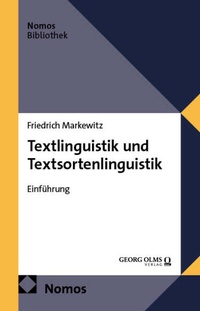
Textlinguistik und Textsortenlinguistik
Einführung
Friedrich Markewitz(Author)
Nomos (Publisher)
1st Edition
Published on 15. April 2026
238 pages
978-3-7489-6732-3 (ISBN)
System requirements
for PDF without DRM
E-Book Single Licence
You are acquiring a single user licence for this eBook, which you might not transfer. [L]
Available for download
Description
Alles über E-Books | Antworten auf Fragen rund um E-Books, Kopierschutz und Dateiformate finden Sie in unserem Info- & Hilfebereich.
Diese Einführung bietet umfassende Einblicke in die Entwicklung der Text- und Textsortenlinguistik und vermittelt praxisnahes Wissen zur Analyse sowie Klassifikation von Texten. Mit theoretischen Ansätzen und interdisziplinären Perspektiven aus Diskurs- und Systemtheorie sowie den Kulturwissenschaften wird die Bedeutung von Texten wie Textsorten in ihren sozialen, kulturellen und historischen Kontexten beleuchtet. Anhand aktueller Beispiele wie Filmkritiken, Tagebüchern und Memes werden Funktion, Struktur sowie weitere Ausgestaltungsdimensionen von Texten wie Textsorten aufgearbeitet und Studierende der Sprach-, Medien- und Kulturwissenschaften angeleitet, textuelle Phänomene in ihren vielgestaltigen Ausprägungen erfassen zu können.
PD Dr. Friedrich Markewitz forscht an der Universität Paderborn zu Phänomenen der Text-, Diskurs-, Kultur-, Polito- und Soziolinguistik.
More details
Language
German
Place of publication
Baden-Baden
Germany
File size
5,60 MB
ISBN-13
978-3-7489-6732-3 (9783748967323)
DOI
10.5771/9783748967323
Schweitzer Classification
Other editions
Additional editions

Book
04/2026
1st Edition
Nomos
€24.90
Available immediately

System requirements
File format: PDF
Copy protection: without DRM (Digital Rights Management)
System requirements:
- Computer (Windows; MacOS X; Linux): Use the free software Adobe Reader, Adobe Digital Editions, or any other PDF viewer of your choice (see eBook Help).
- Tablet/Smartphone (Android; iOS): Install the free app Adobe Digital Editions or another reading app for eBooks, e.g., PocketBook (see eBook Help).
- E-reader: Bookeen, Kobo, Pocketbook, Sony, Tolino and many more (only limited: Kindle).
The file format PDF always displays a book page identically on any hardware. This makes PDF suitable for complex layouts such as those used in textbooks and reference books (images, tables, columns, footnotes). Unfortunately, on the small screens of e-readers or smartphones, PDFs are rather annoying, requiring too much scrolling.
This eBook does not use copy protection or Digital Rights Management.
For more information, see our eBook Help page.